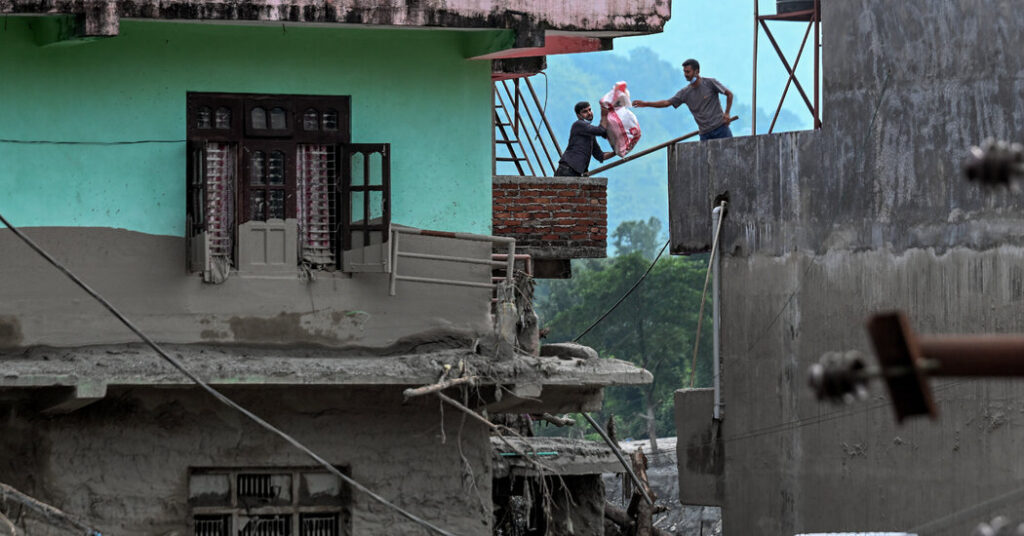
Nepal’s government estimates the damage from the recent floods will cost about $5 billion — a tenth of the nations’s annual economic output and a new burden in a country that invested heavily in hydroelectric power plants that are now destroyed. .
For an impoverished Himalayan country that is still paying for the damage from a 2015 earthquake, billions of dollars do not come easy. The largest component of Nepal’s economy — more than a quarter of its total value — is remitted by Nepalis who work abroad. Most make less than $400 a month and send home whatever they can.
The floods are not expected to interfere with their ability to earn. But other drivers of Nepal’s economy, in particular hydroelectric power and tourism, are directly affected by the disaster.
Counting the human toll is a daunting task in itself. On Tuesday, the number of dead surpassed 1,000 for the first time, with nearly 4,000 people still missing. The loss of life is concentrated among the roughly 25,000 households who inhabit one river system.
While the search for survivors continues, the trail of damage streaks down the Bhotekoshi and Trishuli gorges. Power lines and cell towers have vanished. Whole villages and rice terraces were stripped bare and silted over in minutes.
The country’s economic problems weigh heavily on the fledgling government, which came to power earlier this year after a 2025 Gen Z-led uprising.
In 2015, Nepal was struck by devastating earthquakes and left with a $9 billion bill.
In the 11 years since then, the government’s total borrowing has almost doubled, ballooning from 26 percent of its economy to 45 percent. Now, about 19 percent of all government spending goes to paying down debt and interest. The weakening of the Nepali rupee is also to blame, as the country’s need for imports — like fuel made costlier by the war on Iran — outstrips its ability to export.
Looking back on those disasters, Sujeev Shakya, a founder of the Nepal Economic Forum, a private research institution, lamented the obsolete attitude that the country must depend on handouts. That focuses attention on how many dollars are needed to replace what was there before. Instead, he wrote in a report looking back on the legacy of the earthquakes, Nepal must ask hard questions about “whether recovery efforts translated into long-term resilience.”
Maheshwar Dhakal, an official in Nepal’s environment ministry, has already appealed to a United Nations climate-disaster recovery fund. It fund might be able to offer millions, but not billions.
The lack of productive employment within Nepal, a country of about 30 million that is still mostly agricultural, means that 600,000 Nepalis go overseas each year to find a better living.
The departures board at Kathmandu’s airport is covered with daily flights to Qatar, Saudi Arabia, Malaysia and other countries that send very few tourists to Nepal. The routes exist to transport Nepali labor to wealthier places.
The money those workers send home fuels much of the construction and consumer spending visible around the Kathmandu valley. In turn, it drives up prices and makes it harder for competitive industries to flourish, in a version of what economists call “Dutch disease”: when an economy’s reliance on one pillar impedes the development of others.
To help reduce Nepal’s reliance on remittances, the country has been investing in hydropower. But this promising pathway for Nepal’s export dreams was swept away, along with hundreds of workers. The floods destroyed or damaged 14 hydroelectric projects and took offline 12 percent of the country’s generating capacity.
A tremendous amount of energy rushes down from the Himalayas every year, most of it summertime runoff from the Tibetan plateau. As much as 43 gigawatts could be converted to electricity and sold on to India. But India’s rivalry with China slowed the investment that would be needed to reach that potential, even before the flood set these projects back by years.
Nepal’s third-biggest earner, tourism, is also at risk of being affected by the terrible scenes of flooding seem across the world. “You think of mountains, you think of Nepal,” said Samip Pokharel, a co-founder of Geet Travels in Kathmandu.
Tens of millions of dollars are spent each year on Mount Everest expeditions and millions more, mostly by Indian Hindus, on pilgrimages to holy sites in Tibet. Pilgrims, whose route goes up the valley that was flooded, were also among those swept away in the floods last week.
“This is only one corridor, the rest of the country is functioning normally,” Mr. Pokharel said. He said he’s afraid the disaster “is hampering the destination image of Nepal,” which is only just overcoming its reputation for political instability.
Mr. Pokharel remains hopeful that the tragedy might not deter foreign tourists from making their way to Nepal. “I have not got any cancellations yet,” he said.
The post Nepal’s Economy Has Few Ways to Absorb the Cost of Flood Damage appeared first on New York Times.