This summer I stood in the shadow of a former coal-fired power station that was being converted into a massive new gas-fired plant, which would in turn power a giant A.I. data center.
Just a mile away, I could see a nuclear power plant that was selling electricity to Meta for its A.I. efforts. And not far down the river, a former steel plant was being converted into another hyperscale data center.
I was on the Ohio River in western Pennsylvania, reporting on the influx of data center projects coming to an area that’s been scarred by boom-and-bust cycles of polluting industrial activity.
What I found was a region at a crossroads.
On the one hand, outraged residents were part of a swelling resistance to the mass build-out of A.I. infrastructure around the country. But I also heard from business executives and labor leaders who were eager for the investment and development.
It was a case study in the complex trade-offs that communities consider when they debate whether or not to house these facilities in their backyards.
Making these decisions all the more tricky is the speed at which they’re happening. In Pennsylvania, I spoke with residents and lawmakers who could barely keep track of the flurry of data center proposals reshaping parts of the state.
“Data centers cause real challenges in terms of energy use, emissions, water usage, community issues, and nobody is managing it,” Costa Samaras, the director of the Scott Institute for Energy Innovation at Carnegie Mellon University in Pittsburgh, told me. “It’s a free-for-all.”
Natural gas is powering most new data centers. That means more emissions that will warm the planet and harm human health.
In Pennsylvania alone, just seven of the proposed plants could emit roughly 68 million tons of carbon dioxide or equivalent greenhouse gases each year. That’s roughly the same as the annual emissions from 15 million gasoline-burning cars.
And around the country, communities are confronting an uptick in pollution from the gas-fired power plants that are going in alongside data centers. As Hiroko Tabuchi from the Times climate team reported last month, a new generation of plants that use gas could release as much planet-warming pollution in a year as roughly half of all the passenger vehicles in the United States.
And in Texas, Amazon is investing in a large-scale, natural-gas power plant as part of a huge data center, a facility that could become the largest single source of climate pollution in the United States.
All this comes as the Environmental Protection Agency is moving to make it easier for data center developers to complete their projects with minimal public input.
That tension is already playing out in Pennsylvania, where I met up with Matt Mehalik, a lifelong resident who is now monitoring pollution as data centers proliferate. “This area has suffered from poor air quality for a long time,” he told me. “Data centers are the next chapter.”
That chapter is already a political issue across the country. In elections large and small, data centers have burst into the political debate as a defining issue for many races up and down the ballot.
Artificial intelligence companies are spending billions of dollars rushing these projects to market, and many millions on lobbying efforts in Washington. Meta, for example, recently used private talks with local officials to start a data center project in Louisiana big enough to cover nearly six square miles.
President Trump has shrugged off the mounting concerns around the issue. But politicians have seized on the cause and are not backing down.
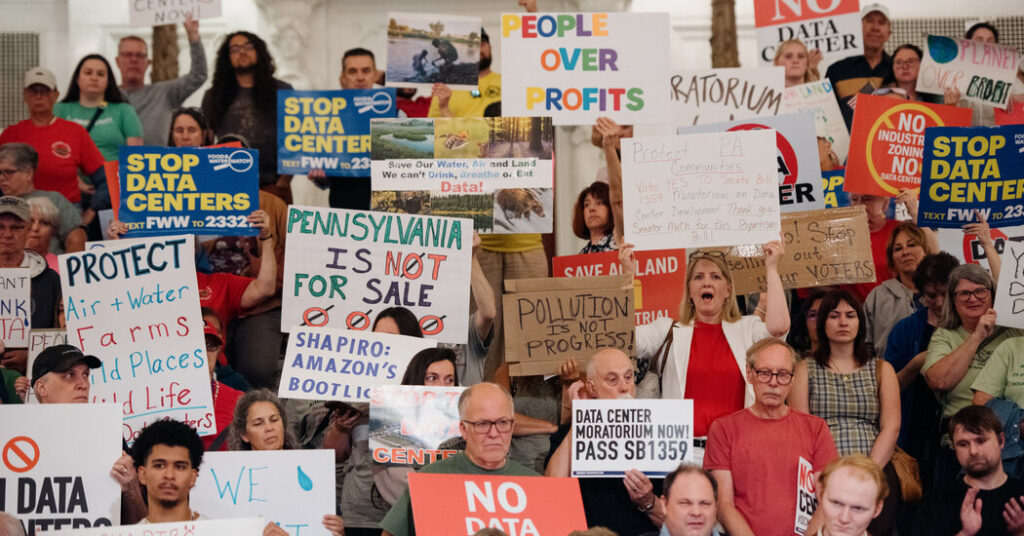
This summer, I also stood in the rotunda of the Pennsylvania Capitol and watched as Katie Muth, a state senator, spoke at an anti-data center rally.
“We are being told that hyperscale A.I. data centers and their associated infrastructure build out here in our commonwealth is a sign of progress, a sign of economic growth,” she said. “We are told that they’re necessary for economic development and national security. What I’m asking today is very simple. Who is this progress for? And at whose expense?”
The crowd roared its approval.
The world’s reefs are running out of time, scientists say
Coral reefs around the world are facing a new threat from global warming: They don’t have enough time to recover between more frequent and more intense marine heat waves.
That was one of the top findings in a sweeping new report this week on the state of the world’s corals by the Global Coral Reef Monitoring Network, a worldwide organization of scientists and conservationists.
It comes as the world’s oceans warm to record levels, absorbing heat trapped in the atmosphere by greenhouse gases. Global average sea surface temperature last week reached a record 21.1 degrees Celsius, or about 70 Fahrenheit, breaking a record set in 2024, according to the Copernicus Climate Change Service, the European Union’s climate-monitoring organization.
The findings are “dire and serious,” said Manuel Gonzalez-Rivero, a researcher at the Australian Institute of Marine Science and the report’s lead author. Corals, he said, are no longer experiencing the natural ebb and flow of stress and recovery. — Quinn Glabicki
Read past editions of the newsletter here.
If you’re enjoying what you’re reading, please consider recommending it to others. They can sign up here.
Follow The New York Times on Instagram, Threads, Facebook and TikTok at @nytimes.
Reach us at [email protected]. We read every message, and reply to many!
The post A Data Center Backlash appeared first on New York Times.