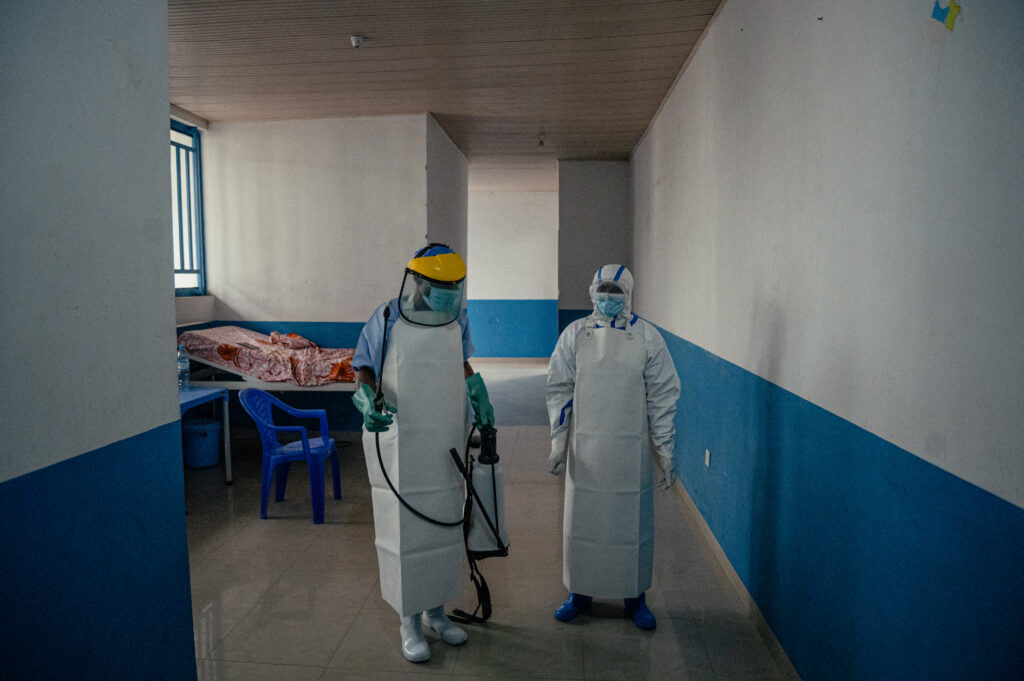
The Trump administration is working to cut global health funding to developing nations by tens of billions of dollars by 2030, according to a new analysis of the secretive agreements U.S. officials have pursued with more than a dozen governments to date.
The planned cuts — targeting programs that combat the spread of HIV/AIDS, Ebola and tuberculosis, among other deadly diseases — appear to reduce U.S. spending on global health initiatives to less than half of Washington’s output in 2024, the analysis found.
The research was conducted by two nonprofits, Public Citizen and Partners in Health, organizations that have taken a deeply skeptical view of President Donald Trump’s “America First” approach to global health policy.
Their analysis offers the most detailed reading yet of the bilateral health agreements drawn up by the State Department with 34 countries after the Trump administration, upon taking office last year, paused all U.S. foreign assistance and dismantled the U.S. Agency for International Development.
Public scrutiny of the agreements has been limited, as the administration, citing a desire to protect what it says are “sensitive” negotiations, has refused to disclose the text outlining their terms. The State Department said earlier this year that it would release them only after all were signed, though it has not disclosed a timeline for that to happen.
The analysis by Public Citizen and Partners in Health relies on documents that the nonprofits recently obtained from the U.S. government after suing the Trump administration and other previously disclosed material detailing what is contained in many — though not all — of the agreements.
It questions, among other things, how the Trump administration’s plan to reduce global health spending in developing countries over the next several years accounts for billions of dollars in related funds already appropriated by U.S. lawmakers. Since Trump’s return to office, the Republican-led Congress has voted to keep the amount of U.S. global health funding relatively constant despite the administration’s push for greater self-sufficiency among recipient countries.
There’s a “big, yawning gap” between how much money lawmakers have apportioned and how much the United States intends to spend via the deals it is reaching with developing countries, said Vincent Lin of Partners in Health, noting that the administration, according to its own accounting, is far behind on spending money related to HIV/AIDS prevention.
The State Department said in response to questions about the analysis that it does intend to spend the money apportioned by Congress and that more global health money could go to religious aid organizations and what has been dubbed an “innovation fund” to support the use of new U.S. technology in fighting disease. The department did not address the slow pace of HIV/AIDS funding, which Congress approved separately under the President’s Emergency Plan for AIDS Relief (PEPFAR), a long-running global health effort.
A State Department spokesman, Tommy Pigott, said in a statement that the Trump administration is defining the “next phase of U.S. global health foreign assistance in a way that prioritizes greater efficiency, transparency, country self-reliance, and American innovation.”
In most cases, the agreements specify that countries receiving diminished U.S. health funding must at the same time increase their own spending.
The State Department said that the deals reached so far amounted to $14.5 billion in new U.S. assistance, alongside more than $10.1 billion in “co-investment” from recipient countries.
The analysis by Public Citizen and Partners in Health shows that across 17 countries whose full agreements were reviewed, and an 18th where just the top-line figures have been revealed, the Trump administration is seeking to reduce global health funding by 59 percent from 2024 levels by 2030.
For decades, global health funding has enjoyed bipartisan support in the U.S., with lawmakers arguing that it is both morally correct and in the self-interest of wealthier nations to combat disease globally.
The Trump administration has sought to reshape this consensus, emphasizing “trade over aid” and criticizing global aid structures, but it has encountered resistance from Congress, which rejected a budget that sought to cut global health spending by $6.2 billion. (Lawmakers later approved a $615 million reduction compared with the previous year.)
The funding reductions pursued by the Trump administration are most pronounced in poorer African nations that have relied on tens of millions of dollars annually in U.S. foreign assistance to support their fight against HIV, the analysis by Public Citizen and Partners in Health shows.
Burundi, for example, among the poorest countries in Africa, will see its U.S. health funding fall to 22 percent of baseline levels, according to the nonprofits’ analysis. Rwanda sees the sharpest drop among the documents examined, with U.S. funding falling to just 3 percent of what it received before Trump reentered office, the analysis shows.
While recipient countries are expected to ramp up their own health spending to fill the gap, Public Citizen and Partners in Health have raised doubts about how feasible some of those targets are. They note, too, that the agreements include language detailing penalties for noncompliance, including further cutting U.S. funding.
“Sierra Leone is supposed to make up a 71 percent U.S. funding drop in less than five years,” said Peter Maybarduk of Public Citizen, referring to another poorer nation being asked to step up its health funding. “It’s going to be very difficult, and if a country like that falls behind, and then is punished for that, then of course the health problems compound.”
The State Department said in response to questions that the differing rates were based on a model that evaluated a range of factors, including the wealth of a country and its vulnerability to diseases, and analyses that looked at “the level of instability and conflict in a country.”
Beyond its planned cuts to bilateral health funding, the Trump administration is behind on spending money appropriated by Congress under PEPFAR, according to tracking by Lin and other analysts. It’s an enormous concern to advocates for disease prevention in developing countries.
PEPFAR funding must be spent within five years, Lin noted, meaning the administration has not breached the law by underspending it. Still, it could lead to a situation in which programs break down before the funds can be spent, he said.
“Right now, it looks like a dramatic underspend by billions of dollars … leading to preventable suffering and death,” said Maybarduk. “If that’s not the case, the burden is on the State Department to tell us how.”
The post Trump’s deals in Africa could cut U.S. health aid by more than half, analysis shows appeared first on Washington Post.