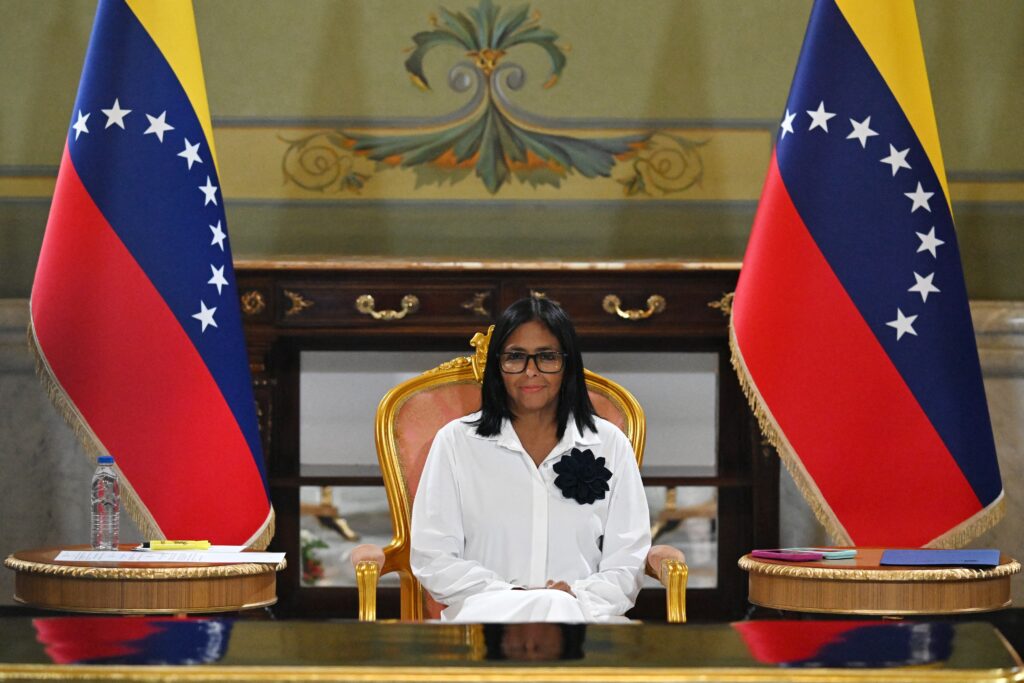
As Nicolás Maduro’s vice president in Venezuela, Delcy Rodríguez once accused her political rival of planning to hand over the country’s riches — its vast oil reserves — to the United States.
“They are her owners,” Rodriguez said in 2024 of María Corina Machado, then the U.S.-backed opposition leader. “Her master gives her orders to do what? To hand over the oil, the gas, the gold … to hand over and trample on our historical dignity.”
Now, Rodríguez is the country’s interim leader, thanks to President Donald Trump. And on Friday, Trump announced what he called the “biggest oil deal in world history” — a pact that would give the U.S. a long-term controlling stake in nearly a quarter of Venezuela’s untapped oil reserves.
The deal calls for the U.S. to enter a joint venture with a private company, creating a new oil giant that the Trump administration said will hold 100-year contracts at the Venezuelan oil fields. It would become the second-largest private oil company by reserves in the world, after Saudi Aramco.
The deal cements the United States’ long-term dominance over Venezuela, which has become a neo-colony since the U.S. military’s capture of Maduro in January, when Trump vowed to “run” the country and exploit its oil wealth. The agreement now stands to lock in the United States as Venezuela’s primary oil partner for generations.
The agreement appears to contradict much of what Venezuela’s government has stood for since then-President Hugo Chávez proclaimed it a socialist state. For Venezuelans, it also creates a sense of history repeating itself, with a twist: A government long criticized for its opaque oil deals, and widespread corruption, is now entering a murky, long-term arrangement with a new protector, the United States.
Trump, in announcing the deal, said it will boost the country’s oil reserves and oil supply and “set Venezuela on a course toward Tremendous Success and Great Prosperity.” Secretary of State Marco Rubio, posting on X, said the agreement “will bring nearly $100 billion in private investment” to Venezuela.
“One of the things I am going to do with the Venezuelan Oil is fill up the Strategic National Reserves which, because of Sleepy Joe Biden, has been virtually emptied,” Trump posted Sunday morning on Truth Social. “The ‘topping out’ process will begin very shortly, and is a Gift from Venezuela to the People of the United States.”
But few details have been disclosed about the agreement, leaving Venezuelans with more questions than answers.
It remains unclear how much Venezuela will earn from the deal; how much it will cost U.S. taxpayers, given the need for expensive front-end investment; and how much will simply end up enriching the private company — and the controversial businessman, Alejandro Betancourt — at the center of it all.
Rodriguez has defended the deal, saying in a statement that it will “facilitate a significant flow of investment aimed at the recovery and reconstruction of strategic infrastructure for the development of our hydrocarbons industry.”
In comments broadcast Saturday night, Rodriguez thanked Trump, Rubio and the U.S. government for their effort to reach the agreement.
But she added to the confusion over the deal by contradicting Trump and other U.S. officials on some of its details. She said the project was signed for a term of 25 years, not 100 years, with a production target of more than 1.5 million barrels per day. She estimated the country’s revenue would reach $209 billion for the Venezuelan state, or $19 per barrel.
She added, “There is something that must be absolutely clear: Venezuela retains ownership of and sovereignty over its resources, while it uses capital, technology, and operating capacity to leverage the recovery of a strategic industry hard hit by sanctions.”
One key player who clearly stands to benefit is Betancourt, a Venezuelan businessman with extensive experience in the country’s oil industry, who over the past decade has faced multiple investigations into alleged money laundering around the world, including in the United States.
As part of the deal, the U.S. will partner with Betancourt’s company, North American Blue Energy Partners, NABEP, Venezuela’s second-largest private oil producer.
As Betancourt grew more important to the Trump administration, serving as a critical intermediary with Venezuela’s oil industry and broker of early oil deals this year, U.S. officials lobbied to resolve a money laundering investigation against him in Switzerland, The Post reported last week, citing two people familiar with the matter.
The U.S. also has not acted on a Swiss arrest warrant against him, said the people, who spoke on the condition of anonymity to discuss a sensitive situation. Instead, he has been allowed to enter the country repeatedly for meetings with the Trump administration, people familiar with his travel said.
Betancourt has not been charged, and his attorney previously has denied he was involved in money laundering.
Francisco Palmieri, the former U.S. diplomatic chief of mission for Venezuela who helped broker the easing of some oil sanctions ahead of the country’s 2024 election, said the United States’ willingness to work with Betancourt — someone “loathed by almost all sectors in Venezuela” — undermines the credibility of the deal.
Beyond Betancourt’s role, Palmieri said, he worries that new agreement could create conditions for the interim Venezuelan government to delay elections and remain in power to ensure the new arrangement is carried out.
“What is the quid pro quo?” Palmieri asked. “If it’s just the U.S. continuing to exercise total control over the regime, it just means that the United States owns more and more of what happens in Venezuela over the next few years.”
Palmieri and other Venezuela analysts and former Venezuelan officials have acknowledged the need to open up the country’s oil industry to private investment, including from the U.S., and to alleviate concerns from U.S. oil companies that in recent months have shown deep reluctance to take a chance on Venezuela.
But Francisco Rodríguez, a Venezuelan economist at the University of Denver, said very little is known about the agreement, which has been presented as a done deal. “That in itself is the problem,” Rodríguez said, noting there does not appear to have been any public bidding process, or an effort to go through the country’s national assembly to approve the plan.
“This is precisely the type of lack of transparency that the country got used to during Chavismo,” he said of the ruling socialist party, “and embodies everything that has been wrong about how those governments handled Venezuelan affairs.”
The deal also risks widening a chasm within the government’s ruling socialist party, which has fractured since the capture of Maduro and the emergence of the U.S. as protector of a government that long viewed Washington as an imperial enemy.
For some original supporters of Chávez, the deal amounts to a national humiliation and loss of sovereignty.
“The country needs information,” said Juan Barreto, a former pro-Chávez political leader in Venezuela.
Venezuela’s oil workers, Barreto said, are learning of a contract that is “being signed behind the people’s backs, with no explanation and cloaked in a secrecy that raises the suspicion that it does not serve the interests of the great majority and puts the national patrimony at risk.”
Rafael Ramírez, who ran the Venezuela state oil company, PDVSA, and the oil ministry for a decade under Chávez before breaking with Maduro and fleeing into exile, called the agreement a historic act of surrender.
Posting on X, Ramírez said the deal cedes control of territory and oil to a foreign power. He complained that Venezuelans “had to find out from Trump” that the deal had been reached.
Ricardo Hausmann, an economist at Harvard’s Kennedy School of Government, who served as Venezuela’s planning minister in the early 1990s and later as chief economist of the Inter-American Development Bank, was among the most prominent voices criticizing the deal.
Writing on X, he called it an unconstitutional bargain struck by an “illegitimate interim government.”
Roxanna Vigil, a former Treasury Department and White House official who focused on Venezuela, said the first Trump administration had made a strong case, including through sanctions, “for why the Maduro regime was one of the most corrupt regimes in the hemisphere, maybe even in the world.
“But now they’re relying on those same people and behaviors to be able to establish this opaque system where we don’t know how a lot of the money is really being managed,” Vigil said. There is an assumption, she said, that the U.S. will “not be as corrupt as Venezuela.”
The lack of transparency in these deals, and how funds are being managed, raises a key question, Vigil said.
“Are we a better manager of Venezuela’s money? A more trustworthy custodian?” she asked. “Or are we really just partnering with the same people who destroyed Venezuela?”
The post Venezuela vowed not to ‘hand over’ its oil. Trump aims to grab a windfall. appeared first on Washington Post.