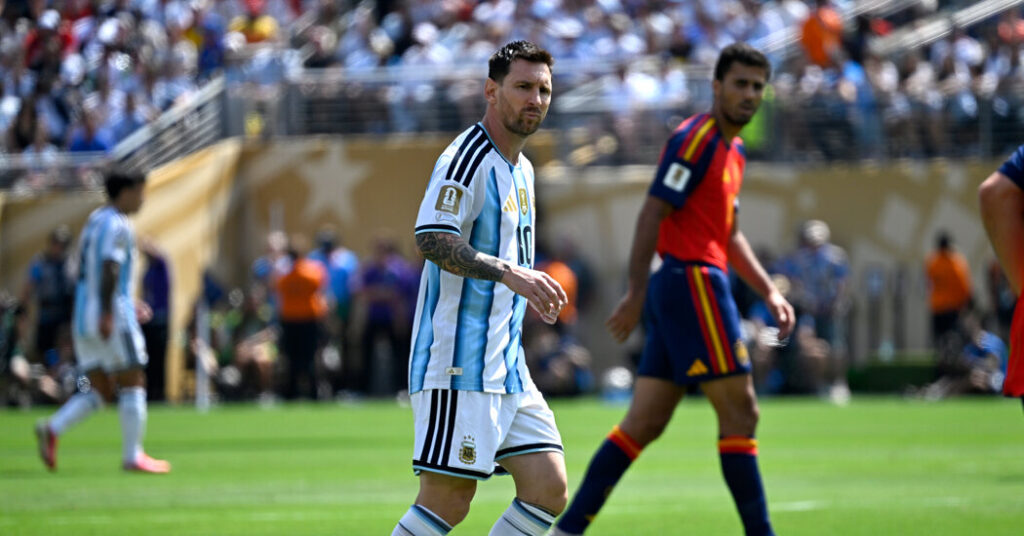
They had hoped he would stay forever. When Lionel Messi announced on Monday that he was retiring from the national team it unleashed a depth of grief and disbelief in Argentina rarely seen for an event everyone knew was coming.
“It hurts me so much,” said Damián Tiralongo, 47, the owner of a soccer jersey store in Buenos Aires. “It’s the end of an era.”
The retirement of Messi, the soccer star who restored Argentina to global glory by leading the team to the 2022 World Cup and to the final this year, sparked not only fears of a diminished team, but heartbreak over the departure of an icon who had carried the hopes, pride, and much of the identity of an entire country for two decades.
It is difficult to find an Argentine who does not own a Messi jersey. Some have his number tattooed on their biceps and his face has been printed on candles, lollipops and devotional cards. In a country famously divided by “la grieta,” or a deep political rift, Messi — with his quiet refusal to take part in ideological debates — is a unifying religion.
“He united Argentines a lot,” said Cynthia Alexandra Lozano, 38, a college professor sitting in a Buenos Aires square on Monday. “This creates a before-and-after in our football culture.”
Messi, the captain of the national team, is, at 39, youngish in the world beyond soccer but elderly for a world-class player. His departure had been long anticipated but never officially confirmed. His announcement on Monday — a handwritten letter published on Instagram — felt to many Argentines like a tender farewell from a star long admired as much for his humility as his soccer genius.
“I gave every last drop of myself; I have nothing left to give,” he wrote. “Now I will be just another one of you, always supporting and standing by the team from the outside (in the good times, and even more so in the bad).”
Messi wrote that he had already prepared those words after his last World Cup appearance, when Argentina was defeated by Spain in the final last month, but that he is even more convinced of them now, after his father died this month.
Many Argentines had watched the final knowing that it was likely Messi’s final game with the national team, but still, somehow, the announcement felt like a blow.
“I am kind of shocked,” said Alejandro Wall, an Argentine sports reporter. Messi, he said, was “someone who felt like he would last forever.”
That was especially true for Argentina’s youth, who only ever knew the country’s national team during an era when Messi made it seem nearly invincible, leading it to back-to-back Copa América titles and World Cup glory four years ago in Qatar.
“It’s not nice to see Argentina without Messi,” said Ignacio Giménez, 14, a high school student who was getting ready to play soccer with his friends in Buenos Aires on Monday, wearing a Messi jersey. “It’s just not what I’m used to.”
Many Argentines feared that the country would never again be blessed with someone like Messi. Others were hopeful that another soccer demigod would emerge. They had already said goodbye to a soccer hero before, they said, after Diego Armando Maradona retired from professional football in 1997.
“After Maradona, there was nobody — then came Messi,” said Carlos González, 60, as he waited for a bus on Monday in Buenos Aires. “Someone else will have to come along. I don’t know when,” he added, “but I’m sure someone will appear.”
Daniel Politi and Lucía Cholakian Herrera contributed reporting from Buenos Aires.
The post Argentines Hoped Messi Would Stay Forever appeared first on New York Times.