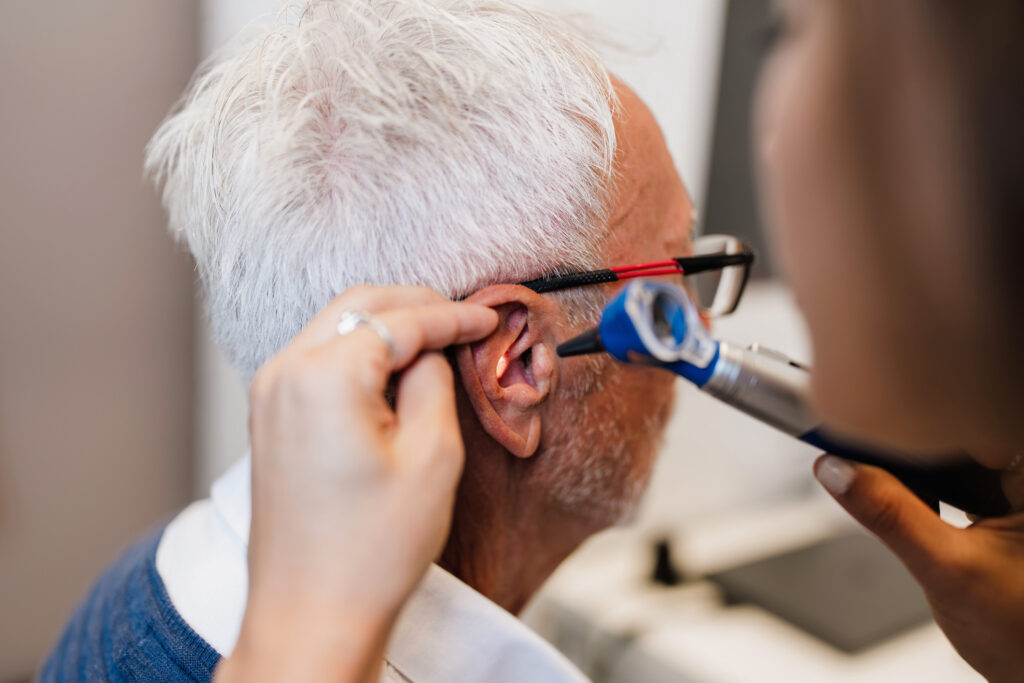
About three years ago, Ryan Arnold, 46, started noticing conversations were becoming harder to follow in restaurants and crowded rooms with background noise.
“I found myself asking people to repeat themselves more often, especially if they weren’t facing me,” said Arnold, founder and president of DeSoto & State Communications and a former on-air personality at Chicago’s WXRT-FM (93.1). In the last year, the decline grew more noticeable; the persistent ringing in his ears, known as tinnitus, became harder to ignore.
Conversations started getting trickier to navigate, too. “Some sounds seemed broken up instead of clear. I remember thinking, ‘People sure do mumble a lot,’” he said. Eventually, he realized they probably weren’t. He was just having trouble hearing them.
Some hearing loss gets more common with age. An estimated 15 percent of Americans over 18 have some trouble hearing, but that climbs to about 33 percent after age 65 and nearly 50 percent after age 75.
The signs aren’t always obvious, but it’s important to catch and treat hearing loss as soon as you can. That’s because hearing loss is linked to cognitive decline and lack of social interaction, which can also affect brain health and quality of life as you age. “The less you’re hearing, the less likely you are to want to go out with friends and family, and we know that social isolation is associated with cognitive impairment,” said Jamie Bogle, chair of the division of audiology and an assistant professor of audiology at the Mayo Clinic College of Medicine & Science.
Hearing loss is often years in the making. Exposure to loud workplaces, concerts and blasting headphones can cause cumulative damage to the delicate parts of your ears, and the older you are, the more your ears have endured. Other factors, including high blood pressure, certain medications (like some antibiotics, cancer drugs and hormone therapies), and even cigarette smoking and secondhand smoke can increase your risk of hearing loss, too.
But it’s not always clear why one person’s hearing declines and another’s doesn’t. Some of the risk may be inherited. “There’s likely a pretty heavy genetic component,” Bogle said. In some cases, that might mean that if your parents had significant hearing loss, you may be more likely to as well. In other cases, you may have inherited a gene that increases your risk for hearing loss, even if no one else in your family has noticed hearing changes.
Signs of hearing loss
Typical signs of hearing loss associated with aging or damage to your ears include:
- Background noise becomes harder to filter out: In busy settings with many people talking, like restaurants, you might find it harder to hear the person you’re having a close conversation with, Bogle said. You might also notice it’s harder to understand phone calls or higher-pitched voices.
- You turn the TV or radio up louder: Even in quiet settings, you might notice yourself turning up the volume on the television or music you listen to, she said.
- A ringing in your ears begins: “This is one of the reasons people come in, because that’s a new thing you can hear,” Bogle said. Tinnitus can also sound like buzzing or hissing and can range greatly in severity.
- Your loved ones notice a change: Often it’s a family member or a spouse who points out you’re not hearing them like you used to that sparks a visit to a doctor, Bogle said.
- You think others are mumbling: Or, you frequently ask people to repeat themselves. You might not connect the dots that this is hearing loss because it doesn’t feel like a volume issue but a clarity issue, said audiologist Kathleen Wallace.
- You have trouble distinguishing between similar-sounding words: Sometimes your brain can fill in the gaps with context clues to determine if someone said sat, fat, that, cat, hat or chat, for example. But it doesn’t always work, and it can be mentally draining, Wallace said.
In 2024, Karli Barokas, 49, a managing partner at Finn Partners in California, caught herself frequently asking people to repeat themselves. She was surprised it was happening because she never really listened to loud music, even when she was younger. “However, I attended a lot of concerts in my 20s and 30s and thought perhaps this is what may have contributed to my hearing loss,” she said.
What you can do now to protect your hearing
In the absence of treatments that halt or slow age-related hearing loss, your best bet is preserving the hearing you have.
Start by monitoring the volume when you’re wearing headphones, Wallace said. Safe listening levels are around 70 decibels; repeated exposure to 85 decibels or higher can cause hearing loss. Depending on what device you’re listening on, you may be able to adjust your settings to not allow the volume to go higher than that or to notify you when you’ve been listening at too loud a volume for too long.
Consider wearing ear plugs whenever you’re in a loud environment. What counts as loud? “If you’re in a place where you need to be shouting for someone to hear you, that’s a good tell that you should be wearing hearing protection,” Wallace said.
Many phones and smartwatches will alert you when you’re in a dangerously loud environment.
That doesn’t just mean at concerts or weddings but also when you’re using power tools, at a movie theater, at a group fitness class or mowing the lawn, for example. “That’s going to help protect as best we can from any further progression,” Bogle said.
The foam ear plugs you can buy in any pharmacy tend to muffle all noise. High-fidelity ear plugs, sometimes called musician’s ear plugs, lower the volume but keep music and speech clear. Relatively inexpensive, you can buy these in stores or online and see if they work for you. While they’re pricier, high-fidelity ear plugs that are custom-made may be best if you’re frequently in noisy environments.
If you’re purchasing ear plugs or over-the-ear protection, look for what’s called the Noise Reduction Rating, developed by the Environmental Protection Agency. “That will basically tell you how much noise the earplugs will be protecting you against,” Wallace said.
The NRR generally ranges from 0 to 35 decibels, and a higher number is more protective, Bogle added. In certain loud scenarios, such as working with a chainsaw, experts recommend using two sets of protection: something in your ears and something over your ears. “That gives you the absolute most protection,” Bogle said.
Hearing protection can reduce sound by a maximum of 33 decibels with ear plugs and 31 with earmuffs or over-the-ear protection. You can see what a difference that can make when you consider the volume of common sources of loud noise:
- Ambulance siren: 130
- Rock or pop concert: 120
- Car horn: 110
- Hand dryer: 100
- Hair dryer: 90
Arnold has been taking such steps to protect his hearing. “I already wore high-fidelity earplugs at concerts and loud events because of my work in music and broadcasting, but now I’m even more consistent about using them anywhere prolonged noise exposure is possible,” he said. “I’m also more mindful of headphone volume and give my ears a break after loud environments.”
Eventually, he brought up his hearing changes with his primary care physician, and he has an appointment scheduled with an audiologist for a more comprehensive hearing evaluation in September.
That’s wise, because hearing changes might not just be due to aging or noise, Bogle said. Your doctor might want to screen you for other conditions that can affect your hearing such as diabetes, heart disease or even an ear infection that could be treated, she said.
Most of the time, hearing loss is gradual, but it’s important to take any sudden hearing changes seriously. In some cases, the hearing loss might be reversible if treated promptly. Sudden sensorineural hearing loss is a medical emergency that could lead to permanent hearing loss without rapid treatment.
You should seek immediate medical attention if you have:
- Sudden ringing or buzzing in your ears
- Sudden hearing loss, especially in just one ear
- Sudden ear pain
- Any leaking from the ears
- Dizziness
Barokas also talked to her doctor about her hearing changes. Her primary care physician did a hearing test and referred her to an audiologist, who found she had lost hearing at the same range in both ears.
She’s taken steps to protect her hearing, like wearing ear protection at concerts. She’s also enlisted the help of loved ones. “I ask friends and family to look directly at me when speaking versus to the side or away so I can watch their face and mouth, which helps me not miss as many words,” Barokas said.
She’s made other small lifestyle tweaks, too. “I began watching TV with subtitles on as I found myself missing words. When dining at restaurants with outdoor seating, I always prefer that option, as there is less background noise to interfere with conversation,” she said. She’s considering purchasing hearing aids in the next year.
Hearing aids help amplify sounds and may restore some of the hearing you’ve lost. There are over-the-counter options for people “with perceived mild to moderate hearing loss” and prescription options for people who have more severe hearing loss, Wallace said.
That said, cost can be a barrier. Over-the-counter hearing aids average around $930 per pair, and prescription devices average around $3,300, according to the National Council on Aging. Talk to your provider about financial assistance programs or demonstration models that might be free or sold at a reduced price when they’re no longer needed. There are also organizations that can help with the cost of hearing aids, such as Help America Hear and the Hearing Aid Project.
There are no official recommendations for hearing tests as an adult, but you can ask to have your hearing tested during a physical. Experts often recommend having your hearing tested at least once by age 60, even if you’re not yet concerned. This baseline measurement can help your care team monitor you moving forward.
Wallace hopes for a future where a hearing test is as regular as, say, getting your blood pressure checked. “I would love for us to get to the point that routine monitoring of your hearing is just another number you know,” she said.
The post 6 sneaky signs of hearing loss and what you can do about it appeared first on Washington Post.