With D.C. streets in front of the U.S. Capitol transformed into a racetrack, drivers on Sunday bolted past the National Gallery of Art, the National Archives and other landmarks in the Freedom 250 Grand Prix, the first IndyCar street race ever in the nation’s capital.
President Donald Trump waved the green flag to start the competition at around 1 p.m. Then the rubber met the road. For nearly three hours, cars swarmed by in a brightly colored blur that shook the pavement and filled the air with exhaust fumes.
The downtown racetrack spanned 1.66 miles and had seven turns, including two particularly challenging ones. Drivers took the straightaways along Pennsylvania and Independence avenues at speeds of around 160 mph. They circled the National Mall 147 times covering roughly 250 miles.
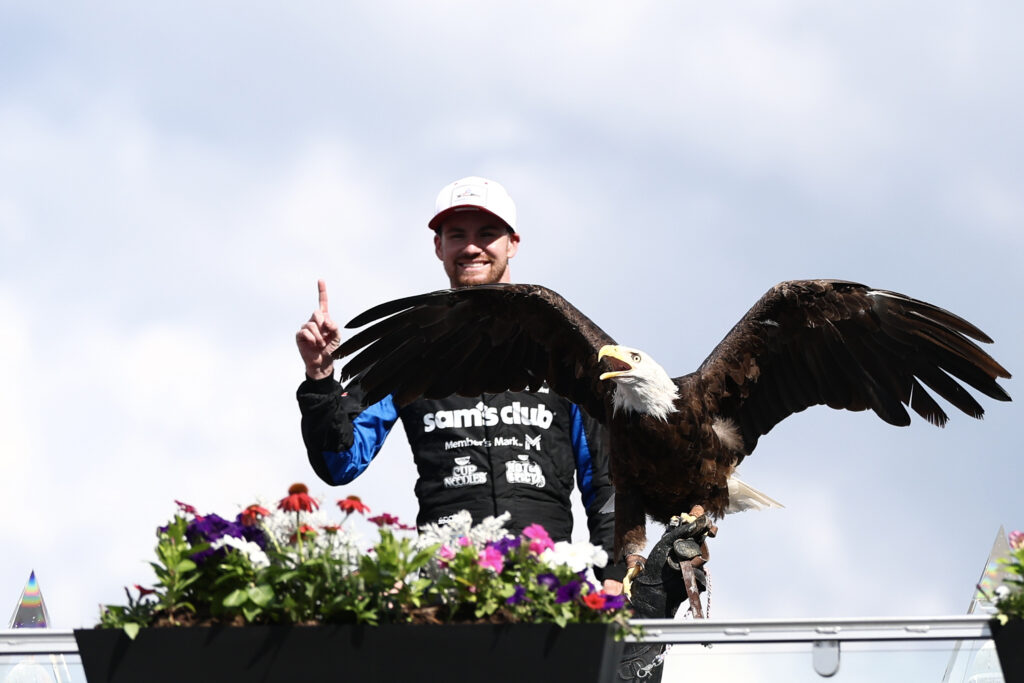
Around 4 p.m., Kyle Kirkwood, a 27-year-old Floridian, emerged as the winner. He told reporters that he had woken up the morning of the event with his heart racing because he was so excited for it.
“Outside of the Indy 500, there’s not another race that you want to win [as much],” he said.
The street race, which drew upward of 150,000 spectators, was the culmination of events this summer launched by Trump to mark America’s 250th birthday.
Earlier festivities included an Ultimate Fighting Championship event on the White House South Lawn in June and a Fourth of July pyrotechnic show, which made history with more than 840,000 fireworks but was delayed when a lightning storm forced the crowd to disperse.
The weather for the Freedom 250 Grand Prix was far more favorable, with sunny skies and temperatures in the 80s.
Still, predictions of a perilous course proved prophetic. Thirty-seven laps into the event, American racer David Malukas crashed into a wall coming out of a turn and fellow American Sting Ray Robb ran into Malukas’s disabled car. Safety workers quickly arrived on the scene, and neither driver appeared to be injured.
Fans line up to buy jerseys, an IndyCar model and crab cakes
Thousands of spectators crowded into the National Mall, temporarily rebranded the Air National Guard Fan Zone.
Some sported IndyCar jerseys of their favorite teams. Others wore patriotic or America 250-themed attire. Long lines formed at concession tents with names like “Freedom Grill” and “Checkered Faves,” selling chicken tenders, $25 crab cake sandwiches and other festival fare.
Trailers lined along the Mall hawked official race merchandise, including T-shirts, caps and beer cozies. A red “Make Racing Great Again” cap was selling for $60.
A commemorative coin went for the same price. A model IndyCar, meanwhile, could be had for $99. As the hours ticked down before the race, spectators lounged in the grass, played cornhole and other lawn games set out, or sought shade beneath scattered picnic table umbrellas.
Besides a few complaints about the long lines and lack of grandstand seating, the crowd appeared in good spirits.
Dave Hausfeld, who drove up from Raleigh, North Carolina, to be at the race, said his only critiques were “not enough grandstand seating, and not enough TV monitors around for us to see what the hell is going on.”
“Other than that, I think they’ve exceeded expectations,” he said, calling the event a “once-in-a-lifetime opportunity.”
Trump takes a lap in the ‘Beast’
Before the sun came up Sunday, the reinforced presidential limousine known as “The Beast” could be seen navigating the track as early as 3 a.m. in preparation for Sunday’s ceremonial lap, according to a person with knowledge of the trial run who was not authorized to speak to the media.
“I’m going to make a little circle in a nice, secure car,” Trump said in a broadcast interview with Fox before the race. “Slightly slower than the ones we’re going to witness, but we’ll have a good time.”
Trump, who personally greeted the drivers and took a photo with them alongside first lady Melania Trump, said officials had to close bridges leading into the city “because so many people wanted to come.”
During the race, Marcus Armstrong triggered two cautions, the second one after he aggressively took a corner and clipped Christian Rasmussen, who then took Rinus VeeKay out of the race.
Earlier, Alex Palou, the heavy favorite, was assessed a penalty for hitting the equipment of another team’s car when exiting the pit area. He was forced to drive at pit stop speeds through the pit area while the rest of the field kept racing.
The penalty dropped him from sixth at the time to 21st, effectively erasing his chances.
Instead, Kirkwood prevailed. Denmark’s Christian Lundgaard finished second and Australian Will Power finished third.
‘Like no other race, ever’
In the lead-up to the event, Trump said it would be “like no other race, ever” — a sentiment echoed by IndyCar President Doug Boles, who called it “iconic” in an interview with “Fox & Friends Weekend.” Boles described seven months of planning that went into building the track, installing concrete barriers and welding down of more than 200 manhole covers.
Before the race, Mayor Muriel E. Bowser (D) served as the grand marshal, ushering drivers to their cars. Interior Secretary Doug Burgum delivered the famous line “Gentlemen, start your engines.”
Josh and Vanessa Sigler drove 11 hours from their home in Terre Haute, Indiana, just to see the race.
“It’s awesome. I hope they do it again,” Josh Sigler said of the experience.
Hadley Kader, 28, made the trek with her family for the race from Virginia Beach for what she described as history being made in real time.
The whizzing cars and soaring planes, Kader said, represented what America is all about.
“Freedom, yeah,” Kader said. “That’s one word that can describe it.”
Some spectators said they were drawn to the event by a love of auto racing, not enthusiasm for Trump.
“I don’t like the guy, but you can’t say no to an event like this,” said Pablo Jara, 35, of Falls Church, Virginia. “Especially as somebody that grew up watching racecars, this is a once in a lifetime opportunity. Don’t care who put it together.”
Showcase for motorsports
Trump had been personally involved in the Freedom 250 planning from the start. In January, he signed an executive order launching the first IndyCar street race in the nation’s capital as part of the year-long celebration of America’s 250th birthday. The order directed the Interior and Transportation departments to help map a course around the National Mall and expedite the permits and approvals.
The president has promoted the race as a showcase for American motorsports and Washington’s monuments. In July, he hosted IndyCar stars Palou, Malukas and Felix Rosenqvist at the White House for a preview that included a live pit-stop demonstration outside the West Wing.
“I don’t think anything will ever … top what we’re going to be having,” Trump said of the Freedom 250 Grand Prix.
While officials have touted the Freedom 250 Grand Prix as an opportunity to showcase the city, some restaurants in the security zone saw disruptions to their businesses last week by road closures and parking restrictions. BASIS DC, a public charter school in Penn Quarter, had to dismiss classes early to accommodate increased security and event setup.
Preservationists, too, raised concerns about the effect that racecars running more than seven times the speed limit would have on federal art collections, potentially causing damage through vibration.
Still, the White House and Bowser touted the benefits of bringing a “world-class sporting event” to the District.
Keith Krach, the Freedom 250 CEO, said after the race that he’d love to do it again.
“We’ll determine that later on, but people are talking about that, left and right,” Krach said.
Krach added that he spent “a lot of time” talking with Bowser about the prospect of the race returning to the District.
“Everybody’s been supportive of this,” he said.
But for now, most of the track will be gone by Labor Day, Krach said. But the viewing suites will take three or four weeks to remove.
The post IndyCar drivers roar through D.C. streets in Trump’s Freedom 250 Grand Prix appeared first on Washington Post.