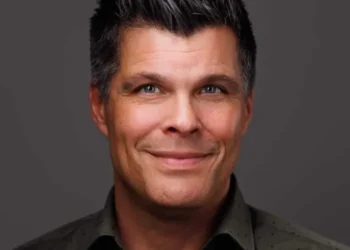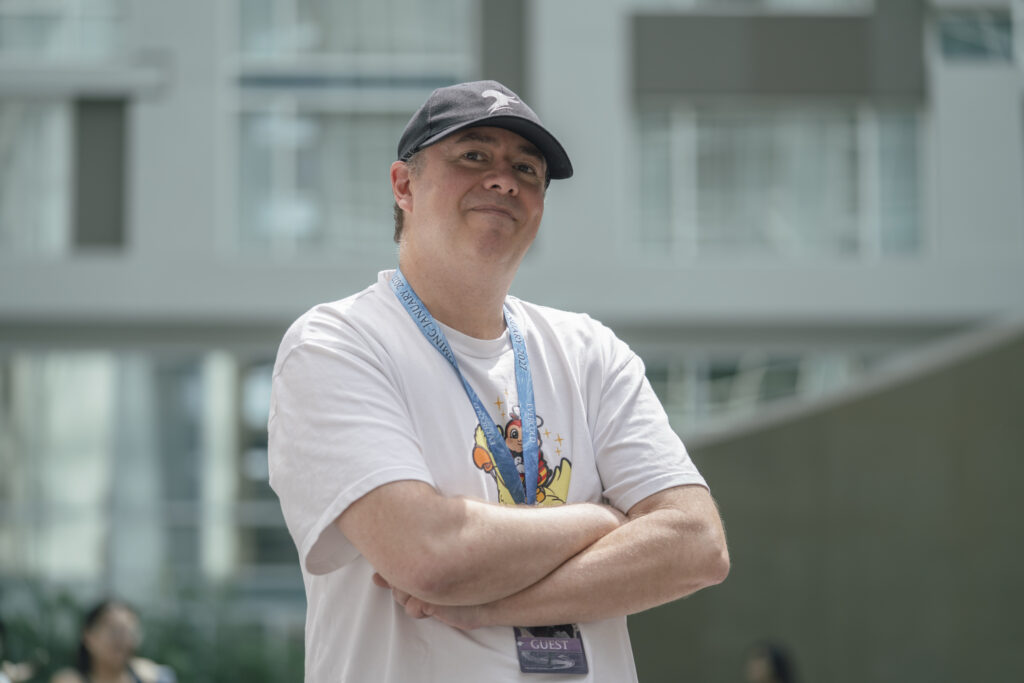
Michael-Christopher Koji Fox remembers spending roughly a week worrying over two words: Final Fantasy.
Certainly, he’s been worrying about Final Fantasy for 23 years. He has been an English translator for the celebrated games since the 11th title and now supervises the team that “localizes” them for English speakers. But this was different. He had to decide how to translate a potentially cringey title drop that came right at a pivotal moment of “Final Fantasy XVI.” In Japanese, the hero utters the name of the series to a villain in a parting one liner.
“I get the cheese,” Fox said, laughing, in an interview with The Washington Post. “I couldn’t imagine a world in which any person would say that with a straight face.”
But Fox wanted to preserve the wink. So he and his team cycled through alternatives for a week, the longest he can recall working on a single phrase. They landed on a sentence that nods to the audience without quite breaking the fourth wall.
“We’re not doing academic translation, we’re doing entertainment translation,” said Fox, who has lived in Japan for 30 years. “You can get the words across, but if you’re not getting the message across, then that’s not a good localization.”
The question of what is a “good” translation matters to people more than ever. For the last few years according to Netflix, non-English titles make up more than a third of the network’s viewings. The streaming giant cited its most popular titles as being from South Korea, Japan, Spain, India and South Africa.
Japanese animation, once a relative niche interest outside its home nation, has become a global phenomenon. The Association of Japanese Animations estimated the broader anime market as hitting 3.8 trillion yen in 2024, with the overseas market surpassing Japan’s domestic audience.
For decades, anime fans in particular have debated “subs versus dubs,” often treating subtitled Japanese dialogue as more authentic than the English-language performances. Social media allows multilingual fans to compare scripts by line, while online communities routinely explode over whether localizers are changing meaning, inserting contemporary slang or politics, or otherwise straying from the original work’s intent.
Fox doesn’t mind the scrutiny. He moved to Japan when he was 20, his language studies inspired by the Japanese games he grew up on, like the Legend of Zelda and Final Fantasy franchises.
“I think it’s always been happening,” he said of arguments over translation. Social media, he said, has simply made “everyone’s opinion more accessible.”
He also welcomes the debate, to a point. Different interpretations can force people to think about what a piece of writing actually means, he said, which encourages analysis of themes and characters. The problem comes when interpretation is mistaken for some kind of mathematical equation. This simplifies the complexity of language and culture too much, Fox said.
“People tend to look at this language being more complex … when it’s really not about complexity, it’s about the type of language, and being low context, high context or somewhere in between,” Fox said. “Languages like English are low context, being very information heavy. Everything that you need to know is in the sentence.”
Japanese takes into account who is speaking, relations with who is listening and other cultural context clues.
The word “washi,” for example, translates to “I,” Fox said, but it implies an older speaker. The Japanese language often puts a greater onus on the reader or hearer to decode meaning than English would, he said.
Different translations can use different words and still be defensible. The version someone encountered first can become definitive through that first impression, evolving into nostalgia.
Fox pointed to the original English translation of “Final Fantasy VII.” Released in 1997, video game localization was still in its infancy, with work dumped on small teams or just one person. The result was charming yet awkward lines of English beloved by a generation of players simply because they were the words they grew up with.
“Again, that ultimately comes down to interpretation, what each individual wants out of a translation and how they’re interpreting those translations,” Fox said. “That’s why you get so many different opinions, and people are super passionate.”
Another common accusation levied against translators is that they have agency to “censor” something for different audiences.
Localizers simply don’t have that power, Fox said. Differences between regional releases can originate from the creators themselves, or be shaped by publishers, branding requirements and ratings boards.
“It’s easy to point at localization because something changed between the versions, but a lot of times there are just so many factors that no one sees,” Fox said.
When a line is ambiguous or tricky, Fox said the best solution is to simply ask the original writer about what they meant.
For “Final Fantasy XVI,” Fox and his team were given unusual latitude. The writers wanted the story to feel true to Western medieval fantasy stories. The initial script was written in Japanese, but the translations accounted for the actors and pacing of dialogue.
Japanese dialogue, Fox said, regularly features one character speaking at length while another listens and occasionally utters brief acknowledgments. In English, conversation is about call and response. So his team sometimes broke monologues apart, giving other characters lines and turning them into exchanges. The ideas are the same, but the rhythm is different.
The team used the Oxford English Dictionary when considering phrases for the game to avoid expressions originating after 1900. The goal was to create dialogue that sounded old while being accessible.
Still, the Japanese writing team has veto power. The ending for “Final Fantasy XVI” remained ambiguous about the fate of one character, and Fox wanted to make that more clear-cut. Fox lost that argument.
It all depends on the goal for the audience. When a Japanese joke is translated literally, the words may be accurate, but the humor is locked away in cultural context and wordplay. His team would sometimes test translated jokes among colleagues, reworking those that confused or fell flat.
For Fox, that’s not necessarily an inaccurate translation. Getting the laugh may be more faithful to the writing than reproducing precise vocabulary.
“You could translate it perfectly, but if it’s not getting the Western audience to laugh like you got the Japanese audience to laugh, then it’s a failed translation,” he said. “The words are important, but it’s the message that is more important.”
The post In translating the world’s biggest entertainment, accuracy isn’t everything appeared first on Washington Post.