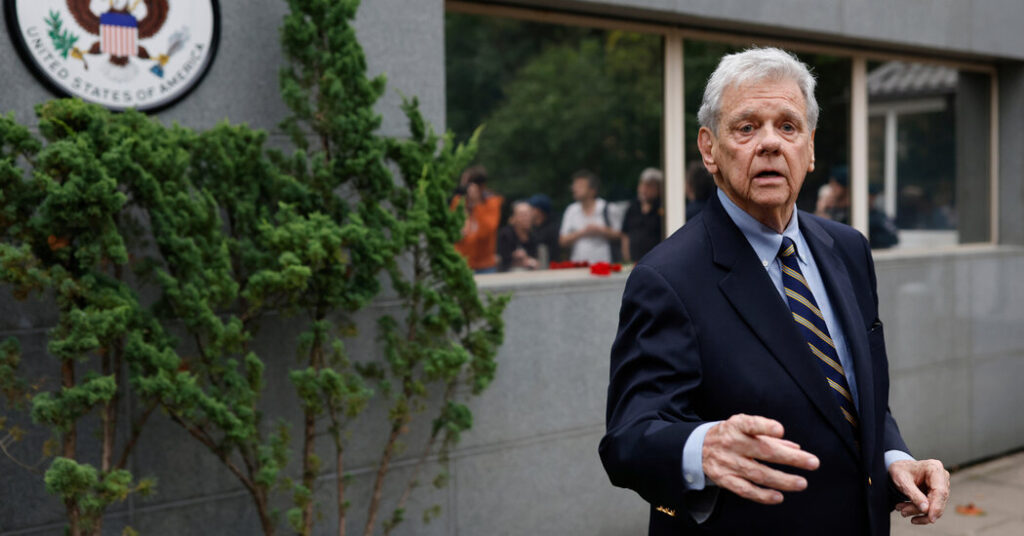
When John Coale, a friend of President Trump’s serving as a diplomat in Eastern Europe, was asked on short notice to meet with Belarus’s strongman leader, Aleksandr G. Lukashenko, he followed colleagues’ advice to “yuk it up.”
It was perhaps a surprising suggestion. The U.S. government had given Mr. Lukashenko the diplomatic cold shoulder after he asked President Vladimir V. Putin of Russia for help in 2020 to violently suppress pro-democracy protests. Mr. Lukashenko further isolated his country by letting Mr. Putin use Belarus as a staging ground for Russia’s invasion of Ukraine two years later.
Still, Mr. Coale gave it a shot, arriving in Belarus’s capital, Minsk, last year armed with wisecracks and banter. As the special envoy to Belarus, he began building a relationship with Mr. Lukashenko over dirty jokes, vodka shots and weight-loss advice. Their rapport paved the way for Belarus to free 500 political prisoners and grant pardons for several hundred more. Its leader has also become a back channel between the United States and Russia, which is Belarus’s closest ally.
In exchange, Mr. Coale has negotiated sanctions relief for Mr. Lukashenko and has offered a road map to normalizing ties between the United States and Belarus.
“Humor is a gigantic weapon,” Mr. Coale, 79, said in a recent interview in Washington at a private club overlooking the White House. “If you can get the other guy laughing, you’re halfway there and you’re not a threat.”
Their repartee embodies Mr. Trump’s preferred personalized, deal-making approach to diplomacy. The president often sidelines career diplomats in favor of envoys like Mr. Coale, a lawyer with little previous government experience. Mr. Trump relishes the drama of high-profile prisoner exchanges and hostage releases, counting them as wins that offer a clearer narrative of success than more complex geopolitical conflicts.
Mr. Coale’s efforts have earned him attention from the president. Mr. Coale said the two have discussed expanding his mission to include liberty for political prisoners anywhere in the world. The White House declined to comment publicly.
To critics, Mr. Coale is rewarding a corrupt, authoritarian government. Some Belarusians are uncomfortable with exchanging sanctions relief for political prisoners. Activists have called the judicial system “a conveyor belt” because new political prisoners are being locked up while others are being released. Others allege that effectively trading freedom for sanctions relief “encourages human trafficking.”
Mr. Coale rejects those complaints. He said he had two goals in Belarus: to free prisoners and to get its government “to want to be in the family of nations.”
Others advocates credited Mr. Coale and the State Department for the mass prisoner releases, calling them rare achievements.
“He does tremendous work without being preoccupied about being seen negotiating with Mr. Lukashenko,” said Valery Kavaleuski, a former Belarusian diplomat and a founder of a prisoner advocacy group.
Mr. Coale, a Baltimore native, was a lawyer before he joined the Trump administration. He represented victims of the world’s worst industrial disaster, the Bhopal gas leak in 1984, and negotiated the first big settlement with Big Tobacco companies in 1997, worth $386 billion.
He was politically active, building connections with both Democrats and Republicans. He said he had been a Democrat but concluded the party moved further left than he was comfortable with. His wife, Greta Van Susteren, is a former Fox News presenter now at Newsmax TV.
After mainstream social media networks banned Mr. Trump following the Jan. 6, 2021, attack on the Capitol, Mr. Coale said that several of the president’s allies, including Senator Lindsey Graham, suggested he take on Mr. Trump as a legal client. At the president’s golf club in Bedminster, N.J., Mr. Coale pitched the legal strategy that would eventually result in Meta, YouTube and X each paying tens of millions of dollars to settle lawsuits over their suspensions of Mr. Trump.
Eventually, Mr. Coale was offered a role in the administration, first as deputy envoy to Ukraine before the Belarus posting.
Home to about nine million people, Belarus is sandwiched between Russia and the European Union and is considered an important buffer zone between the two. Mr. Lukashenko’s repressive rule earned him the label of “Europe’s last dictator” from Condoleezza Rice in 2005, when she was secretary of state. Washington has not had an ambassador in Minsk since 2008.
The two countries pursued cautious engagement, including during Mr. Trump’s first term, but that halted with Mr. Lukashenko’s violent suppression of the 2020 protests. After years of isolating the strongman, Christopher W. Smith, a career diplomat widely credited for driving Washington’s re-engagement with Belarus, quietly laid the groundwork for negotiations. The first meeting with Mr. Coale, the most senior U.S. official to come to Minsk in years, was another diplomatic coup for Mr. Lukashenko.
Twenty minutes into that first encounter, Mr. Lukashenko was inveighing against European leaders who have sought to isolate him. “He was ranting and raving about them, so I said, ‘They’re a bunch of cowards,’” Mr. Coale recalled, using a more vulgar term.
“I knew that’s what he wanted to hear, something like that, to lighten everything up,” Mr. Coale added with a chuckle, explaining that his views of other European leaders are actually more nuanced.
“He loved me after that,” said Mr. Coale, who is self-deprecating and projects a friendly, unpretentious confidence. “The Europeans didn’t.”
After the E.U.-bashing, it was time to drink. Mr. Coale said he downed two shots of Mr. Lukashenko’s personal branded vodka, and then poured others on the floor to stay sober for negotiations.
After toasts, Mr. Lukashenko told Mr. Coale that in addition to releasing an American citizen whose freedom Washington had sought, he would send home another American who hadn’t been part of negotiations “because I like you.”
During a subsequent meeting in Minsk in June 2025, Mr. Lukashenko noticed that Mr. Coale had slimmed down. The American told him about Zepbound, the weight-loss jab that had helped him lose 40 pounds. He had accompanied Keith Kellogg, a retired lieutenant general and Mr. Trump’s envoy for Russia and Ukraine, and the meeting lasted more than six hours.
Shortly after, 14 political prisoners, including the husband of the opposition leader Svetlana Tikhanovskaya, were released.
Mr. Coale and Ms. Van Susteren had dinner not long after with Mr. Trump, whom they have known socially for decades. When Ms. Van Susteren told the president that her husband’s most recent visit to Belarus had resulted in 14 prisoners being freed, he insisted on talking to Mr. Lukashenko by phone. Days later, Mr. Trump called while en route to his meeting with Mr. Putin last year in Alaska and said he hoped to welcome the Belarusian leader to the White House one day.
At a penal colony in Belarus, in between sewing law enforcement uniforms and doing manual labor, Katsiaryna Andreyeva watched Mr. Coale’s visits on state television. Ms. Andreyeva, jailed for covering the 2020 protests for the Warsaw-based channel Belsat, had resigned herself to serving her two sentences totaling more than eight years. But Mr. Coale’s visits gave her some hope.
In mid-February, she was transferred to a state security services prison in Minsk. After five weeks of psychological pressure, including stints in a padded cell, she said, masked men put her into a vehicle and told the inmates to ride in silence with their heads down.
It was only when Mr. Coale, whom she had seen on television during enforced propaganda-watching sessions, threw open the doors of the prison van that she knew for sure she was free.
“You are free!” she remembered him saying. He extended his arm for a handshake. Ms. Andreyeva pulled him in for a hug.
Mr. Coale said that watching as political prisoners realized they were free was the biggest driver for him. “What motivates me is opening the doors” to vehicles carrying newly freed prisoners, he said.
He plans to leverage his relationships to help Russian political prisoners, too. Mr. Coale said he had been approached by the Russian Nobel Peace Prize laureate Dmitri A. Muratov to facilitate a civilian prisoner exchange between Russia and Ukraine. While such an effort would be enormously complicated, Mr. Coale said he had received financial commitments from two organizations to resettle the prisoners elsewhere.
But first, he wants to get the rest of Belarus’s political prisoners out of jail. He was expecting, he said, another big exchange very soon.
The post How a Trump Envoy Uses Vodka and Dirty Jokes to Conduct U.S. Diplomacy appeared first on New York Times.