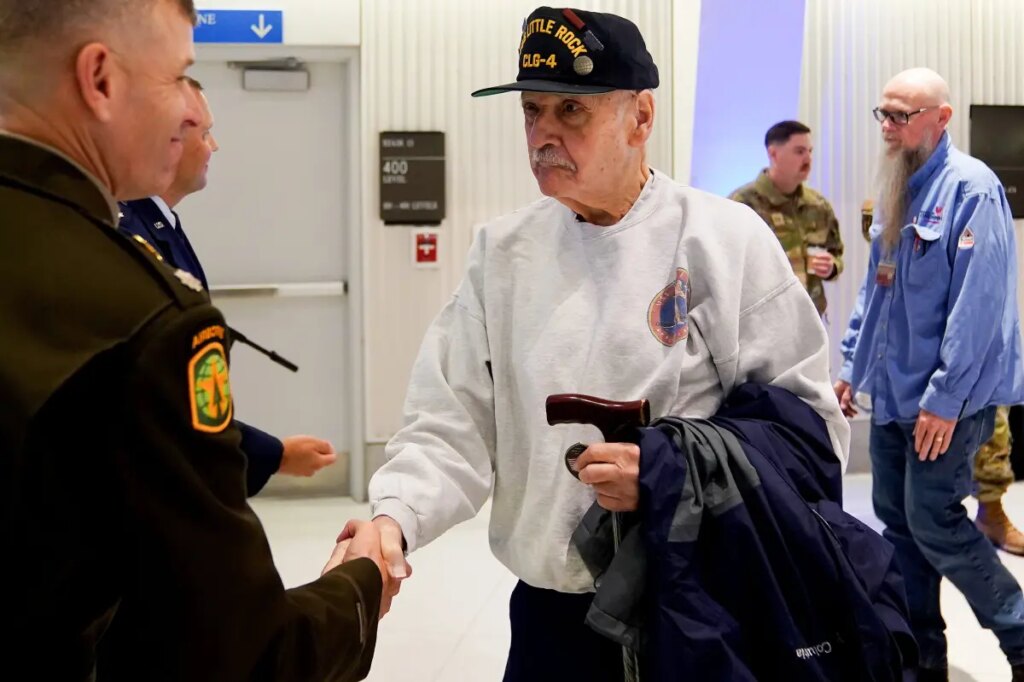

Every Veterans Day, in cities and towns across America, men and women who served our country stand a little straighter as the flag passes by.
Some fought in Korea or Vietnam; others stood watch through the Cold War. A precious few fought in World War II.
Then the parade ends, and all too many of them go home alone.
Nearly half of America’s military veterans are 65 or older. We rightly honor their service.
But they are only part of a larger generation of Americans who built this country.
Last month in Pittsburgh, I hosted a Senate Aging Committee field hearing with my Pennsylvania colleague Sen. John Fetterman.
As we examined programs that keep older Americans connected, the hearing raised a larger question about the dignity and compassion we owe our elders.
Across America, our aging population is often described as an economic burden, especially in Rust Belt states like mine.
Older Americans now outnumber children in 11 states and in nearly half of all US counties.
We hear warnings of fewer workers, higher taxes and rising health-care costs.
Those challenges are real.
But focusing on them misses something essential: Our 61 million older Americans are a treasure, and one of our nation’s greatest sources of strength.
Too many, however, are being left behind.
At our Pittsburgh hearing, I shared a story from Meals on Wheels of the Greater Lehigh Valley, which delivers food and a smile to 2,000 homebound seniors every day.
When a volunteer’s regular client didn’t answer his door, she went around back and found him lying on his kitchen floor.
She rushed in, called for help, and asked if he was hurt.
“It’s OK,” he said calmly. “I wasn’t scared. I knew you were coming.”
For seniors living alone, that reassurance can matter as much as the meal itself.
Spouses pass away. Children move. Driving becomes difficult.
For many seniors, the world gets small, fast: Nearly one in four Americans 65 and older is socially isolated.
Addressing this challenge is a national imperative for three reasons.
First, our seniors are our role models and inspiration.
In places like Pennsylvania, they worked the mills and mines, served in uniform and built the churches, union halls and VFW posts that hold our towns together.
When steel collapsed, many stayed and rebuilt.
They gave us more than structures and institutions; they passed down the values that made America great — hard work, faith, family and service to one’s neighbors.
At a moment when those values are under siege, their example matters more than ever.
Second, keeping seniors connected is good policy.
Social isolation is associated with roughly $1,600 in additional Medicare spending per person annually, while a private nursing-home room now costs nearly $130,000 a year.
Helping seniors stay healthy, independent and engaged benefits them, their families — and taxpayers.
Third, it’s our moral obligation.
I’ve always said you learn a lot about a country by how it treats its veterans.
The same holds true for its elders.
Sen. Fetterman and I both have aging parents in rural Pennsylvania, and we’ve seen the challenges firsthand.
Americans believe in paying it forward to the next generation — but as Anglo-Irish statesman and philosopher Edmund Burke observed, “People will not look forward to posterity, who never look backward to their ancestors.”
We have an obligation to those who came before us, too.
Answering that call is a team sport: Families, community organizations and every level of government must play a role.
I’ve cosponsored bipartisan bills to renew the Older Americans Act, which supports meals and transportation for seniors, and to improve loneliness screening through the SENIOR Act.
The Senate passed the Older Americans Act bill unanimously in July; the House should follow suit.
But legislation is only part of the answer.
Our Pittsburgh hearing brought Republicans and Democrats together with researchers, volunteers and county officials responsible for senior services.
We need that same cooperation nationwide, and at all levels of government.
That’s because we owe our seniors more than a hearing — we owe them results.
More is required of each of us, too.
Call your parents.
Check on the neighbor who lives alone.
Sign up to deliver a meal.
Caring for our elders isn’t just a government program — it’s a duty every American shares.
On Veterans Day, we promise those who served that they’ll never be forgotten.
We owe that same promise to every older American who helped build this country.
We must show up for them so that each can say, as that Lehigh Valley man did from his kitchen floor:
“I knew you were coming.”
David McCormick, a combat veteran, represents Pennsylvania in the US Senate.
The post On Veterans Day and beyond, treasure the seniors who served America appeared first on New York Post.