LAUREL, Md. — Ralph Lorenz dreamed up the idea of flying a helicopter through Titan’s thick methane-laden atmosphere back in 2000 in a speculative research paper and a cover story for New Scientist magazine.
“It was a fantasy,” Lorenz said.
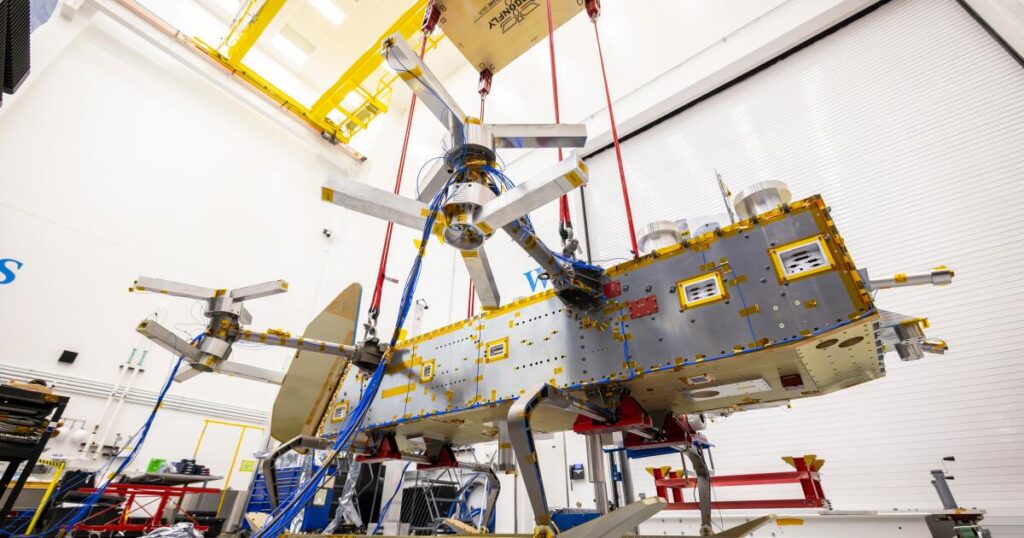
A quarter-century later, that fantasy is turning into reality inside a 40-foot-tall clean room at the Johns Hopkins University Applied Physics Laboratory just outside the Washington, D.C., Beltway. The Dragonfly spacecraft, a $3.3-billion nuclear-powered space-copter, has survived a decade of uncertain budgets and a shift in NASA priorities to become the space agency’s last, large-scale planetary science mission, scheduled to blast off in July 2028 bound for Saturn’s largest moon.
To meet that launch window, technicians in protective suits test electronics on the spacecraft’s chassis, which resembles a gray metal box with four outstretched arms. Over the next few months, workers at APL will bolt on eight three-bladed rotors that will allow Dragonfly to fly several miles at a hop above the alien surface. Then comes a bevy of scientific instruments, a small nuclear engine, and shiny orange foam to keep the instruments warm in space.
More than 1,000 scientists, engineers and contract workers across the country are putting together pieces of Dragonfly, which — when finished — will be about the size of NASA’s Perseverance Mars rover (or a Mini Cooper).
Jet Propulsion Laboratory in La Cañada Flintridge is also a partner in the mission, and will help design Dragonfly’s complex flight path. JPL also manages the Deep Space Network — the global array of massive antennas that will transmit commands to the copter and receive data from Titan.
“Dragonfly is special,” Lorenz said. “We are going to a fundamentally interesting place, and there’s rich potential for discovery there, and we’re going to explore it in a very cool way.”
Why Titan? It’s super cold — minus-290 degrees Fahrenheit — and is surrounded by a methane atmosphere that condenses, forms clouds and drops rain onto methane lakes and rivers — the only place in the solar system besides Earth where liquid exists.
Scientists speculate there may have been life on Titan’s surface in the past, and a tiny chance that some kind of life might exist in the ocean of liquid water that exists 35 to 50 miles below the frozen surface.
“Life as we know it has a fairly restricted temperature domain that basically relies on liquid water, at least in small amounts, and Titan’s surface is far too cold,” Lorenz said. “But in the deep interior you do have habitable conditions.”
Lorenz is the mission’s architect, responsible for figuring out the atmosphere’s turbulence, the hardness of the rocks for a sampling drill, and how much light will be available to allow Dragonfly’s sensors to navigate. He reports to Elizabeth “Zibi” Turtle, the mission’s principal investigator and his wife.
Turtle and Lorenz are seasoned hands in the planetary science world. They worked on the Cassini/Huygens mission that explored Saturn and landed a small probe in 2005 on Titan’s surface that fed back data for 72 minutes before it conked out.
Turtle developed imaging instruments aboard the Europa Clipper, a NASA mission currently on its way to Jupiter’s icy moon Europa, another intriguing location in the search for life. Turtle said Titan is like Earth in many ways.
“The landscape would be very familiar to us if you were standing on the surface,” she said. “There are these vast longitudinal dunes that are very much like the dunes in the Namib Desert.”
Turtle is less hopeful about finding fingerprints of life on Titan. She notes that the hydrocarbons needed for life that we have on Earth are on Titan’s frozen surface, while liquid water is buried 50 miles below. “It’s very difficult to transport material through an ice crust that big,” she said.
Turtle said Dragonfly will be looking for signs of earthquakes or volcanoes that might allow hydrocarbons like methane to move between the surface and the ice-covered ocean. Its mission will last up to 40 months, giving scientists on Earth enough data to analyze for years.
With the launch of NASA’s $4.3-billion Nancy Grace Roman space telescope later this month, Dragonfly is the last big planetary mission left on the books, according to Casey Dreier, space policy analyst at the Planetary Society, a space-based nonprofit research organization based in Pasadena.
“There’s very little else coming down the pipeline,” Dreier said. “So a lot’s riding on it.”
The Trump administration cut NASA’s science mission budget in half in 2025, jeopardizing several planetary missions. Congress restored the money last year, but the Trump administration made similar cuts to NASA’s 2026 science budget. The uncertainty in funding has put on hold future missions to Uranus, Venus and Enceladus, and a return of rock and soil samples from Mars, Dreier said.
Dragonfly is a survivor, just like its insect namesake. Turtle and other scientists who have spent decades working on the mission will be on edge when it makes its two-hour descent to Titan’s surface in 2034.
She often considers what it would be like to stand on Titan’s surface. Despite the cold, there’s no radiation to worry about and only gentle 10 mph winds to disturb those dunes.
“It’s a pretty benign environment and well-protected,” Turtle said. “It would be fascinating to explore and to consider, hang-gliding over the surface. It would be just wild.”
The post NASA’s nuclear Dragonfly copter to search for signs of life on Titan: ‘A lot’s riding on it’ appeared first on Los Angeles Times.