To the Editor:
Re “Therapy Needs to Get Help,” by Daniel Duane (Opinion guest essay, nytimes.com, Aug. 9):
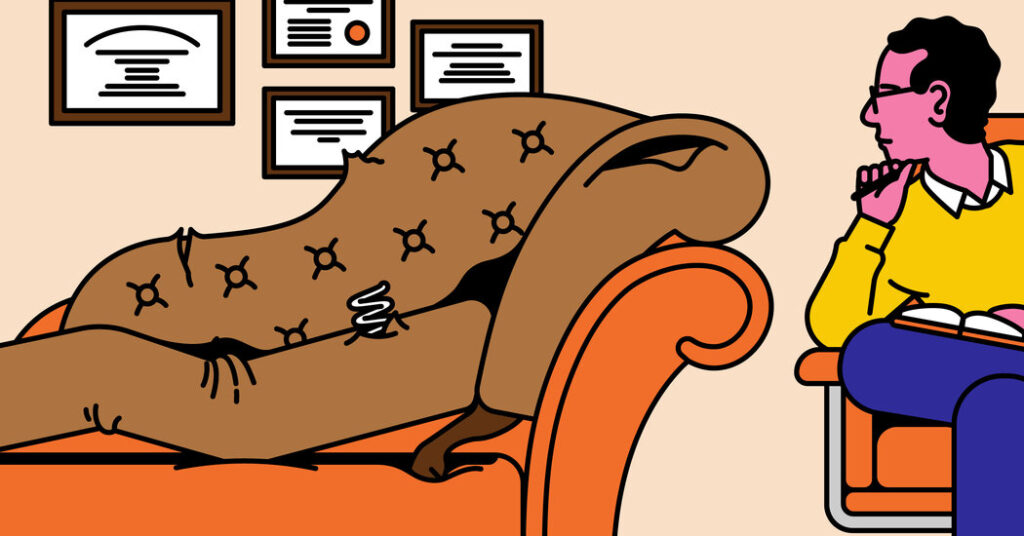
Mr. Duane provides a cogent diagnosis of what’s gone wrong in the field of mental health care and research. Over time, the field has been devalued and deprofessionalized to such an extent that the public is confronted by a confusing series of pale substitutes that bear only a slight resemblance to psychotherapy.
Whether UberTherapy platforms, TikTok “therapists,” coaching or self-help tools dressed up as A.I. chatbots, these substitutes lack the key ingredients of real psychotherapy: the relationship between therapist and client, the safety to challenge one’s working assumptions of the world and acknowledge one’s blind spots, and the support to risk trying new ways of being and relating.
What these new platforms and products do offer is a means to enrich their investors, which include private equity financiers, venture capitalists, big tech firms like Amazon and the insurance companies.
These companies are focused on their quarterly financial statements, not your mental health. They want data to hone their targeted advertising strategies, whereas protecting privacy and confidentiality is a necessary ingredient of any successful therapy.
These trends are also making it harder for therapists to get started in their careers and make a living. Therapists are being forced out of the profession at the very time they’re most needed, perpetuating the access-to-care crisis.
Neuroscience is confirming the effective ingredients of therapy and can provide evidence of its efficacy, which we should trust much more than what the insurers, influencers and financiers are touting.
Linda Michaels Chicago The writer is a psychologist in private practice and the chairwoman of Psychotherapy Action Network, a nonprofit that advocates improved access to effective mental health care.
To the Editor:
Daniel Duane writes about research showing that all models of psychotherapy are equally effective (the dodo bird verdict). This claim is misleading. While diverse psychotherapy treatment models often produce similar outcomes, some models are clearly more efficacious in the treatment of specific psychiatric conditions.
For example, in the treatment of anxiety disorders, which are the most frequently diagnosed class of psychiatric conditions in the United States, cognitive behavioral therapy has been shown to produce patient outcomes that are superior to other therapy models.
Hundreds of randomized control trials in the treatment of anxiety disorders regularly conclude that C.B.T. treatment often leads to significant symptom remission and improved patient functioning. There is not another psychotherapy model that can make this claim.
Bruce Kirby Rockville, Md. The writer is a psychotherapist.
The Triumphs of ‘Jellicle Ball’
To the Editor:
Re “This Is Why Broadway Is Broken,” by Naveen Kumar (Opinion guest essay, Aug. 10):
Mr. Kumar correctly identifies many of the factors that make it difficult to turn a profit on Broadway, and it’s a shame that “Cats: The Jellicle Ball,” the thrilling ballroom-themed reimagining of “Cats,” did not run longer.
But I would prefer to celebrate the triumphs of getting this “vibrant and Black and queer” show onto Broadway in the first place, including: running for four months to acclaim and awards, giving 17 cast members their Broadway debuts and bringing the yearning, joy and pain of ballroom to a diverse, mainstream audience.
In the time before the current megahit culture took hold, a four-month run was seen as decent. Now, any show that doesn’t recoup its investment is considered a failure. But this glorious “Jellicle Ball” is no more a failure than “A Strange Loop,” “Shuffle Along” or “Ain’t No Mo’,” other brilliant shows highlighting marginalized characters and communities that succeeded artistically but failed to turn into tourist staples and earn a profit.
The bottom line is not the only, or most important, measure of success.
Jeffrey S. Trachtman New York
The post Why TikTok Therapy Isn’t Psychotherapy appeared first on New York Times.