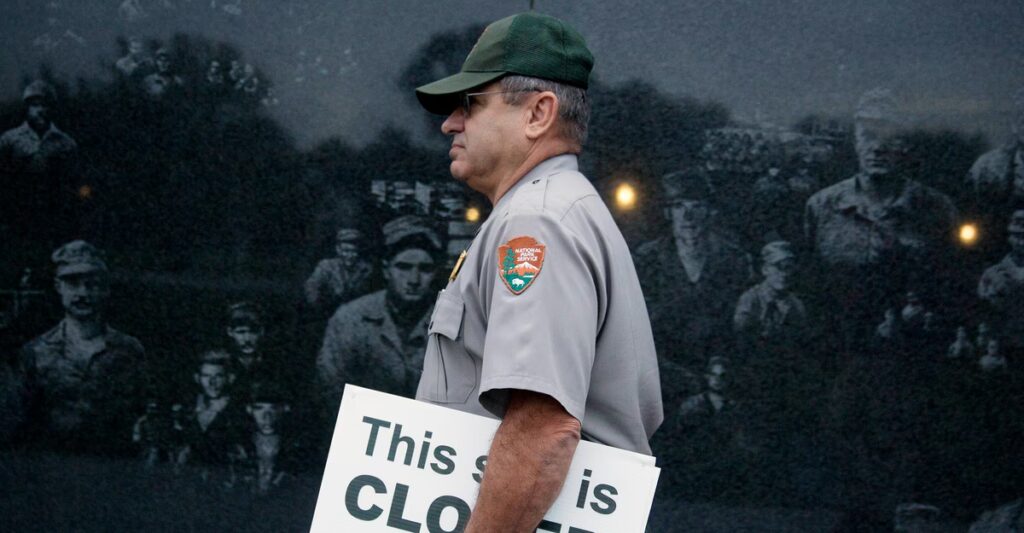
President Trump gets what he wants, when he wants it, from the National Park Service. One and a half million dollars to replace brick pavers in Lafayette Park, across from the White House? Contracting officials at the NPS Washington headquarters found the money within five days last month. A $170,000 request to remove a fence around the Hains Point golf course, preparing the ground for a new “championship-quality” layout? Six days this summer. And the more-than $5 million project to gild equine statues along the nearby Memorial Bridge? That took 12 days.
The rapid-approval system is specific to projects Trump wants, thanks to a reorganization at the Interior Department, led by Secretary Doug Burgum. Trump issued an executive order to make the District of Columbia “safe and beautiful,” justifying the creation of an NPS docket of “White House priorities” that is handled separately from other park projects and is prioritized both for funding and contracting resources, according to documents I obtained and interviews with five current or former NPS officials. Meanwhile, many other projects throughout the nationwide system of parks are languishing.
The list I received includes Trump’s well-known projects on the National Mall and the refurbishment of the White House, along with several lesser-known efforts: The hiring and equipping of 450 new U.S. Park Police officers in the Washington region, and more than $12.8 million—some of which came from the Department of Justice—for police equipment, including new Flock license-plate-reading cameras, radios, tasers, laptops, body cameras, and body armor. Internal documentation for park projects typically includes “Consequences of Failure to Act,” which scores the urgency based on health and safety measures. When work began in January on fountains near the White House, officials described the need for the work in this way: “Such failure will disappoint visitors, as well as residents and employees of the White House.”
The new project-funding system was described by a contracting officer during an April meeting with NPS officials. “There’s three different lists: White House priorities, high priorities, and low priorities,” the official told colleagues on the virtual call, according to a transcript that was provided to me. Those on the call, who do not work on White House priorities, were advised that projects on the low-priority list likely would not be completed, so they should attempt to get their needs moved to the high-priority list. White House priorities, meanwhile, were nonnegotiable. As Washington is beautified at great expense, officials told me, vital needs at dozens of national parks are not being filled.
I obtained copies of the high- and low-priority lists that circulated this summer inside the NPS. As of mid-July, that low-priority list included 1,573 projects, including many that officials told me would have been funded under prior administrations. Projects that have not yet been funded from that list, according to a separate national-park database, include requests for new wildlife-resistant dumpsters in Bryce Canyon National Park, snow machines to provide fire remediation in Alaska’s remote Yukon–Charley Rivers National Preserve, and an archaeological survey of recently acquired land at Camp Nelson National Monument, a major Union supply base during the Civil War that trained Black soldiers.
The Interior Department dismissed the concerns over this approach when I reached out for comment and told me that the low-priority list I had obtained included items that had been “mis-prioritized and were corrected.” Interior leaders have also boasted about new funding streams, including revenue from more expensive national-park passes for foreign visitors. “In any year, the National Park Service must prioritize projects most in need,” the press office said in an unsigned statement. “The National Park Service has not only been focused on beautifying the district for the 250th celebrations in our nation’s capital but has also been working on many deferred maintenance projects throughout the country.”
[Read: ‘Rush project at request of POTUS’]
But those working in the parks say it is not just money holding these projects back. It’s also a lack of staff who are able to handle contracts, after rounds of workforce reductions, a problem that the contracting official on the April call referred to as “capacity.” When Elon Musk’s Department of Government Efficiency targeted the department last year, many contracting managers at the NPS took buyouts, and many of those who remained found themselves reassigned within the larger department. The NPS had 179 full-time administrative officers in June, a 21 percent decrease from the month Trump took office, according to Office of Management and Budget records. The result is a growing backlog of unfinished projects in far-flung parks, as government employees try to jury-rig temporary fixes, the officials said. “There is very little acquisition support,” one of the NPS employees told me. “This is going to get exponentially worse.”
Spencer Morgan, the site superintendent of the Theodore Roosevelt Inaugural National Historic Site in Buffalo, New York, told me that his facility is still waiting on this fiscal year’s promised operating-support funding, which needs to arrive before the end of September, or he will have to institute major cuts. He has been told that an additional stream of routine-maintenance funding he was expecting will never arrive. Since the site is run in conjunction with a local nonprofit that pays Morgan’s salary, he said he was comfortable speaking openly about the struggles his staff faces as funding and resources are instead directed to the White House list. “I am not beholden to hold my tongue at this point,” he said.
Inside the NPS, Morgan said, the staff has been decimated. “I started in this role in April of 2024, and the number of people who are not there since I started is gut-wrenching,” he told me. “There is a whole loss of institutional knowledge.”
Other NPS employees requested anonymity to speak with me because they fear retaliation from their supervisors. One employee told me their park can’t hire employees to fill vacant slots, but also can’t contract out work, because it’s difficult to get on the high-priority list. “We keep being told to be creative,” this employee said. “And we are running into dead ends every time we try to pivot.”
This reduction in spending showed up in budgetary documents I reported on in June. The documents showed a decrease of $854 million, or 68 percent, in spending on projects in park regions outside the Washington area in the first eight and a half months of fiscal year 2026, compared with the full prior fiscal year. During that same period, spending around Washington increased by about $100 million, not counting about $310 million in donations that the NPS received from allies of the president, most of which is going to fund a new White House ballroom.
The frustration over these shifting priorities has been a frequent topic of conversation among park superintendents, who are struggling to maintain services this summer. At another NPS meeting in early July, an employee presented a list of 133 projects, totaling $35.8 million, that they said were ready to go but lacked contracting staff to make them happen, according to a person on the call.
It’s not clear if all of the projects on the White House priority list will receive funding this fiscal year. The list also includes a $25 million plan to replace the Eagle One helicopter used by the U.S. Park Police (and at least once by Burgum when he was running late for an Air Force One flight), $475,000 to clean and repaint the White House exterior, drones “to support law enforcement” in the Washington region, a new park-police substation for Rock Creek Park, and streetlight replacement along the National Mall. The priority list also includes improvements for parts of the country where Trump is known to travel. The document shows a $77,300 expense to clear brush and plant new trees around Camp David, the presidential retreat in Maryland, as part of a much larger effort to plant 3,000 trees and provide a “security benefit” to the facility. And Trump continues to add more projects to the list—or expand projects already on it. Take, for example, the brick pavers in Lafayette Park outside the White House gates. In May, Trump had said the park renovation would be funded by “a contribution that I made,” even though internal documentation shows public funds being used. After the Fourth of July celebrations, the NPS agreed to pay an additional $1.5 million to replace more of the brick pavers in that park. Then, in August, the president told reporters in the Oval Office that he was still deliberating on whether the brick pavers were good enough.
“Now we have a big decision to make,” he said. “Do we take the pavers that are red—you know, the red brick pavers—and do we change them into a granite, to gray granite? They’re beautiful, but they’re not the original. So we’re gonna have to make that decision.” The National Park Service, no doubt, will be ready to follow the president’s lead if he pivots.
The post President Trump Has a Pet-Project Docket at the National Parks appeared first on The Atlantic.