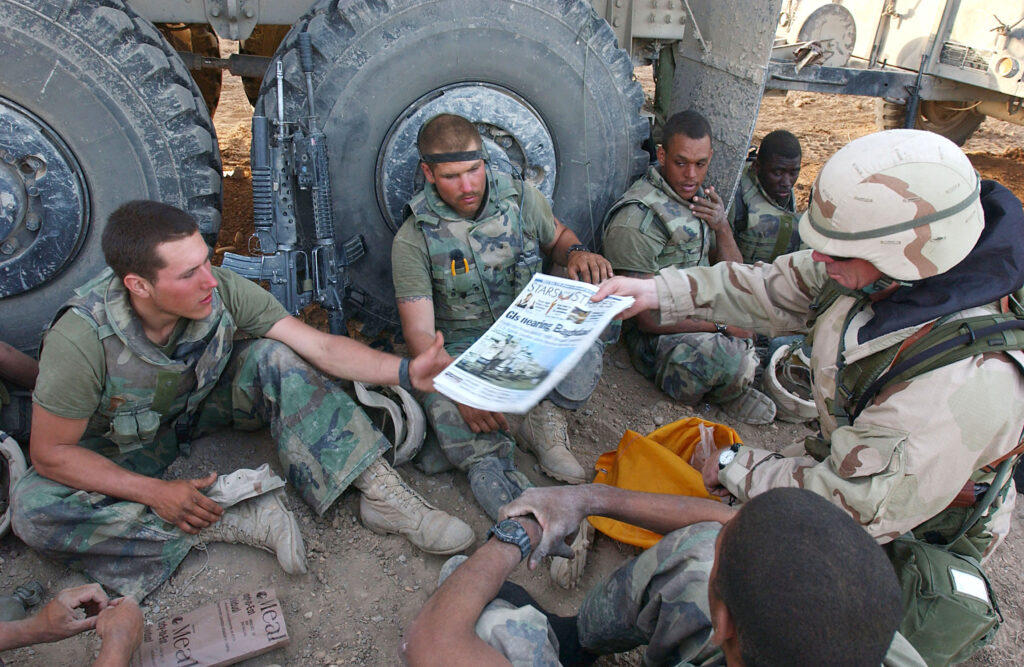
The longtime publisher of Stars and Stripes announced he’s stepping down weeks after the Pentagon installed an active-duty Navy captain at the military newspaper, an atypical appointment that staffers, board members and Democratic lawmakers say risks further eroding the publication’s independence from the government.
Max Lederer, who spent more than 30 years at Stars and Stripes, announced Tuesday he was stepping away after nearly two decades as publisher. His email to staff about his departure included a parting shot at the Defense Department.
“It has become clear that my philosophy of leadership, and my understanding of the value and mission of Stars and Stripes, differ in fundamental ways from the direction the leadership of the Department of Defense has for the organization,” Lederer wrote in an email obtained by The Washington Post. He said his retirement is effective Sept. 30.
Though Stars and Stripes staffers are government employees and the newspaper gets some funding from the Defense Department, it has enjoyed long-standing editorial independence from the Pentagon. But that independence has come under threat during the second Trump administration as top Pentagon leaders have derided the newspaper as “woke.”
For decades, the newspaper’s independence has hinged in part on its civilian leadership, which helps ensure the publication doesn’t turn into pro-government propaganda. William Urban, an active-duty Navy captain and public affairs officer, was appointed earlier this month as a deputy to Lederer. The appointment was made without Lederer’s consultation, according to Rufus Friday, chair of the Stripes advisory board of publishers.
Placing uniformed personnel among the newspaper’s leadership has raised concerns among members of the Stripes publisher’s advisory board about the newspaper’s independence.
Three Democratic senators on Thursday sent a letter to Defense Secretary Pete Hegseth, expressing concern that Urban’s placement at the newspaper threatens its independence.
“The placement of an active-duty Public Affairs officer in the senior leadership of an organization whose credibility depends on its independence from the military chain of command raises serious questions. Mr. Lederer’s abrupt departure only heightens those concerns,” wrote Sens. Richard Blumenthal (D-Connecticut), the top Democrat on the Senate Veterans’ Affairs Committee, Elizabeth Warren (D-Massachusetts), and Jeanne Shaheen (D-New Hampshire). The three senators also serve on the Armed Services Committee.
In the letter, the senators hailed the role of Stars and Stripes in providing reliable news to U.S. service members, but said that trust hinges on the newspaper’s editorial independence. “That trust depends on preserving a clear separation between independent journalism and the Department’s public affairs apparatus,” they wrote. “At this critical moment of leadership transition, that independence must not be compromised.”
They asked Hegseth to provide by Aug. 28 an explanation of Urban’s role, including whether he has any influence over editorial operations. They also asked whether Urban will replace Lederer as the permanent publisher.
One Stripes staffer, who spoke on the condition of anonymity out of fear of reprisal, said they were apprehensive about what would happen at the paper without Lederer’s leadership.
“He has spent years working really hard to ensure our editorial independence and our ability to report honestly to service members about the topics that impact them directly,” the staffer said. “There’s a lot of unknown with what comes next without him in that seat.”
The Pentagon did not respond to a request for comment.
Urban in an email said he was hired as “military deputy to the publisher” and remains in that role despite Lederer’s departure. He said that while hiring a new publisher could take months, it’s possible that the Pentagon appoints an interim publisher from inside or outside Stars and Stripes. He declined to comment on questions about his qualifications and the independence of the paper.
In an Aug. 14 letter to congressional committees about Urban’s appointment, Friday, the advisory board chair, expressed concern about his lack of journalism experience.
“Placing an active-duty Public Affairs Officer at the senior management level of Stars and Stripes creates a serious concern about the appearance and reality of its editorial independence,” he wrote.
Urban was most recently director of public affairs at the U.S. Navy Bureau of Medicine and Surgery. Before that he was the lead spokesman for NATO and U.S. Central Command.
Lederer is an Army veteran and lawyer who joined Stripes in 1992 as general counsel in Germany, according to his LinkedIn profile.
Bill Church, another member of the Stripes publishers’ advisory board, also expressed concern about Urban’s lack of journalism experience.
“How does someone with zero experience in a global news organization walk into a senior-level role at Stars and Stripes?” said Church, who is also the executive editor of the Santa Fe New Mexican newspaper. “We should all worry about the future of Stripes.”
Gabe Rottman, vice president of policy at the Reporters Committee for Freedom of the Press, said editorial independence and civilian leadership are what make Stripes a valuable source of news for service members.
“This is another intrusion by the Pentagon into the independence of the press and it is essential that Congress step in to insulate Stars and Stripes from political influence,” Rottman said.
Lederer declined an interview request. In a Stripes article about Lederer’s departure, Erik Slavin, the newspaper’s editor in chief, said the publisher was an “inspirational leader.”
“For decades, Max Lederer championed the interests of service members and their families by supporting their access to credible reporting, independent of the military chain of command,” Slavin said.
Lederer’s forthcoming departure is the latest sign of upheaval at Stripes, which was first published during the Civil War and has continuously reported on and for the U.S. military community since World War II.
In March, the Defense Department outlined a broad “modernization” effort for the newspaper, according to an internal memo reviewed at the time by The Washington Post. That memo came after a pledge made in January to overhaul the publication and rid it of “woke distractions.”
In April, Defense Department official Sean Parnell fired the publication’s ombudsman. Jacqueline Smith, the ombudsman, sued the Pentagon in June, alleging that her dismissal was retaliatory and violated her First Amendment rights.
“I’m charging that my First Amendment rights were violated for speaking out in the columns that I’ve written since Jan. 15, which were critical of what I saw as the Pentagon’s attempts to control the editorial content of Stars and Stripes,” Smith said in a June interview.
The absence of editorial independence at Stripes would be “unconscionable,” said Susan “Suki” Dardarian, another member of the Stripes advisory board.
“Service members are the ones who are out there defending our Constitution, and part of that Constitution is the First Amendment,” she said.
Stripes has continued to report critically on the U.S. military, including on concerns about mental health and the risk of self-harm for sailors aboard the USS Abraham Lincoln in the Persian Gulf.
The post Democrats sound alarm about a new leader in uniform at Stars and Stripes appeared first on Washington Post.