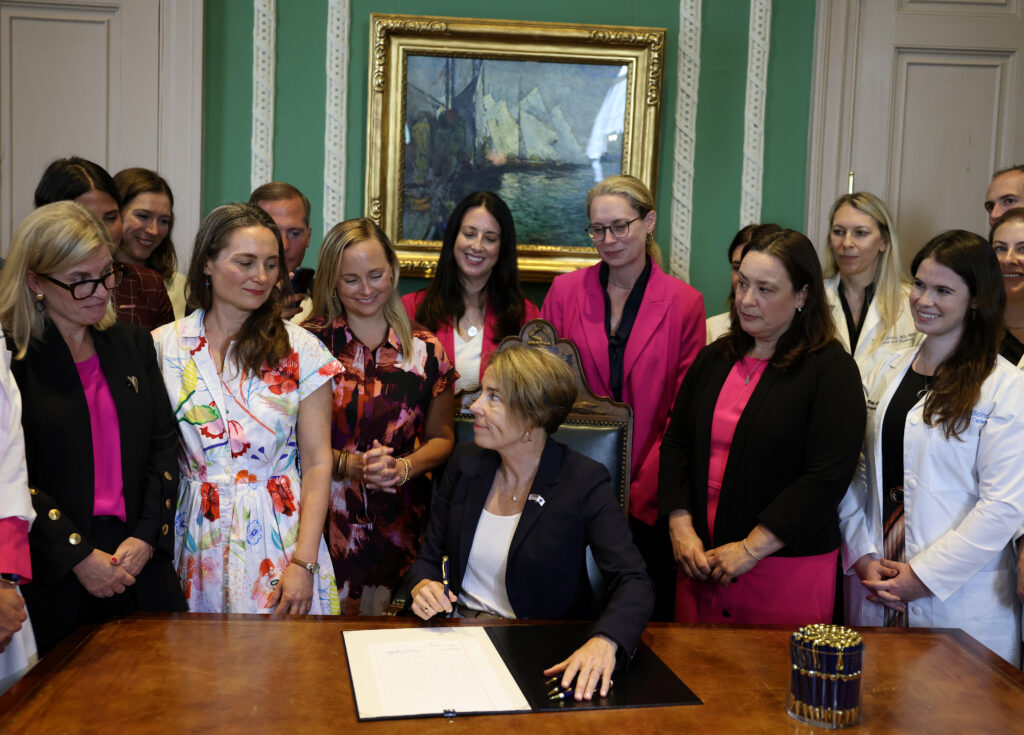
Democrats historically haven’t liked talking about late-term abortion, but Massachusetts Gov. Maura Healey isn’t so reluctant. Last week, she signed the Prioritizing Patient Access to Care Act, which in effect removes the state’s restrictions on the lethal procedure after 24 weeks. The decision, Healey suggested, was necessary to strengthen an imperiled right.
Yet it’s difficult to see what, in her view, was weak about the status quo. Massachusetts already allowed post-viability abortions to protect a mother’s “physical or mental health” or in cases involving a “lethal fetal anomaly or diagnosis.” The new law allows women to terminate pregnancies until birth, for any reason, so long as it accords with a physician’s “professional judgment.” That was too much even for some Democrats, nine of whom joined Republicans to oppose the bill in the House, 119-33. It limped through the Senate by a 15-4 standing vote, with less than half of the chamber weighing in.
The new legislation isn’t what I would have chosen for my home state, but it’s hardly surprising, either. The end of Roe v. Wade meant the authority to regulate the issue returned to the states, and Massachusetts evidently favors maximum permissiveness. The law, according to Healey, is a triumph for choice: “Real freedom,” she wrote, “means health care decisions belong to women and their doctors. Not their government.”
That would suggest she favors increasing resources and information for women, no matter their views on abortion. Instead, the governor has smeared the dozens of organizations that support vulnerable mothers seeking alternatives.
The attack on pregnancy resource centers has been years in the making. The governor in 2024 launched a “first-in-the-nation public education campaign” to protect residents from the “dangers of anti-abortion centers.” The effort, aided by the Reproductive Equity Now Foundation and backed by $1 million in taxpayer funding, appeared on social media, billboards and public transportation with its message.
The state says pregnancy resource centers “can put your health at risk” and “mislead you about your options.” In the government’s telling, the groups lure abortion-seeking women in and trick them into not terminating their pregnancies. Elizabeth Warren, the state’s senior Democratic senator, put the accusation more sharply in 2022 when she said that such centers “torture” women and ought to be shut down.
With little evidence, a state webpage asserts that these centers “may delay” scheduling appointments to run down the clock on getting an abortion, now a moot point. Their staff, it adds, “may even wear white coats” to look like medical professionals, but don’t offer “comprehensive care.” Worse, they “may include false information about access to abortion” and exaggerate its risks. “In fact,” the site adds, “abortion is one of the safest medical procedures.”
The generalizations don’t stop there. The state links to a list from Reproductive Equity Now naming more than 30 “anti-abortion” centers in Massachusetts. But these facilities range from licensed medical clinics offering free ultrasounds and pregnancy tests to religious charities that distribute supplies to needy mothers. Some are openly pro-life, and many publicly note that they don’t offer abortions.
The rift between the state and crisis pregnancy centers has led to a volley of legal challenges. One pregnancy center network argued unsuccessfully that the state’s initiative infringed on its free-speech and equal-protection rights. (The group has appealed a federal judge’s decision to dismiss its suit.)
The Bethlehem House sued Reproductive Equity Now last year for defamation after it alleged that the outfit uses “deceptive tactics” to attract women. But as Bethlehem House notes: It is an explicitly pro-life, religious organization — not a medical clinic — that has connected 5,000 vulnerable women with supplies like diapers, strollers and cribs. It isn’t located near an abortion facility, and it doesn’t brand itself as one. No reasonable person could believe otherwise.
Yet to some of its opponents, helping mothers is threatening enough. In August 2022, vandals spray-painted the sidewalk outside the facility: “If abortions aren’t safe, neither are you.”
None of this means crisis pregnancy centers are beyond scrutiny. One faced a lawsuit after a woman alleged that the clinic failed to alert her about an ectopic pregnancy. (The center reportedly settled without admitting liability.) But cases of medical malpractice aren’t reason to mistrust all hospitals. Neither should allegations of misconduct at one crisis pregnancy center justify treating the rest as inherently evil.
The governor makes no such distinctions. The state’s blanket smear appears more focused on having a monopoly on what ideas like “choice” mean than on keeping women safe. State guidance explicitly urges them to avoid centers with names that include “hope, options, or choice/choices,” as if those words belong only to state-approved selections.
It’s a narrative that co-opts the mantle of female empowerment while assuming women’s ignorance. The state brands crisis pregnancy centers as coercive because they offer options that many of the state’s pols would rather women not consider. That’s especially true when it comes to the vulnerable: The state attacks centers for deigning to operate in “lower income communities and communities of color, where there may be fewer options for comprehensive reproductive health care.”
But pregnancy center services are voluntary: They can’t force a woman to follow their advice or take their free supplies any more than Planned Parenthood can force her to get an abortion. In fact, according to some of the resource center staff I’ve spoken to, many of their clients go on to terminate anyway.
Abortion will remain abundant in Massachusetts. If Healey were sincerely committed to safeguarding “reproductive freedom,” she’d recognize that crisis pregnancy centers are more necessary now than ever.
The post In Massachusetts, ‘reproductive freedom’ goes only one way appeared first on Washington Post.