Juan Quiroz believes that nearly any dog can be a circus dog. “Dogs, they are smart,” he said. “They find a way.” Not every dog can do every trick, and breeding matters. The short-legged, long-bodied dachshund, for example, will never execute a backflip. But a good trainer, like Quiroz believes himself to be, can teach most any dog to perform.
“You need to see the dog, to see the body, to think what you can do with that body,” he said authoritatively on a brisk morning in New York City just before Thanksgiving.
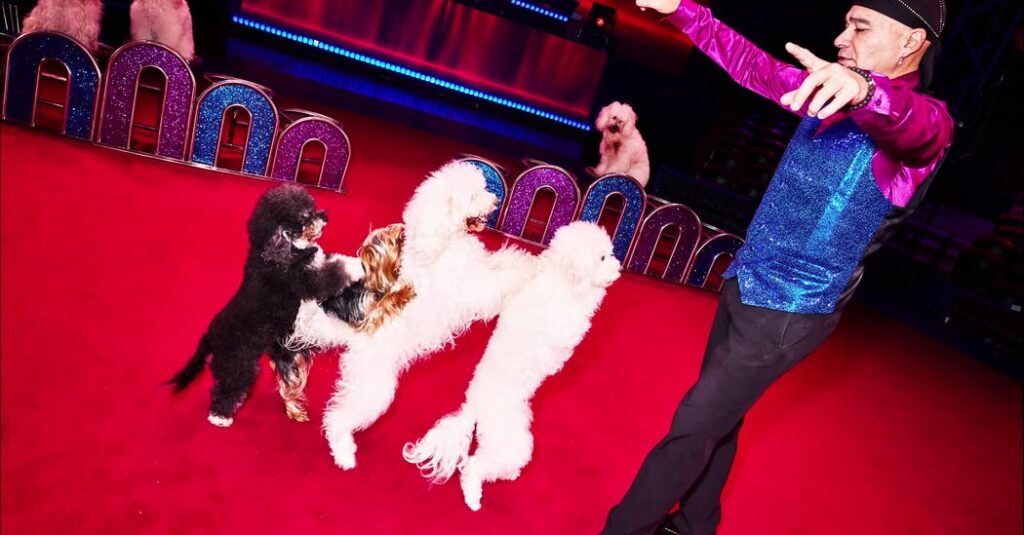
Quiroz, a third-generation Chilean American circus performer, was putting his co-stars through their paces. Inside the otherwise deserted tent of the Big Apple Circus, housed on the southwest corner of Lincoln Center, Quiroz and his assistant, Jirah Whitehouse, dazzling in a rhinestone-bedecked bodysuit, urged a pack of dogs to dance and prance, to leap over or scurry under metal hurdles. Quiroz, snazzy in blue sequins, cued them with commands in Spanish and various hand signals. Between routines, he lay on the big top’s carpeted floor and let the dogs nuzzle him.
Mentored by an uncle, José Olate, Quiroz has been working with dogs since 1998. (A different uncle, Richard Olate, led the Olate dog troupe that won “America’s Got Talent” in 2012.) Quiroz currently travels in a caravan with 14 dogs, including three trainees and four retirees; the seven current performers include Copo, Diana, Suzy, Tomasa, Lana, Riso and Charlotte — poodles, poodle mixes and one Yorkie. Quiroz believes that Poodles aren’t necessarily smarter or more nimble, but they ones he trains are on the smaller side, which makes them easier to travel with and live beside.
These dogs are an international troupe — some Colombian, some Chilean, some American. Two are litter mates, but otherwise they are unrelated. Most of them are females, because females, Quiroz said, are a little easier to train; and while a couple are rescues, Quiroz purchases most of his dogs from breeders, so that he doesn’t have to compensate for the neglect or harm a rescue dog may have experienced. (The Big Apple Circus, which has operated, barring a brief bankruptcy hiatus, since 1977, phased out its exotic animals more than two decade ago. It now only hosts domestic animals.)
Quiroz doesn’t begin training the dogs until they are about a year old. “No, I let them play,” he said. And while the training varies from dog to dog, he estimates that it takes about six months to make each one tent ready. Once a dog is a part of the act, it has a working life of about a decade before downshifting into retirement. How does he know when a dog is ready to retire? “They tell me,” Quiroz said.
The dogs have different abilities and different personalities — a diva, a sweetheart, a lunatic, a star. Each contributes to the act, or as Quiroz likes to say, “All the monkeys work.” Some of the dogs even help to shape the act. The bit when a dog goes down a slide backward? That was a canine improvisation. So is a gag in which a dog pushes down hurdles instead of jumping over them. Over the years, one or two dogs have suffered stage fright, but the rest seem unfazed by the noise and the crowds.
“They are very focused on me,” Quiroz said. “I’m more important than the audience.”
Quiroz is secretive about his training methods. But he did offer a few clues. Patience was key. And consistency. But also flexibility, because not every dog learns the same way. Dogs are smart, but the trainer he said, has to be smarter, to make the training easy and pleasurable. He uses treats at the beginning, but not too many. He wants the dogs to perform for the pleasure of the routines themselves, not for any reward. And besides, these dogs are elite athletes. A dog who has eaten too many treats will struggle to do a backflip.
The dogs perform once or twice each circus day, for about six minutes. Practice is minimal, so much of the day is spent in the caravan with Quiroz and Whitehouse or running around a fenced-in pen outside of it. (On tour in other cities, the dogs have more room to run, but New York City real estate offers less untenanted space.) The rest of the time is taken up with grooming and care — coat, ears, nails, teeth.
Are the dogs happy performing? Quiroz thinks so. During the interview there was some growling and at least one attempt to lick a voice recorder, but otherwise the dogs were beautifully behaved and seemingly cheerful as they rehearsed a conga line, ran atop a wheel, executed backflip after backflip. Throughout, Quiroz spoke gently to them, and was unstinting in his affection. This perhaps was that proprietary secret — more important than any innate athleticism or musculature.
“You need to love them to be able to do this,” he said.
Alexis Soloski has written for The Times since 2006. As a culture reporter, she covers television, theater, movies, podcasts and new media.
The post The Show-Stealing Dogs of the Big Apple Circus appeared first on New York Times.