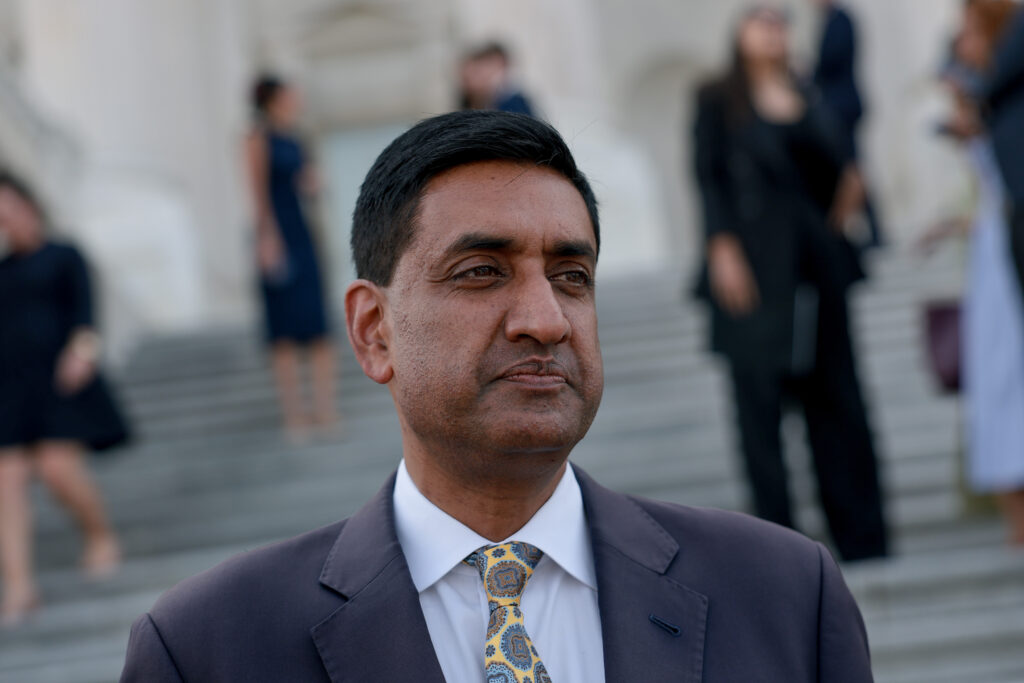
Rep. Ro Khanna (D-California) supports his state’s billionaire tax proposal on the ballot in November. Texas businessman Mark Cuban had a question: What about founders of promising start-ups who are billionaires only on paper?
Khanna’s solution was revealing. Hint: It would create another tool for government control.
On Saturday, Cuban noted on X that California has more and more “deca unicorns” — start-ups with valuations of $10 billion. If a founder owns even 10 percent of such a company, he or she could be considered a billionaire despite not having much wealth aside from the paper value of a yet-unproven firm. It’s not clear how such a person would pay the supposedly one-time 5 percent tax Khanna wants to impose.
Khanna replied to Cuban that the paper-billionaire founders could, essentially, get loans from the government using their companies as collateral. “Allow illiquid founders to pledge shares with a loan from the government to pay tax,” Khanna posted. “At the end of the period, the loan is either paid back in cash, or the government assumes the shares.”
So, Khanna’s plan is for government to … front people money to cover their taxes. That’s a variation of current policy for people of modest means; a significant portion of welfare spending amounts to returning money that households already paid in taxes that same year.
But Khanna wants a revenue treadmill for people he considers rich. The state would lend taxpayers’ money to other taxpayers so they can pay a novel wealth tax back to the state.
The congressman’s proposed security for the wealth-tax loan is meaningless. If a deca unicorn start-up succeeds, its founders will likely have enough cash to pay back the loan. But if the business sputters and the high valuation disappears, the government would then own shares of a failed company.
That means many loans would never be paid back and the government would accumulate stakes in failed companies. It’s socialism without the purported benefit: California would own the means of non-production.
No sensible bank would ever give a loan to a start-up with private shares as the only collateral. It’s too risky. That’s why venture capital and other forms of non-bank lending exist for start-ups — and why most venture investments don’t pan out.
Cuban’s scenario might be uncommon, it’s true. But every payer of California’s proposed billionaire tax would present a rare situation. There are about 200 billionaires in the state. Creating a profile of their wealth and property for tax purposes is not as simple as adding up money in a bank account.
In addition to driving out the rich, wealth taxes are uniquely challenging to administer. That’s why most of the rich countries that have tried the idea have repealed them.
Today’s advocates of wealth taxation have offered a series of bad explanations for how the foreseeable problems would be addressed. Khanna’s is only the latest. If your tax requires the government to start giving out special loans to pay itself, maybe it’s not a good tax in the first place.
The post Mark Cuban bests Ro Khanna on wealth taxes appeared first on Washington Post.