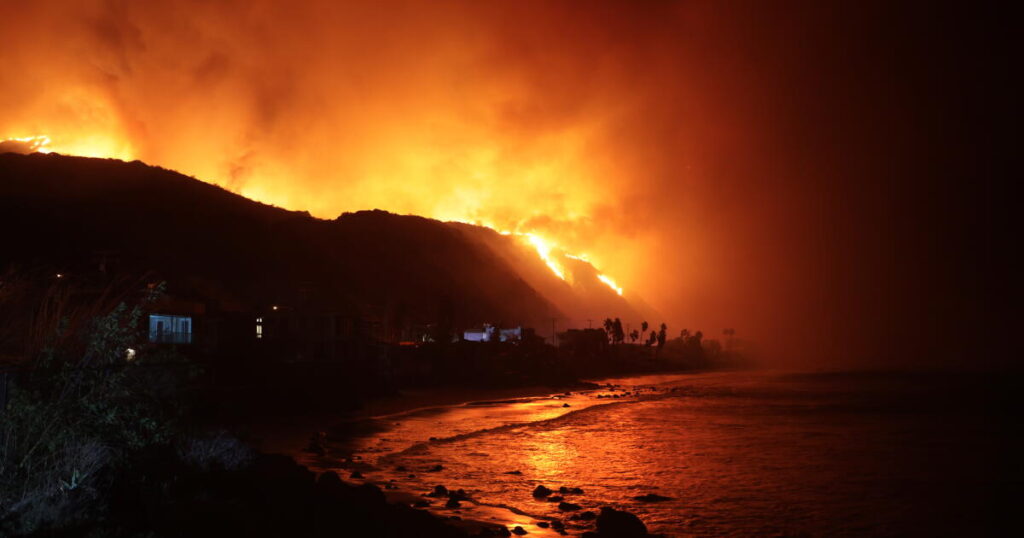
When an investigator asked suspected arsonist Jonathan Rinderknecht why someone might set the blaze that would eventually become the Palisades fire, he surmised it “would be out of resentment of the rich enjoying their money” and compared it to Luigi Mangione’s vigilante assassination of a United Healthcare executive.
I have a follow-up: What did the wild animals displaced, maimed and killed by the fire do to you?
It’s a question nobody on the prosecution seems to be asking. In next month’s highly anticipated retrial, Rinderknecht will face charges of “destruction of property by means of fire and arson” and “arson affecting property used in interstate commerce.” An earlier charge of setting timber afire was jettisoned after his June hearing ended in a mistrial.
In a just world, cruelty to animals would have been included as part of the prosecution from the beginning.
It’s no secret that the area the Palisades fire scorched is home to many human residents, who ran for their lives as walls of flames encircled their neighborhoods. But the Santa Monica Mountains also fall within one of only two “biodiversity hotspots” left in the continental United States. The wildlife in this region is already under constant threat from human encroachment — an existential risk the world’s largest wildlife crossing hopes to mitigate when it opens for nonhuman transit in December. Time is of the essence. Under a business-as-usual scenario, a looming extinction vortex has threatened to wipe out the area’s last remaining mountain lions within 15 years.
Those were the high stakes before Rinderknecht allegedly took it upon himself to ignite a blaze on Hidden Buddha Hill in the early hours of New Year’s Day 2025. Prosecutors say his fascination with fire dates back to at least 2018, when he and his then-girlfriend reportedly took pleasure cruises up the coast to “admire” neighborhoods annihilated by previous megafires.
When the Palisades fire later roared to life, frightened mountain lion cubs were seen scrambling down Topanga Canyon Boulevard in a desperate attempt to flee. Across town in Altadena, disoriented deer sprinted through ash clouds as the Eaton fire decimated the surrounding hillsides — tiny fragments of a much larger picture as some of Southern California’s most prominent wildlife epicenters burned to the ground.
This isn’t the first time members of the public have demanded that arsonists face justice for their crimes against other species.
In 2018, People for the Ethical Treatment of Animals called for convicted arsonist Brian McGlover to face cruelty to animals charges for his role in igniting Riverside County’s Cranston fire, writing that “anyone who deliberately sets fires is signing a death warrant for wild animals, who often have no chance of escape.”
As someone whose century-old cabin has nearly burned to the ground multiple times — most recently in the Eaton fire, which was kept at bay by heroic neighbors and their garden hoses — I’ve seen the consequences of society’s collective indifference to animal suffering firsthand.
In 2020, the Bobcat fire incinerated more than 100,000 acres of Angeles National Forest right behind my house. I vividly recall gazing up at the colossal plumes of smoke rising from behind the ridgeline while live news coverage triumphantly declared that, despite widespread devastation, “no homes have been destroyed” and the blaze had caused “no injuries.”
Those statements were plainly untrue, as countless forest residents, from rabbits and squirrels to coyotes and mountain lions, were killed or maimed in the megafire, and the areas they once called home were reduced to ash. Some animals that managed to escape were seen desperately crawling into adjacent human neighborhoods with bloody, singed paws.
In emergency situations, deer and other large mammals will often try to outrun blazes to reach water, University of Alberta professor Erin Bayne told me, while smaller mammals like mice will attempt to ride out the danger in underground bunkers. One former forest firefighter has spoken about the heartbreak of watching bear cubs instinctively run up a tree in a desperate attempt to avoid harm. Their mother knows better but will often refuse to abandon her kids, causing the whole family to perish.
Those that do make it out of a fire’s path alive often find themselves indefinitely displaced, with none of the geographical landmarks they have come to know. When a forest burns to the ground, vegetation can take up to a dozen years to return to the levels that large mammals need. Their world, as they knew it, is gone.
Conventional thinking has for too long held that only human communities are inhabited places. Once we settle in a given area, it is, by definition, populated. By contrast, the millions of other species we share this planet with have historically been viewed as living brief and transitory lives among pristine and “unpopulated” wilderness.
This antiquated mindset must be revisited — and our conception of “populated” areas expanded — to take the homes and landmarks of other species into account.
Only when viewed through that wider lens does the full scope of an arsonist’s ghastly act come into view — a necessary step toward delivering justice for the victims of their crimes against humanity and the rest of the animal kingdom.
Ryan Huling is the author of “The Hidden Nations of Animals.”
The post Charge wildfire arsonists with cruelty to animals appeared first on Los Angeles Times.