They call it the horizon line, the point on a river where the water disappears over the drop of a rapid and you can’t see what’s coming next. Once you pass it, you’re committed to the force of the water.
I felt that force above Badger Creek Rapid, the first major white water on the Colorado River in the Grand Canyon. The walls of the canyon pinched in and the river sped up, pulling us toward the horizon line. Our boat tipped over the edge, rushing into the waves and then we crashed through the rapids, immersed in the canyon.
I’d been chasing that feeling since I was 18, when I started working as a river guide on cold, clear rivers in Maine, far from the desert depths of the Grand Canyon. For over two decades, I’d held up the Grand Canyon as the ultimate river trip: the longest, the biggest rapids, the most stunning canyon, the start of so many river stories. And now, I was finally getting my chance.
I was on the river last summer tracking down one of those stories for a book about underappreciated female adventurers. I was in search of the tale of Georgie White, who was one of the first people to raft the Grand Canyon and was the only female river guide for decades.
She spearheaded a lot of what we now think of as tourism and adventure travel by being one of the first people to run rubber rafts and motor rigs on the Colorado. She made movies about the canyon enticing visitors. She insisted on new permitting rules protect the landscape and protested dams. She only wore leopard print, was known for wrestling National Park Service rangers and brought more people down the Grand Canyon than anyone because she thought the best way to love the canyon was from the river itself. She never wanted to be anywhere else.
The Colorado runs between two dams, which contain the two biggest U.S. reservoirs. Lake Powell, upstream of the canyon, and Lake Mead, downstream, both now have historically low water levels — less comes in because of drought and too much goes out because of rising demand from ecosystems, municipalities, agriculture and more. On Aug. 15, the water in Lake Powell fell to its lowest level ever, according to the Bureau of Reclamation, the federal agency that manages the reservoirs; earlier in the month, Lake Mead had hit its lowest level ever.
The falling water levels have been worsened by climate change. The Southwest has been getting hotter and drier over the past three decades, research has shown, in a “megadrought” not seen in at least 1,200 years.
The federal policy managing the water expires this year, and states using the water failed to agree on future management. The Bureau of Reclamation stepped in with a plan, including cutting back on the amount of water flowing downstream from Lake Powell.
And if less water flows through it, the canyon and the vast life it contains would be fundamentally changed. The future might look very different on the Colorado. That was part of why it felt important to be out there.
Surprises in the Canyon
In the early days of river running, when Georgie was starting out, there were no maps of the river. Boaters didn’t know when they’d hit white water, or where to find the best camps. Now, you can watch videos of every rapid, or scroll through forums about what to pack or which side hikes to explore. I thought I knew what I was getting into, but from the first drop, I was surprised by how much I hadn’t been able to prepare for the canyon’s immensity.
It turns out that on America’s standout white water river trip, much of the river isn’t white water. The canyon spans 277 river miles and while there are more than 100 significant rapids, some 260 miles are flat water. There’s time to loosen your grip and look around. Over the trip, the Colorado River is less of a roller coaster and more of a conveyor belt, slowly giving up its secrets.
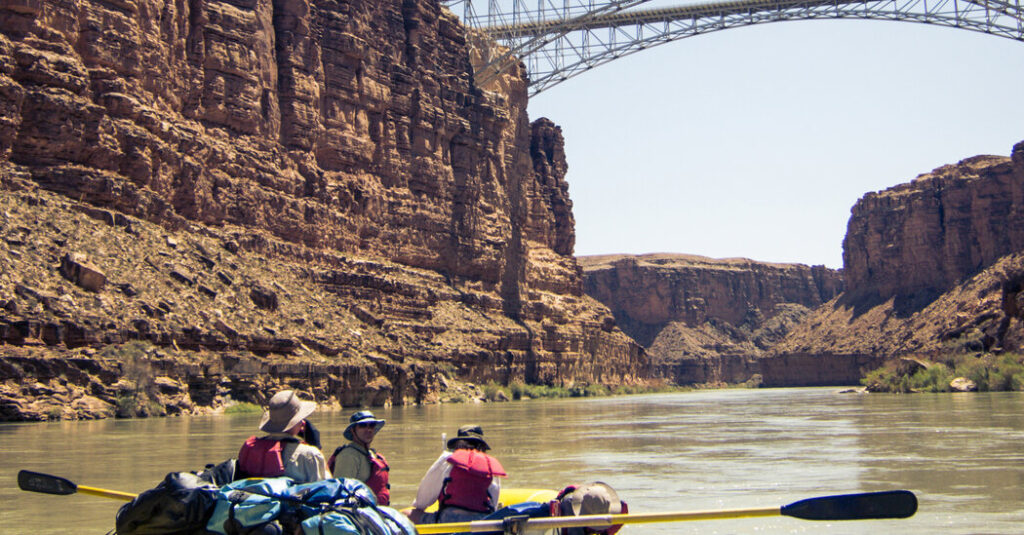
I was on a commercial trip with OARS, one of the longest-standing rafting companies. The guides with us seemed to know every detail. They pointed out endangered condors in the crossbars of Navajo Bridge, the last bit of civilization we would see for 16 days, and they showed us granaries hidden in the cliffs. They pointed to places where the canyon could still be developed and explained the threat of proposed mines. At night in camp, they told us ghost stories and tales of flipped rafts and unlikely adventurers.
On the fourth day, with the afternoon light getting low, we stopped at the confluence between the main Colorado and the Little Colorado River, which runs down from Arizona’s White Mountains. It was a shocking shade of teal, thanks to a high concentration of calcium carbonate, which coats the ruddy rocks and the shoreline with a slippery talc-like layer.
The inflow from the Little Colorado is ecologically significant: The area where the rivers join is home to one of the last viable populations of the endangered humpback chub, a native fish. Crucially, it’s also sacred for 11 Indigenous tribes including the Hopi and Navajo, whose historic homelands include the Little Colorado, and who have been fighting for decades for their right to the river and to their most important religious sites. The Hopi believe life started at a spring near the Little Colorado confluence that they call the Sipapu, and being around the stream felt reverent.
One morning 100 miles in, we pulled the boats over at Shinumo Creek, which seemed like a nondescript side stream. After a few minutes hiking up the creek, we found a clear green waterfall, an oasis entirely unlike the desert river we’d been on. There were monkey flowers and maidenhair ferns growing in the seeps along the grotto walls, and when I dove under the falls, I felt something nibbling my toes. One of the guides told me it was likely some of those tiny fish.
The Canyon holds so much history: Native American origin stories and tales of Spanish conquistadors who said the canyon was unnavigable in 1540. We saw boreholes high up on the canyon walls where the Bureau of Reclamation thought about damming the Colorado in the 1960s before the project was rejected when environmental groups protested. We heard about early river runners at camp.
I could feel the layers of time, and that was without even considering the physical history of the canyon, where the basement rocks deep in the gorge are 1.8 billion years old.
The Final Rapids
The Grand Canyon is both deeply untamed and heavily controlled.
Every day we could feel the river change based on demand upstream at the power plant at the base of Lake Powell. Some mornings the boats floated higher as more water was released to create power, while other days there was more beach. “Guess they’re running the A.C. in Phoenix,” we joked when the water surged.
I realized that what I really wanted to experience was to feel the river changing, the experience of being a part of history, the physical rush and the range of emotions. That’s what Georgie White was trying to show people. She wanted to get them down in the gorge so they could see the changing rock layers, get thrashed by the rapids and hike to ancient ruins. So they’d love it on their own terms.
And I think this is true of any kind of travel. You can’t understand it until you feel it for yourself.
I had that in mind as we approached the last big rapid, Lava Falls. Getting through it takes precision and force. We’d been talking about it the whole trip, and then, we were there. We stopped and scouted the Lava, looking at the move you must make right at the top, the rock you could get pancaked on, the massive hole in the middle of the channel frothing white. Even the rock along the shore felt menacing — a glossy black volcanic intrusion.
Looking at it made the anticipation worse, but eventually we had to go, because you can’t make it through the canyon without making it through Lava, so we got into the rafts and pushed off toward the horizon line.
I rode on the front of the boat, clutching the bowline, choking on my own laughter as we accelerated into the first drop, blinded by a wave of white water. I gasped as the boat pivoted and bucked. When we washed out at the bottom of the rapid, still upright, I felt a rush of adrenaline and relief, knowing exactly what it felt like to be there on the river.
Follow New York Times Travel on Instagram and sign up for our Travel Dispatch newsletter to get expert tips on traveling smarter and inspiration for your next vacation. Dreaming up a future getaway or just armchair traveling? Check out our 52 Places to Go in 2026.
The post Rafting a River in Flux Through the Grand Canyon appeared first on New York Times.