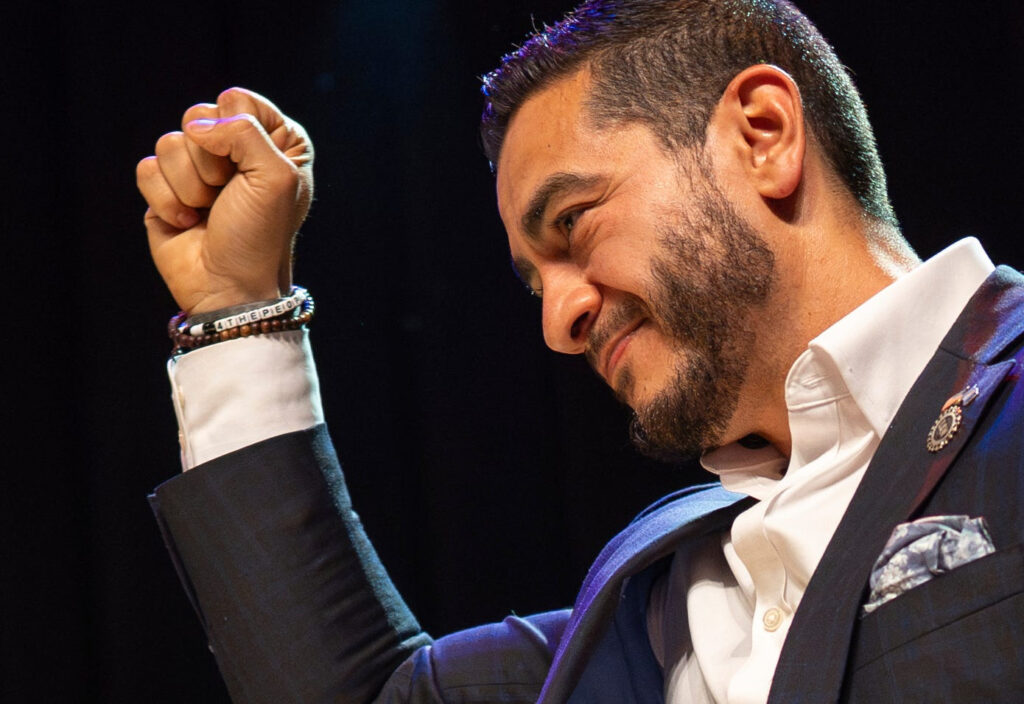
Abdul El-Sayed’s victory in Michigan’s Democratic primary has complicated Senate Minority Leader Chuck Schumer’s plans to help Democrats retake the Senate in the November, tying his party’s fortunes to a candidate some Democrats in Michigan say they cannot support — even if it means costing Democrats the Senate majority.
Michigan is crucial for Democrats. The party’s path to a Senate majority relies on holding the state and all of its other current seats, as well as flipping four Republican-held seats — including at least two seats in states that Donald Trump won by double-digit margins in 2024. If El-Sayed loses in Michigan, which Trump carried by less than two points in 2024, Democrats would need to flip a fifth Republican seat in deep-red territory.
Schumer backed Rep. Haley Stevens over El-Sayed in the primary, saying he thought she had a better chance of winning in November. The New York Democrat endorsed El-Sayed after the primary and the two men have spoken about working together to hold the seat — but they have pronounced differences about Israel.
Schumer, the first Jewish Senate leader, has spoken out against rising antisemitism in both parties. He is a longtime ally of Israel, even as he has castigated Israeli Prime Minister Benjamin Netanyahu.
El-Sayed has said he is as committed to Jewish safety as he is to the safety of his daughters. But his blistering criticism of Israel during the primary alarmed many Jewish voters in Michigan, who say he has not done enough to denounce antisemitism.
El-Sayed’s challenges run deep enough that three Democratic donors in Michigan are hosting a fundraiser for his Republican opponent, former congressman Mike Rogers, on Tuesday evening, according to an invitation obtained by The Washington Post. One of them, Brian Hermelin, wrote in an email to potential donors last week that El-Sayed’s rhetoric on Israel and toward Jews meant he could not support him.
“A party has to understand that there are consequences when it moves away from the values that brought us to it,” Hermelin wrote. “For me, this Senate race is that point.”
In an interview, Schumer acknowledged he disagreed with El-Sayed on Israel and other issues but said they would work together to win in Michigan. He did not answer directly when asked whether he viewed anything El-Sayed has said or done as antisemitic.
“I think he makes an effort to fight antisemitism even though his views on Israel are much different than mine,” Schumer said.
Some Jewish voters in Michigan are not convinced.
“How can a leader like Schumer not even talk about concerns that he has?” Asher Lopatin, a rabbi in suburban Detroit who said he typically votes Democratic, said in an interview. “It’s been very disappointing, to say the very least. I think it’s been infuriating for Jews here.”
Other Jewish voters in Michigan support El-Sayed or remain open to voting for him. But losing even some of the state’s Jewish voters could endanger Democrats’ hold on the seat in a close race. Jewish voters represent about 1.4 percent of the electorate in Michigan, according to Brandeis University’s American Jewish Population Project. Sen. Elissa Slotkin (D-Michigan) won her race in 2024 by less than 0.4 percentage points.
The race has put Schumer in a tough position. On one hand, he has called out those on the left who are “too complacent or forgiving about those who exhibit antisemitism within their ranks.” On the other, he often describes Democrats as having a big-tent party, capacious enough to include Sen. John Fetterman (D-Pennsylvania) — an ardent defender of Israel — as well as the country’s critics.
El-Sayed’s public criticism of Schumer — whom he suggested during the primary that he did not want to see remain as the Democratic leader in the Senate — has not made it easier. “If you’re Chuck Schumer, I’m pretty damn dangerous,” El-Sayed said last month.
El-Sayed’s campaign declined an interview request.
“Though Senator Schumer and I may have deep disagreement on a number of important issues, we both understand how critical it is to win Michigan and defeat Mike Rogers,” El-Sayed said in a statement to The Post. “I appreciate his pragmatism.”
A crucial Senate race
Michigan is not the only primary that has not gone Schumer’s way. Maine Gov. Janet Mills, whom Schumer recruited to challenge Sen. Susan Collins (R), suspended her campaign before the primary, ceding the nomination to Graham Platner, an oysterman and Marine Corps veteran who criticized Schumer.
Platner’s campaign imploded last month after he was accused of sexual assault; he has denied the allegations. Democrats replaced Platner on the ballot with Troy Jackson, a former state Senate president. Like Platner, Jackson has criticized Schumer, telling the New York Times that he would not support him as the Senate Democratic leader.
But Schumer has embraced Jackson, describing him as “a much stronger candidate” than Platner.
“There are so many negative issues against Collins, she’s always going to try to change the subject, and with Platner she had ample opportunities to change the subject,” Schumer said in the interview. “She’s going to have a rough time attacking Jackson.”
Two polls conducted since Platner dropped out have found Jackson with narrow leads over Collins.
Blake Kernen, a Collins campaign spokeswoman, said in a statement that Collins “is not all-consumed with ‘attacking’ her opponent” and is focused on contrasting her record in office to Jackson’s.
Schumer’s other recruits have fared better.
Former governor Roy Cooper is leading in polls in the race for an open Republican-held seat in North Carolina. Two other Schumer recruits — former senator Sherrod Brown in Ohio and former congresswoman Mary Peltola in Alaska — have helped make those Republican-leaning states into battlegrounds. And Democrats are running competitively in two other red states, Iowa and Texas.
“Leader Schumer has put Democrats in a very strong position to take back the Senate,” Sen. Sheldon Whitehouse (D-Rhode Island) said in a statement. “This map was unthinkable a year ago.”
But Michigan — where Democratic Sen. Gary Peters is not running for reelection — has emerged as a potential problem for Democrats. The state has not elected a Republican senator in more than three decades — but a Fox News poll of registered voters conducted after the primary found Rogers leading El-Sayed 51 percent to 47 percent. Ten percent of Democrats they were “extremely concerned” that El-Sayed, a progressive endorsed by Sen. Bernie Sanders (I-Vermont), holds positions that are too extreme, and 8 percent said they planned to vote for Rogers.
El-Sayed’s victory over Stevens has given Republicans renewed confidence that they will hold the Senate majority, even as Trump’s approval rating languishes and gas prices remain high.
“If Republicans flip Michigan, it is nearly statistically impossible for Schumer to recapture the majority,” Alex Latcham, who runs Senate Leadership Fund, the flagship Republican super PAC in Senate races, said in an interview.
Schumer said he was confident El-Sayed would win, citing the enthusiasm of his supporters. Still, Schumer and J.B. Poersch, the president of Senate Majority PAC, the lead Democratic super PAC in Senate races, both disputed that Democrats had no shot at retaking the majority without Michigan.
“A path to winning back the Senate clearly goes through Michigan, but we have a whole bunch of different paths,” Schumer said.
A backlash in Michigan
Few Democrats have spoken out more forcefully against antisemitism than Schumer, who published a book last year, “Antisemitism in America: A Warning.” Witnessing growing antisemitism on the left in the wake of the Oct. 7, 2023, attack on Israel and the war in Gaza, Schumer wrote, has been “extremely painful.”
The politics of Israel have shifted rapidly among Democrats since 2023, and El-Sayed’s calls for ending unconditional military aid to Israel and other countries are popular. Fifty-five percent of Michigan voters support cutting off military aid to Israel and 44 percent oppose it, according to the Fox News poll.
In interviews, though, Jewish voters in Michigan said their concerns were rooted in how El-Sayed talked about Judaism and Israel. El-Sayed has not directly said whether he believes Israel has the right to exist, though he said on CNN after the primary that he believes “in equal rights to peace, dignity and self-determination for Jewish Israelis and Palestinians alike.”
Jewish Democrats also criticized El-Sayed for campaigning with Hasan Piker, a streamer who has said that Hamas, the Palestinian militant group responsible for the Oct. 7 attack, is “a thousand times better” than Israel. And they questioned his response to the March assault on Temple Israel in the Detroit suburbs.
El-Sayed condemned the attack on Temple Israel at the time, saying “antisemitism has no place in our communities.” But he also pointed out that members of the attacker’s family had been killed in a recent Israeli airstrike in Lebanon. “Hurt people hurt people,” El-Sayed said in March — which some Jewish voters saw as justifying the assault on the synagogue.
Hannan Lis, one of the Democratic donors who is hosting the fundraiser for Rogers, said those comments made it impossible for him to support El-Sayed.
“I don’t think the Democratic Party should seek to gain a majority in the Senate with people like Abdul,” Lis said.
Some Jewish voters in Michigan are supporting El-Sayed, including Andy Levin, a former Democratic congressman who has been working to help shore up El-Sayed’s support with the Jewish community.
“Like me, he hates the Netanyahu government, thinks it’s a disaster, thinks it’s committed genocide, thinks it’s just doing such bad things in Lebanon and so forth,” Levin said of El-Sayed. “But I think he can communicate that he thinks both the Jewish people and the Palestinian people deserve self-determination.”
El-Sayed has spoken with at least some Jewish voters since the primary. He sat down with a small group last week in Detroit, according to Jessica “Decky” Alexander, the chair of the Michigan Democratic Jewish Caucus, who said she left the meeting “in between hopeless and hopeful.”
Peters, who endorsed Stevens but is now backing El-Sayed, said he heard from a lot of Jewish Democrats after the primary — but he predicted El-Sayed would prevail in a state where Trump is unpopular.
“We’re going to have a good Democratic year,” Peters said. ”There’s going to be a tailwind. And I’m confident Abdul will be able to catch the wind and run a strong campaign.”
The post Backlash in Michigan complicates Democrats’ road to retaking the Senate appeared first on Washington Post.