Hydrogen, viewed by its advocates as a clean fuel and a solution to climate change, is having a “non moment,” but don’t ask anyone in the industry to say that on the record.
Years of market turmoil, federal funding cuts, canceled projects and industry pullback have made it clear: California’s grand vision for fleets of vehicles and heavy industry running on clean hydrogen fuel has stalled.
Yet at a recent gathering in Sacramento, those in the nascent industry continued to tout the potential of a fuel they hope will turn around and thrive. Practically no one wanted to be quoted on the bleak outlook.
“It’s tough,” said Andrew Carman, a hydrogen dealmaker at the conference who said there just aren’t enough buyers to justify much new fuel production.
Hydrogen is an alternative to gasoline, diesel fuel and natural gas that’s part of California’s climate strategy because it doesn’t produce greenhouse gas emissions when used. It can be made cleanly by cleaving the hydrogen out of water using clean electricity.
But that’s not what usually happens. Some 95% of hydrogen used today is made from natural gas. That’s because freeing hydrogen from its bond with oxygen in water requires an extraordinary amount of energy — and expensive equipment — making it cost prohibitive.
Former Gov. Arnold Schwarzenegger drove a Hummer powered by hydrogen, putting the fuel on the state’s map in 2004 with his vision of a 200-station “hydrogen highway.” But as electric cars dropped in price and gained popularity, the highway has more or less been left for dead.
“There was a race between batteries and hydrogen, and batteries won,” said Bill Magavern, policy director at the Coalition for Clean Air.
There are some 14,000 hydrogen cars registered in California, and that number declined for the first time last year. There are eight fewer hydrogen fueling stations now than in 2023 too — a total of 57, according to the California Energy Commission. And about a third are out of order.
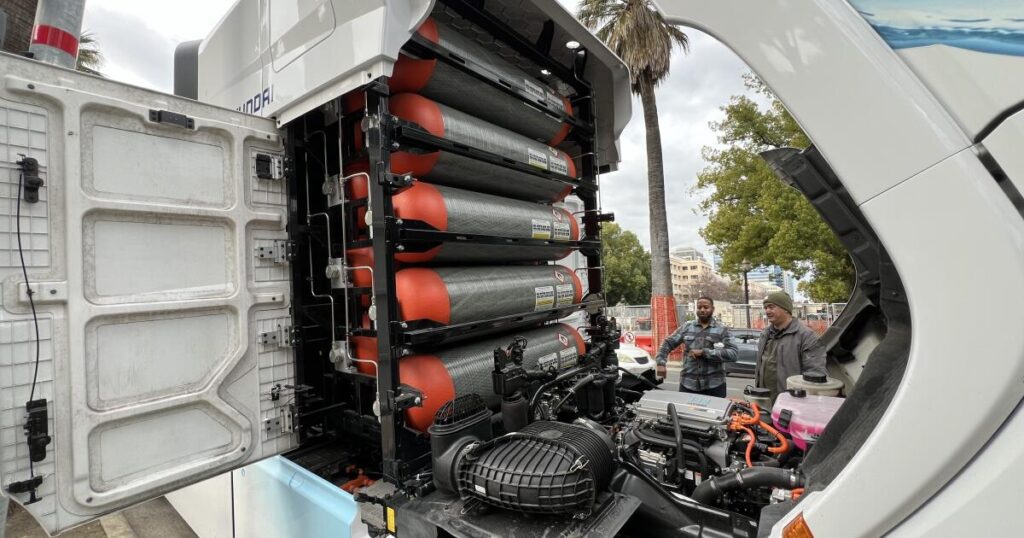
In recent years, the state has pivoted toward hydrogen for buses, trucks and port equipment, but these too have struggled to get off the ground.
Carman said there are 400 or so hydrogen buses and trucks on the roads, and he has faith in new, smaller production plants and stations eventually opening to serve them. He recently brokered a deal for a maker of water treatment chemicals in Pittsburg, Calif., to sell hydrogen, one of its byproducts, to transit agencies.
But the state’s dream of a vast network of green fuel production sites and pipelines serving thousands of hydrogen-powered vehicles across California is a harder sell.
“How do you get to that next scale?” asked Carman, who runs PACC Services. “That’s not an easy problem to solve.”
Many environmental groups have long been skeptical even of the 1% of hydrogen that is produced cleanly — called green hydrogen. They contend the costs and energy demands of producing and distributing it make it inferior to batteries in almost every case.
President Trump pulled the rug out from under ARCHES — a public-private partnership to create a green hydrogen economy in the state — when he canceled up to $2.2 billion in grants for West Coast hydrogen hubs in a politically motivated decision now being challenged in court. He also cut short tax credits meant to bolster the industry.
But even before that, projects to make zero and low-carbon hydrogen were being canceled across the country as they struggled to bring down costs. “California’s hydrogen hype was already fading,” one analysis from BloombergNEF said, calling the West Coast industry “already dead.”
In California, hydrogen costs four times more per mile than gasoline, even with the latest increases in U.S. fuel prices, said Matthew Hodgkinson, an analyst at S&P Global Energy.
There were about 20 times more EV trucks and buses on the road than hydrogen ones at the end of last year. And there are just four public filling stations and 10 private ones at transit agencies to serve them, according to the California Energy Commission.
With a couple of exceptions, vehicle manufacturers, fleet owners and transit agencies are hesitant to invest in hydrogen products when they don’t know whether the fuel and filling stations will be there.
The state is reluctant to fill the void left by federal funding after a series of bankruptcies and cancellations left only one truck maker and one bus maker selling hydrogen vehicles in North America.
“It’s a bit of a chicken and an egg thing,” state Transportation Secretary Toks Omishakin said. “Are we going to be building a bunch of stations when there are no vehicles?”
Meanwhile, stations cost millions to build and owners have trouble getting reliable fuel deliveries. The network has still not recovered from a deadly hydrogen trailer explosion in Colton in February that knocked out over half of its supply.
Industry is feeling the fuel squeeze.
“These very expensive and very attractive pieces of equipment are not operating,” said Michael Galvin, who oversees the Port of Los Angeles’ energy business, as he showed photos of state-of-the-art cargo-handling gear sitting idle for lack of fuel.
“I would not recommend going deeply into hydrogen today,” said Derek Toups, deputy planning director of a small transit agency in Santa Cruz, when asked directly on a panel. With its 20 hydrogen buses on the roads, Santa Cruz Metro is committed to the technology, he said, but the funding landscape has changed drastically. “It makes sense to watch and learn before diving in because it is extremely costly.”
California gets most of its hydrogen for transportation from facilities in Las Vegas and Ontario that make it out of natural gas. Just one very small producer in Fresno makes it with electricity.
A slightly larger green hydrogen producer in Vernon will begin serving 10 trucks and buses a day at the end of the month, with plans to ramp up to 100, according to its founder, Vishal Shah.
But most of the production plants originally envisioned under ARCHES “have been canceled, or just indefinitely delayed. Same thing, really,” said Alfredo Arredondo, a lobbyist for the Green Hydrogen Coalition, who noted a lack of customers as the problem.
Producers are hanging their hopes on utilities, which just got permission to count green hydrogen they burn toward renewable energy targets.
The Los Angeles Department of Water and Power scored a victory for its plans to convert its Scattergood Generating Station in Playa del Rey to run on a hydrogen-natural gas blend this month when the L.A. City Council reaffirmed the plan despite opposition from environmental groups.
The groups, including Sierra Club and LA Waterkeeper, contend that the city utility ignored how much water it takes to make clean hydrogen, the nitrogen oxide pollution from burning the gas, and the fact that it isn’t available. Several have sued over the project.
They also celebrated recently when Southern California Gas Co. shelved long-held plans for a hydrogen pipeline system after an unfavorable ruling from the state’s utility regulator.
“Green hydrogen requires huge quantities of dedicated renewable energy to create,” read a statement from the Sierra Club. “That same energy could be used much more efficiently by directly replacing fossil fuels in end uses.”
SoCalGas suggested the vote was a loss for the state.
“We continue to believe that hydrogen, including clean renewable hydrogen, can help advance California’s energy and climate goals while supporting the long-term affordability, safety, and reliability of energy services for customers,” spokesperson Raul Gordillo said.
The post Hydrogen failed as car fuel. Now California’s big dollar bet on it for green energy is fading, too appeared first on Los Angeles Times.