Destination Crenshaw has taken so long that neighbors have their own name for it: Procrastination Crenshaw.
Pitched in 2016 and started in 2021, the $100-million beautification project was meant to transform 1.3 miles of the Crenshaw Corridor into an open-air museum filled with art and gathering spaces — a celebration of Crenshaw’s role as a hub of Black L.A., home to defining figures such as Tom Bradley and Nipsey Hussle and cultural institutions such as the Museum of African American Art and Dulan’s on Crenshaw.
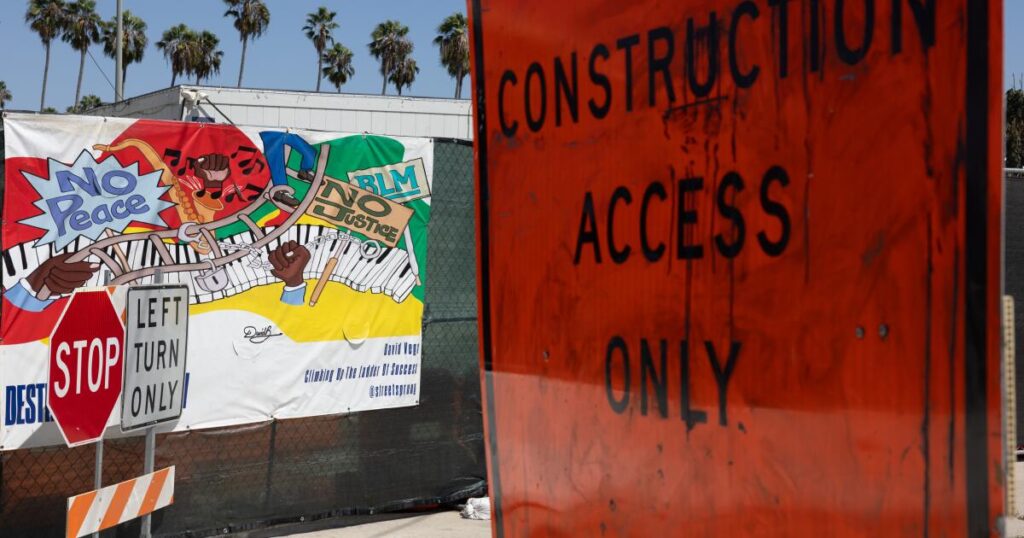
Instead, over the last five years, it has turned the historic stretch of Crenshaw Boulevard into a nuisance, a ghost-town construction site with vandalized fences and barricades sitting for years on end.
Parking doesn’t exist, so cars cram onto the sidewalk. Construction equipment and safety barriers litter the block. The street has become such a maze that it’s unclear what’s even there, resulting in a series of “Businesses Open” signs assuring the public that something still exists inside the chain-link exoskeleton.
“People feel like they’re imprisoned in their own neighborhood,” said Kyron Shorter, senior pastor at Bethesda Temple Church.
Crenshaw residents say construction in many areas lasted only for a few months before funding ran out, leaving the neighborhood in disarray. For years, they questioned city leaders but didn’t receive answers. In July, their frustrations boiled over in a packed town hall meeting at Shorter’s church.
“It was heart-wrenching,” said Tavis Smiley, the veteran talk show host who broadcasts KBLA-AM (1580) from Crenshaw. “This project is years behind schedule, and the entire community is suffering because of it.”
But it appears the meeting made a difference. Smiley said he spoke to Mayor Karen Bass multiple times in the wake of the town hall, and on Monday, city crews showed up to clean up fencing along the corridor. The next day, Bass joined Smiley to walk around the site and discuss the project.
“The work has started,” Smiley said, adding that this is what happens when a community comes together to make its voice heard. “Blockades and gates are coming down.”
Many parking spots have already been restored, and Smiley said that Bass promised parking enforcement would be suspended during the cleanup process to give residents more flexibility.
Paige Sterling, a spokesperson for Bass, said the city is removing fencing and barriers, as well as conducting weed abatement, road repairs, sidewalk improvements, street lighting restoration and implementing traffic control in specific spots that impact businesses and residents.
“As work moves forward on Destination Crenshaw, Mayor Bass is committed to honoring the needs of businesses and community members and ensuring that any issues are quickly resolved,” Sterling said, adding that leaders from the Transportation Department and Bureaus of Street Lighting, Contract Administration, Engineering and Street Services all visited the site.
Bass’ office did not provide information on an estimated timeline for the project’s completion, or reasons why the project has stalled to this point. City Council President Marqueece Harris-Dawson, who spearheaded the project, did not respond to a request for comment. Neither did the Destination Crenshaw team.
Smiley said he hasn’t heard from Harris-Dawson’s office or the Destination Crenshaw team. Bass told him some of the work isn’t under the city’s purview, and Destination Crenshaw, a separate entity from the city, will need to handle some of the cleanup work.
For some locals, it’s the first sign in years that progress is being made. But others are still dubious that the city will fulfill its promises — or that the project itself will ever be finished.
“This is a PR cleanup situation. This is the mayor understanding that businesses are suffering as a result of lack of access,” Shorter said. “These are all good things: cleaning trash, picking up gates. But we’re still left with more questions than answers.”
Shorter, and others, have several questions. Why did it take so long to address the situation? Can resources be applied to get the original vision back on board? Is there really a plan?
So far, the only work has been to clean up equipment, but there’s still construction that needs to be done to finish the project, including parks, landscaping and art installations. Will those projects resume? And if so, will all the barricades return? If so, locals worry the back-and-forth could stretch the project’s timeline even further.
Shorter said the Destination Crenshaw team tore up the streets in front of his church in 2023, which removed parking for his parishioners. He expected the construction to be temporary, but three months in, work stopped. Three years later, he’s still missing parking spots.
“We were promised Black jobs, Black dollars and an economic boost to Crenshaw, but businesses have been crippled one by one,” Shorter said. “This would never happen in Santa Monica or other parts of L.A.”
He said people don’t feel safe among the maze of construction. He fears it could lead to long-term impact.
“People aren’t able to enjoy the beauty of Crenshaw right now, and my grave concern is people won’t come back,” Shorter said. “When people get accustomed to not having access to a community, they make adjustments.”
Resident O’Lita Schafer bought a house in Crenshaw in 2024 on the promise that the neighborhood would be newly transformed. For the last two years, her street has been barricaded. City workers came to clean up the fencing this week, and it was the first time she’s seen a single step taken on the project.
“It’s by no means looking better, but at least there’s movement,” she said.
Schafer’s stuck in limbo. Her home’s foundation needs to be retrofitted to keep it from shifting, but a foundation company told her that they can’t do the work because they wouldn’t be able to bring a concrete truck onto her street due to fencing.
She was also contacted by a film location company who said her house could be a candidate for film shoots, but when they showed up to photograph the property, they said the nearby construction disqualified it.
After years of no progress and no communication, Crenshaw locals are relieved that the city is paying attention. But they want more than attention.
In a letter to Council President Harris-Dawson, the Crenshaw Corridor Business District demanded answers, as well as a request for a business and resident relief fund for those impacted by the prolonged construction and delays. Smiley said they haven’t heard back yet.
“The community rallied to its own defense, which brings me joy,” Smiley said. “But this is just the first step in a long journey of keeping the city accountable.”
The post After local outcry, stalled Destination Crenshaw project sees movement appeared first on Los Angeles Times.