Carlos Garcia, a New York activist and organizer known as Chino, whose fight to save the thriving community center that he co-founded was emblematic of a larger struggle against the gentrification of New York City, died on July 24 at his home in Manhattan. He was 80.
His death, from a heart attack, was announced by Village Preservation, a historic preservation group in Greenwich Village.
Born in Puerto Rico, Mr. Garcia was a high-school dropout and former teenage gang leader who was illiterate until he was nearly 20. But he reinvented himself as a pioneer of self-starting urban reclamation, a grass-roots movement that seeks to transform derelict city spaces. He and a group of fellow Puerto Ricans formed an organization that they called Charas — an acronym derived from the first letters of their names — and began rehabilitating a desolate slice of New York City with sweat equity, volunteer labor and minimal resources.
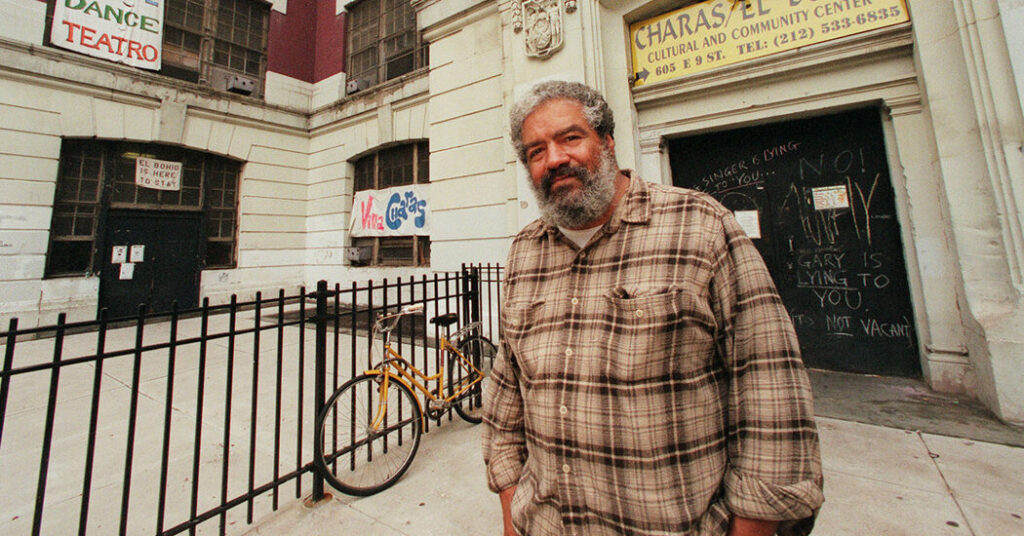
P.S. 64 was the most prominent of the decrepit Lower East Side buildings that Mr. Garcia helped bring back to life, with little help from city officials.
In 1979, the group transformed the abandoned 1906 building, the former Public School 64 on East Ninth Street in the East Village, into the Charas/El Bohio Community Center, a meeting place, art gallery, performance center and rehearsal space for aspiring drama groups. The venue hosted dozens of theatrical performances, concerts and exhibitions. Ensembles that achieved national prominence, including Bread and Puppet Theater and El Teatro Campesino, used the space early on.
Ronald Shiffman, a founder of the Pratt Center for Community and Environmental Development, said in an email message to colleagues last week that Mr. Garcia was “one of the principal architects of the Lower East Side’s extraordinary transformation from a neighborhood marked by abandonment into one celebrated for its resilience, creativity and community power.”
But Mr. Garcia’s adventure with P.S. 64 ended in disappointment. In 1998, the building was sold in a public auction by the administration of former Mayor Rudolph W. Giuliani. (At one point during the chaotic event, demonstrators hoping to stop the sale released 10,000 crickets into the auditorium.) Gregg L. Singer, a developer, bought it for $3.15 million, and three years later, despite impassioned protests and court appeals, the Charas center was evicted from the building. The police showed up in riot gear to remove some of the occupants.
“It was a battle and we lost it, but it wasn’t because we did anything wrong,” Mr. Garcia told the New York Preservation Archive Project in 2017. “I think we did everything right. Everything human and right for human beings.”
Two decades later, P.S. 64 remains vacant. Mr. Singer’s redevelopment plans never came to fruition, and the building was reportedly sold to an investor in 2023.
Mr. Garcia’s journey from a leader of a gang known as the Assassins to a passionate community activist told a larger story about New York and its Puerto Rican community.
The Assassins “dominated” Chelsea in the 1950s, Syeus Mottel wrote in his 1973 book, “Charas: The Improbable Dome Builders,” adding that Mr. Garcia was the “‘warlord’ responsible for arbitrating or organizing the endless number of rumbles with the Sportsmen gang and others.”
But by the late 1960s, Mr. Garcia had moved on from gang life.
“That same energy, we decided to start using it for social issues and humane issues,” he said in 2017. “Our concern was about our community, and it was the physical abuse that was going against us.”
The month before Mr. Garcia died, Village Preservation honored him with an award for his contributions to the East Village.
Fellow Lower East Side activists credited him with bringing new life to the area, noting that he had an exceptional ability to motivate and mobilize young people. “He was a magnificent community leader and community member,” Valerio Orselli, a housing activist and former executive director of the Cooper Square Mutual Housing Association, said in an interview.
Carlos Garcia was born on May 27, 1946, in Rio Piedras, Puerto Rico, one of several children of Carlos Luis Garcia, a construction worker who became a waiter after the family moved to New York in 1951, and Antonia (Fuentes) Garcia, a garment worker who was active in the International Ladies’ Garment Workers’ Union.
He attended Public School 3 in the Bronx and Public School 188 after the family moved to the Lower East Side. As a boy, he shined shoes at the old Pennsylvania Station, he recalled, and worked for his mother’s union.
And then “I joined a gang, a youth gang, mainly because we had problems with other nationalities and races,” Mr. Garcia said in 2017. “We had to confront those people.”
In 1964, he moved back to Puerto Rico briefly to “remove himself from the streets of New York for a year,” Mr. Mottel wrote, at the “suggestion” of the New York City Police Department.
On his return, Mr. Garcia reconnected with his old friends from the gang to form a community aid group. They called it the Real Great Society because “they wanted to fight the real enemies: poverty, poor housing, lack of education, alienation and the inadequacy of work skills,” Mr. Mottel wrote.
They learned how to apply for grants, and received a few, and the group was chartered as a nonprofit by the state. In 1967, using the skills they had acquired while working as house painters, electricians and plumbers, they opened storefront schools in East Harlem and on the Lower East Side, teaching basic reading and math to young people in those neighborhoods.
In 1968, the group discovered the work of the eccentric architect and inventor R. Buckminster Fuller and set about building his patented geodesic domes — a quick and inexpensive way to create affordable meeting spaces or housing — on vacant lots on the Lower East Side, an experience that The Times documented in 1972.
But the group could see that building new structures wasn’t the only way forward. At the time, the strapped city government was shedding real estate, and abandoned structures dotted the cityscape. Charas’s idea was to take over “city-owned buildings and begin to fix them,” Mr. Garcia told the New York Preservation Archive Project. “Hopefully the city would cooperate with that, but we moved into buildings — we squatted in buildings even without their permission, because when you did ask them for permission, they gave you the runaround.”
P.S. 64, which had been occupied by drug addicts and dealers, and stripped of its doors and copper wiring, became the group’s most ambitious undertaking. The rehabilitation effort, aided by young carpenters, plumbers and electricians participating in Adopt-a-Building, a local community program, was so successful that Charas was soon granted a lease.
Mr. Garcia never married. He is survived by his daughter, Taina Jester, and two grandchildren.
With P.S. 64, Mr. Garcia and Charas “turned something that was empty and ugly and dangerous into a vibrant community center,” Francisco Gonzalez, a fellow activist who became a real estate agent, said in an interview. “He was just a grand leader that had a vision that the neighborhood could be so much more.”
The post Carlos Garcia, Activist Who Helped Revive the Lower East Side, Dies at 80 appeared first on New York Times.