About 1,000 miles south of Hawaii, the first signs of El Niño have come to Kiribati, an island nation in the central Pacific Ocean.
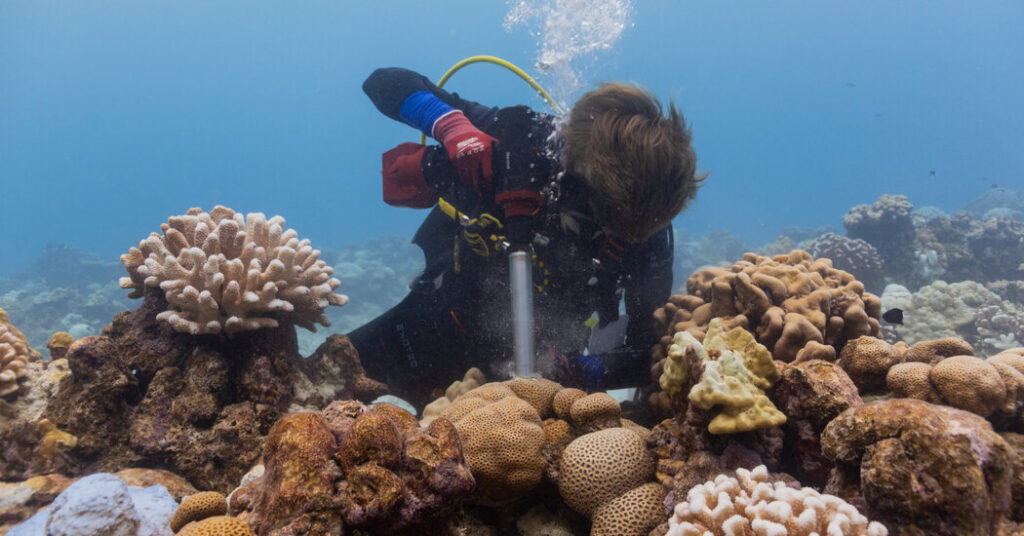
Alyssa Atwood, an associate professor in the Earth, ocean and atmospheric science department at Florida State University, is there now, deploying sensors to monitor ocean heat and salinity, and to track the bleaching of the area’s magnificent coral reefs.
Already, around Christmas Island, one of this nation’s 33 atolls and islands, the ocean surface temperature is 2 degrees Celsius, or 3.6 degrees Fahrenheit, warmer than usual for this time of year, compared with the previous 30 years. And as much as 10 percent of the corals appeared bleached in a series of dives over the past few days, Atwood said.
Bleaching occurs when corals become so stressed that they lose the symbiotic algae they need to survive. Bleached corals can recover, but if the surrounding water stays too hot for too long, they die.
“We expect this to get worse and worse and worse until the end of this year,” she said. “This is just the tip of the iceberg.”
That’s because the El Niño event that’s underway is expected to be one of the strongest ever recorded, and it has not yet peaked.
El Niño is a naturally occurring surge of heat in the Pacific Ocean that usually reaches maximum intensity between December and February. It happens every two to seven years, and it typically spikes global temperatures and scrambles weather patterns around the world.
This year’s event is already strong and having big effects, nudging up global temperatures and causing dry spells and crop failures on multiple continents, my colleagues Raymond Zhong and Chico Harlan wrote in an article this week.
What we know and what we don’t
While scientists expect this to be a very strong El Niño, it’s still not entirely clear whether man-made global warming is intensifying the phenomenon.
The El Niños of the past few decades have been comparably strong, Ray and Chico wrote. But the variables that combine to create an El Niño are complex, and some experts argue that the recent trend could just be a random signal.
What is clear is that El Niño’s burst of heat, boosted by climate change or not, is arriving at a moment when global temperatures are already at record highs.
As Eric Niiler wrote in a separate article this year, the past 11 years have been the hottest since record-keeping began. Last year was either the second or third hottest on record, depending on which record is used, he reported, with global average temperatures 1.43 degrees Celsius higher than preindustrial levels. The year 2024 was the hottest, at 1.55 degrees Celsius above the preindustrial average.
All that heat has led to more intense storms, floods, fires and droughts. All of which could become even more intense in the months ahead.
El Niño will magnify those conditions in some regions and could lift global temperatures to record levels next year, as the heat from the Pacific spreads around the world, Ray and Chico wrote.
Atwood said she hoped the data she was gathering in Kiribati could help scientists understand how man-made global warming is affecting El Niños.
“We don’t know what the human fingerprint is on these systems, which is why we have to be out here actually measuring these things in real time, documenting them as much as possible,” she said. “Because these things are happening now on top of background warming in the climate system.”
What we’re seeing around the world
In Kiribati, El Niño appears to be taking a toll already. Christmas Island, usually very dry this time of year, has been battered by heavy rainfall in recent weeks. During the last very strong El Niño, from 2015 to 2016, heavy rains in the country led to an uptick in mosquito-borne illnesses, including dengue fever and chikungunya virus.
And back then, more than 90 percent of the coral reef around Christmas Island was bleached. The good news, Atwood said, is that much of that coral has recovered over the past decade.
In Panama, normally one of the wettest countries on Earth, some areas haven’t had a major storm since early May. Ethiopia’s fertile highlands are enduring one of their driest summer stretches in four decades. And India had its fifth-driest June since the country’s modern rain records began in 1901.
“It affects weather all around the globe,” Atwood said. “And the bigger the event, the more pronounced those effects get.”
In the coming months, we’ll bring you regular updates about how this event is reshaping the globe and what the science tells us about the climate connection. So stay tuned.
Trump administration kills a flagship Arctic report
The Trump administration has pulled federal funding for an annual report on the changing environment of the Arctic, where rapid warming is upending ecosystems, reconfiguring trade routes and scrambling geopolitics.
The assessment, known as the Arctic Report Card, drew on the expertise of hundreds of scientists and other specialists around the world. Every year for the past two decades, it provided a checkup on the health of the region, which is heating up at several times the pace of the rest of the globe. Sea ice has dwindled. Snow cover has shrunk. Glaciers are thinning out. Tundra vegetation has grown more abundant, leading to wildfires that burn through huge areas. — Raymond Zhong
More news from around the web
-
Delegates from around the world are gathering in Mongolia for United Nations talks on stopping desertification, Climate Home News reports.
-
Marathon organizers are adjusting to warmer race conditions by shifting dates, starting earlier and offering runners shorter alternatives, according to The Associated Press.
Read past editions of the newsletter here.
If you’re enjoying what you’re reading, please consider recommending it to others. They can sign up here.
Follow The New York Times on Instagram, Threads, Facebook and TikTok at @nytimes.
Reach us at [email protected]. We read every message, and reply to many!
The post Early-Onset El Niño appeared first on New York Times.