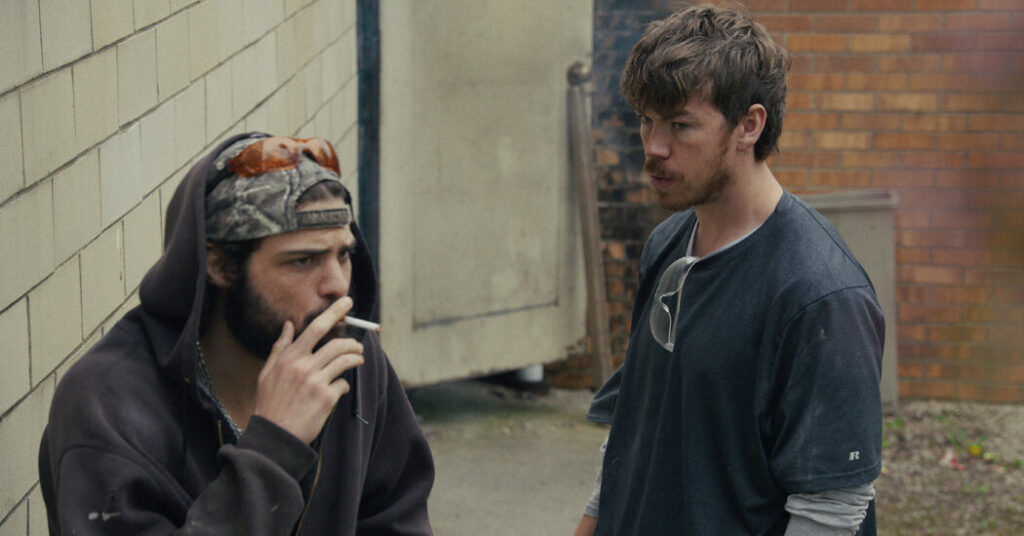
We are almost 90 minutes into “Union County” before we see its central character smile. Not that Cody Parsons (Will Poulter) has much to smile about: Addicted to drugs for many years (he started as a teenager), this reserved young man is beginning a court-mandated recovery program with more quiet resignation than apparent hope.
If we’re relying on Cody for information about how he’s feeling or what he’s thinking, though, we will be disappointed. Taciturn and obedient, he submits to drug tests and counseling like someone whose very personality has been narcotized. By contrast, his foster brother and fellow addict, Jack (Noah Centineo), barely a week into recovery, has a wildness about him that’s both concerning and endearing. Cody’s behavior toward his brother is more difficult to parse: Even after he lands a job alongside Jack in a lumber mill, Cody seems distant and awkward. Not until much later, in a speech that’s all the more affecting for its rarity, do we learn the reason for his extreme discomfort.
“Union County” isn’t a documentary, but it feels like one. Releasing information only in dribbles, the writer and director Adam Meeks, partnering with participants of the Adult Recovery Court in Bellefontaine, Ohio, grounds his movie in the daily struggles of real people. Nonprofessional actors, playing versions of themselves, make up the bulk of his cast, their testimonies an ongoing soundtrack to the brothers’ stories. One after another, in meetings and in the court itself, these men and women relate their highs and lows, successes and failures, with disarming candor and a moving gratitude for the support of their peers.
Expanding his 2020 short film of the same name, Meeks, who was born in rural Ohio and remains emotionally connected to the region and its ongoing battle with opioids, works in a naturalistic style that favors mood over event. Things happen — a failed substance test, a rolling automobile accident, a shocking tragedy — but there is barely a plot in the conventional sense. Hints of romance between Cody and a sweet single mother (a wonderfully genuine Elise Kibler) remain vague, and when Cody visits his estranged sister (Emily Meade, cramming years of fury into little more than one brief scene), their interaction is a snapshot of familial devastation.
Poulter has such a strong screen presence (in “The Bear,” he makes concocting a dessert as riveting as open-heart surgery) that he prevents Cody’s inwardness from becoming tedious. And Meeks never allows us to forget that Cody is only one among many, all of them reliant on the program’s endlessly patient support staff, including the real-life counselor Annette Deao.
Downbeat without being depressing — the program’s participants are almost shockingly cheerful company — “Union County” is a compassionate portrait of a Sisyphean endeavor. Stefan Weinberger’s camera is kind and calm, nurturing a tone that’s empathetic rather than dramatic. For most of these people, simply surviving day to day is all the drama they can handle.
Union County Not rated. Running time: 1 hour 37 minutes. In theaters.
The post ‘Union County’ Review: High Stakes, Understated Portrayals appeared first on New York Times.