In a bright, modernist conference room in Midtown Manhattan this spring, a small group of employees at an artificial intelligence start-up convened to review candidates for a new position.
“OK: Rhea Patel, Canadian woman of Indian descent,” began Josh Taylor, the chief production officer, reading from his laptop in the seen-it-all monotone of a public defense attorney. “Her expertise is van life. She grew up in Vancouver. Her father is an I.T. guy at a big insurance company. Mother is a professor of mathematics at the University of British Columbia.”
At the far corner of a long blond wood table, wearing an artfully knotted fringe scarf and oversize aviator glasses, Katie Brown, the chief content officer, listened skeptically.
“She became interested in wildlife photography at an early age, turned on by David Attenborough documentaries,” Taylor continued. “Tragically, while she was studying during her senior year at the University of Toronto, her twin brother died in a climbing accident.”
Brown straightened up.
“Oh wow!” she said. “I didn’t see that one comin’!”
Taylor went on, unspooling Patel’s tale of hardship and transformation, which had the vague shape of a classic hero’s journey. Though peppered with convincing details (who hasn’t been moved by Attenborough?), Patel’s life story was, in fact, entirely fictional.
Rhea Patel — along with fellow candidates Maria Lockwood, a comics and manga enthusiast; and Caspian Rowe, a budget-minded filmmaking guru — was a prospective addition to a roster of virtual influencers being developed by the company, Inception Point AI. The candidate receiving the most votes from the four people at the meeting would be granted the gift of artificial life, joining a cohort of more than 100 A.I. personas, each with its own market-friendly niche, that could be deployed to host podcasts, star in YouTube videos, converse with followers and — in the company’s loftiest vision — one day navigate the physical world in a robotic body.
Inception Point is just one of several companies in the media, fashion, film and music industries aiming to build the synthetic superstars of tomorrow. The advent of advanced A.I. imaging tools has given any would-be Geppetto with a modest budget and a sliver of vision his or her own magic wishing star, with the power to generate lifelike, photorealistic characters of any description.
But infinite choice is a terrible burden, as any artist who has faced a blank canvas knows. What do people want in an artificial idol? In whose image should such creatures be made? And are their creators threatening human-made culture or extending it?
ON TIKTOK, IN MAGAZINES, ON MUSIC CHARTS and beyond, A.I. avatars have invaded popular culture. A few, like Tilly Norwood, an A.I. actress who recently appeared on the cover of The New York Times Magazine; Xania Monet, an A.I. R&B singer with tens of millions of streams on Spotify; and Aitana Lopez, an A.I. fitness model with more than 400,000 Instagram followers, already enjoy something like mainstream recognition. Countless others regularly go viral on social media, captivating viewers who may not detect their unreality.
The availability of virtual talent — capable of tackling many jobs on command, while requiring neither empathy nor health insurance — has unsettled many communities of human performers. A.I. was a major issue in the Hollywood labor disputes of 2023, as film and television actors found themselves negotiating against the specter of their digital replacements. SAG-AFTRA, the actors union, helped pass a law in New York State last year that requires advertisements to disclose the use of A.I. personas.
“I don’t think A.I. influencers will replace human influencers fully, but as these tools become more and more realistic, I do think we’ll see more of it,” said Jess Rauchberg, an assistant professor at Seton Hall University who studies labor and the creator economy. “And if it’s a more cost-effective way for businesses to get attention, clicks and engagement, then that’s what they will promote.”
At Inception Point, Jeanine Wright, the chief executive, said her company is offering consumers greater choice. Its fleet of A.I. personas, including Nigel Thistledown, a British gardening expert, and Clare Delish, a Latina cooking influencer (each with about 8,000 Instagram followers), are designed to fill gaps in the marketplace, Wright said.
The company can produce specialized, up-to-the-minute content (a recent Thistledown podcast apprised listeners of the proper soil temperature for tomatoes) that few human creators would find worth the effort. While the main pages for the podcasts and the characters’ Instagram bios state that they were created with A.I., individual episodes and posts are not always labeled.
“We can do daily surf reports, or a show that is just about poodles — there are so many niches that we can speak to,” she said. “As long as people like the content, we think they’ll accept that it comes from A.I.”
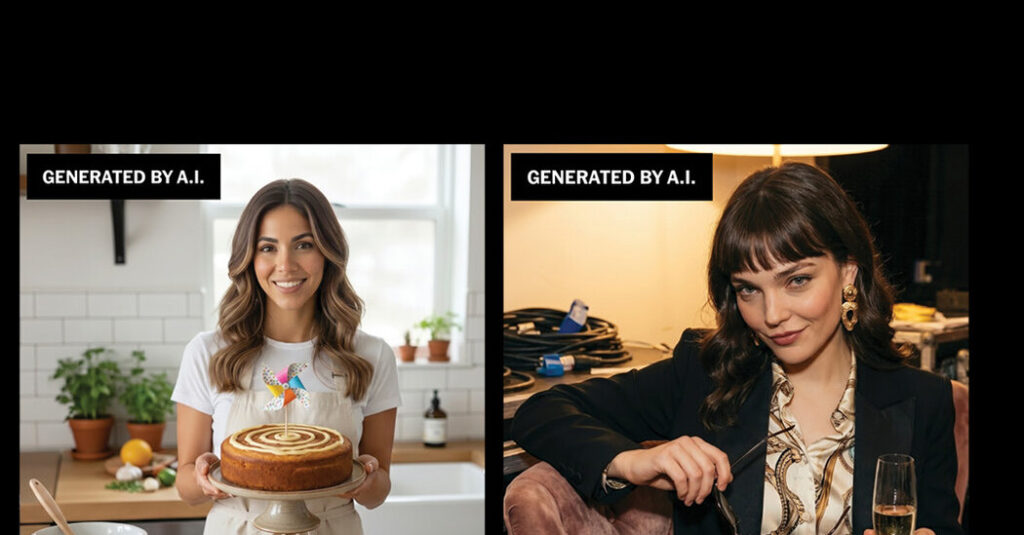
Images from Inception Point AI’s catalog
Wright and her co-founders — William Corbin, the chief technology officer; Brown; and Taylor — started Inception Point in 2023. The company’s ambitions are platform agnostic; it envisions a swarm of autonomous personalities producing across media. But it made headlines last fall for its flood-the-zone podcast strategy, which involved maintaining more than 5,000 active shows and posting thousands of predominantly A.I.-generated episodes per week.
Inception Point’s proprietary software uses commercially available A.I. chatbots and voice generators to produce and read scripts. (Although it has a human review process for sensitive content, most of the podcast scripts are not closely checked by humans.) Because of relatively negligible labor and overhead costs, Wright said, each episode needs only 20 listeners to turn a profit from advertisements.
THE FIRST A.I. FASHION MODEL to appear in Vogue was a pouty-lipped blonde named Vivienne. A genie’s mash-up of Denise Richards and Kate Upton, it was remarkable for just how unremarkable it seemed, how easily it slid onto a durable fashion industry assembly line of ruthless female beauty standards. In a pair of fully A.I.-generated portraits for a two-page Guess ad last summer, Vivienne posed as an effortlessly glamorous vacationer, a nonexistent summer sun gleaming against its nonexistent, poreless skin.
Vivienne was created by Andreea Petrescu and Valentina Gonzalez, the founders of a London-based A.I. marketing agency, Seraphinne Vallora, in partnership with Guess. (The agency’s involvement, and the use of A.I., were disclosed in fine print.) Petrescu and Gonzalez, who met in architecture school, are former jewelry designers who first created A.I. models to promote their own products.
Soon, fashion clients came calling, and they have worked with New York Fashion Week, the Ritz-Carlton Hotel Company and high-profile apparel and accessory businesses, which they declined to name because of nondisclosure agreements.
In addition to Guess, several fashion brands, including Levi’s, Mango and J. Crew, have used A.I. models in their promotional images. Petrescu said that Seraphinne Vallora’s clients request its services to save money — the company charges from five to mid-six figures a campaign, potentially less than one-tenth the cost of a high-end location shoot — and because they want models they can own and control.
“With real models, the problem is they are the face of so many different brands, and anything that they do can affect your brand,” Petrescu said. “With A.I., it’s like a clean slate: You can design it the way you want, she can be as gorgeous as you want, and she’s all yours.”
Before designing a model, Petrescu and Gonzalez interview the client about the vision for the products and the identity of the brand. Vivienne, the Guess model, was conceived as “the embodiment of the divine feminine,” “elegant, poised, angelic and sweet — yet unmistakably powerful.”
For a recent resort wear campaign for the European brand Desislava Gilberte, the designer requested a “vampire-type beauty” with “very voluminous, ’90s hair.”
“We type in whatever we’re trying to achieve as the vibe,” Petrescu said, recalling some of the prompts she and Gonzalez gave their A.I. software. “Large eyes, pale skin, perky lips, full lips, small nose.”
Some industry watchers have warned that fashion companies could use A.I. models to reinforce the status quo, or to nudge beauty standards toward ever more unrealistic extremes. The Guess ad in Vogue triggered a widespread backlash.
“If A.I. is used to create sanitized, idealized people who don’t actually exist, we risk narrowing our definition of beauty instead of broadening it,” said Sara Ziff, a former model and the founder and executive director of the Model Alliance, a labor rights group.
At Seraphinne Vallora, Petrescu and Gonzalez — who are Romanian and Colombian — said they enjoy making images that reflect a wide range of ethnicities, physical features and body types. But most of the models they create are white and conform to conservative, Western beauty ideals. The company’s social media followers, and many clients, they said, tend to prefer white “bombshells,” with blue eyes, big lips and exaggerated curves.
“I’m Latina, but Latinas don’t perform well, so we don’t do Latinas,” Gonzalez said. “It’s a business. We have to just do what attracts.”
AT THE INCEPTION POINT PITCH MEETING in Midtown, Rhea Patel, Josh Taylor’s van life prospect, hit a roadblock. The company already had a character catering to van enthusiasts.
Taylor suggested that Patel could pivot.
“Maybe we could make it more of a backpacking, nature thing,” he said. “There’s gotta be more space for someone like that.”
Most of Inception Point’s personas bear the fingerprints of their creators. Many combine scraps of personal history (Taylor spent a chunk of the early ’90s following the Grateful Dead in a Volkswagen) with elements of figures from popular culture. Thistledown, the gardening personality, is a domesticated riff on Sherlock Holmes. V.V. Steele, a smirking celebrity gossip commentator, gets its looks from Angelina Jolie, Kim Kardashian and Veronica from Archie comics, among other influences.
Staff members use A.I. chatbots to help conjure the interior lives of characters whose backgrounds differ from their own.
“There is a sense of building a utopian society where we can be in other people and other cultures without the barriers,” Taylor said.
Working with chatbots, designers create 15-to-30-page “bibles” describing the persona’s appearance, voice, personality, biography and worldview. Guiding questions include: “What is your cultural background and how is that reflected in your voice?” and “Because of your cultural background, what kind of obstacles have you had to overcome?”
Images from Inception Point AI’s catalog
The characters are often given personal struggles — like Rhea Patel’s dead brother — to make them seem more relatable. Superman has X-ray vision, but Clark Kent wears glasses.
Zayd Portillo, a founder of Stage Zero Entertainment — the creator of the A.I.-powered pop star TaTa Taktumi — said the company starts its design process by identifying a hardship in the persona’s back story, like bullying or heartbreak.
“That’s the stuff that pulls on people’s heartstrings,” he said.
Portillo and his co-founders — the music super producer Timbaland and the film producer Rocky Mudaliar — unveiled TaTa last October (its Timbaland-produced single, “Glitch x Pulse,” has about 265,000 streams across YouTube and Spotify) and is developing new characters for film, music and live entertainment.
A.I. music avatars from other companies and creators, including Monet, the country singer Breaking Rust and the gospel persona Solomon Ray, have cracked several Billboard music charts and garnered hundreds of thousands of Instagram followers. Not all music services require rights owners to identify A.I.-generated content; earlier this week, however, Spotify announced it will begin affixing “AI Persona” labels on profiles it deems to be A.I. generated.
While independent companies like Stage Zero have embraced A.I. avatars, major record labels have generally been more circumspect. In 2022, Capitol Records, a subsidiary of Universal Music Group, signed a record deal with the virtual rapper FN Meka only to cancel it weeks later after a public outcry.
KATIE BROWN, INCEPTION POINT’S chief content officer, had grown fond of Caspian Rowe, the prospective A.I. persona focused on filmmaking techniques. A 30-something white male character with tousled brown hair, it was created by Chris Valentino, a content producer at the company.
“That’s not an angle that we have, and he would be fun to work on,” Brown said.
The room unanimously agreed that Rowe, out of the candidates that had been considered, should advance, and that Taylor would reposition Rhea Patel.
Brown asked Valentino to check in on a few existing characters. On a large monitor at the front of the room appeared Ryan Cole, an acerbic tech analyst with a square jaw and a graying beard, and Oly Bennet, a blue-eyed sports correspondent with glistening biceps.
Everyone paused to admire Lila Walker, a new knitting- and craft-focused persona, created by Brown, who had a chunky wool sweater, long, wavy tresses of red hair, cream-colored skin and a spray of freckles.
“Man, I’m crushing on her,” Taylor said.
“If you want, I can take your picture and put you behind her with a pottery wheel,” Valentino teased, referring to a scene from the movie “Ghost.”
“Yeah, my wife would love that,” Taylor replied dryly.
Ignoring them, Brown asked Valentino to pull up draft images of Walker. A grid of softly lit portraits appeared, including one in which the character looked blissful while collecting seashells on a tide-swept beach.
Brown originally conceived of Walker as an idealized version of her younger self. In the late 1990s and the 2000s, she hosted instructional home cooking and decorating shows, including “Next Door With Katie Brown,” on Lifetime, and “Katie Brown’s Workshop,” on PBS, making her a kind of early influencer. Inception Point’s focus on telegenic subject matter gurus reflects her conviction that people crave authority figures who are simultaneously approachable and just out of reach.
Approaching the screen, Brown traced a circle around an image of Walker staring directly into the camera, with a loose ponytail pulled to one side and eyes squinted in a cheerful smile.
“There, that’s my girl,” she said. “I want more of her.”
The post So You Want to Build an A.I. Star? appeared first on New York Times.