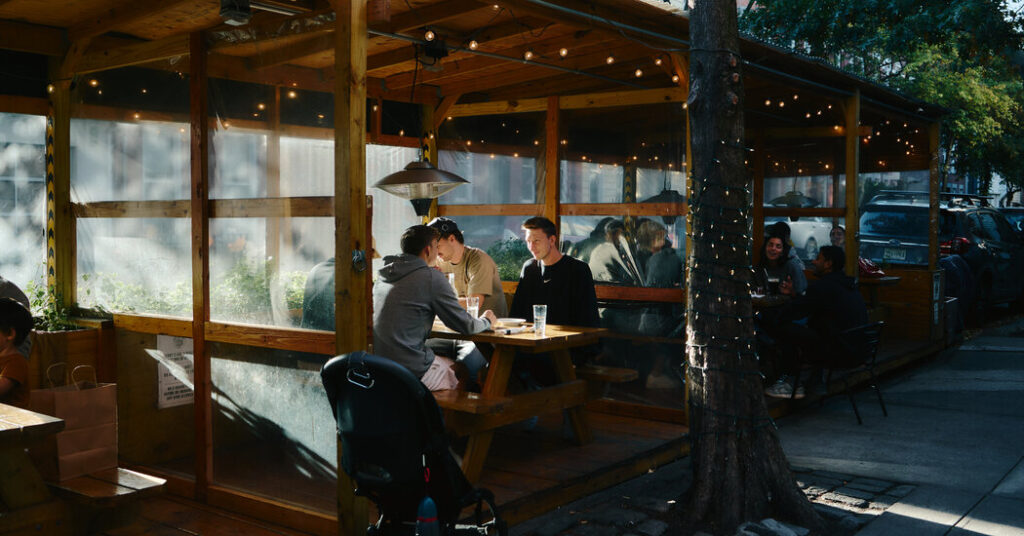
Three years after New York City disappointed legions of diners by limiting roadway restaurant seating to the warmer months, year-round outdoor dining is poised for a comeback.
On Thursday, the City Council is expected to approve a package of bills that would authorize restaurants to again set up dining structures on city streets year-round, and also allow them to winterize the structures — on both sidewalks and streets — to render them more comfortable in the cold.
Under current rules, outdoor dining structures on streets can open no earlier than April 1 and must be deconstructed by the end of November, a costly and cumbersome process that has dissuaded many restaurant operators from participating.
“The No. 1 reason that restaurants no longer provide outdoor dining is because it is stupidly expensive to build, deconstruct and store outdoor dining structures,” said Lincoln Restler, the Brooklyn councilman sponsoring the bill that would authorize year-round roadway dining. “The legislation fixes that.”
Julie Menin, the Council speaker, said in a recent interview that she expected the legislation to pass.
In 2020, as the coronavirus pandemic kept New Yorkers out of indoor spaces and restaurants teetered on the edge of insolvency, Mayor Bill de Blasio issued an emergency order that allowed outdoor dining on roadways, in an ultimately successful effort to bolster the industry.
The program “created 11,720 jobs, resulting in $373 million of total annual wages, and $9.6 million of annual income tax to the city” at its peak, the former city comptroller, Brad Lander, wrote in a report last year.
But as the years passed, complaints mounted that some of the outdoor dining setups were poorly maintained and served as little more than rat warrens occupying scarce parking spaces.
Under the next mayor, Eric Adams, the city adopted rules that made the roadway dining program permanent, but allowed it to operate only from April to November. Restaurant proprietors could have sidewalk tables year-round, but were barred from building enclosed structures around them, and the rules restricted where the seating could be placed.
The city also imposed strict guidelines on what types of roadway setups were allowed. Restaurant owners who did not comply received hefty fines as the city cracked down on the variety of tents, huts and sheds that had sprung up. Many small-business owners have called the regulations oppressive.
The outdoor dining program has since languished, with a large permit backlog overseen by the Department of Transportation. The number of restaurants across the city that offer outdoor seating dwindled to about 2,700 this year, from between 6,000 and 8,000 at any given time during the height of the pandemic.
The restaurant industry is eagerly anticipating the bills’ approval. “If this passes, this is a big deal,” said Manny Colon, the owner of Manny’s Bistro on Manhattan’s Upper West Side. “It’s a whole new ballgame for restaurants.”
Manny’s Bistro opened during the pandemic. While the previous restaurant there had long had sidewalk seating, Mr. Colon expanded the business’s square footage by putting tables on the roadbed, too. He said that winterizing the structures would make them more popular and create more jobs.
Andrew Rigie, the executive director of the New York Hospitality Alliance, agreed, describing the bills as “critically important reforms.”
Council support for the bills is not universal. Councilman David Carr, a Staten Island Republican, for one, plans to oppose the legislation because it does not grant individual council members a say in where the roadway cafes are located. “I’m deeply uncomfortable with that,” Mr. Carr said, adding, “The members know their districts, they’re in touch with their local constituencies.”
Before she was speaker, Ms. Menin voted for the April-to-November outdoor dining schedule, despite her qualms about its limitations. She said she had suggested dedicating a city-operated warehouse in each borough for storing restaurants’ tables and chairs when they were not in use outside, to save business owners that cost. That idea was not adopted.
“Making outdoor dining year-round is a big, big win,” she said. “This is a way to fix what I really think was a broken program.”
Ms. Menin noted that one of the bills, sponsored by Councilman Justin E. Sanchez of the Bronx, would require restaurants to keep their outdoor dining setups clear of trash, graffiti, rats and other unsanitary conditions, which she said would help balance “neighborhood concerns with also promoting small businesses.”
The current mayor, Zohran Mamdani, has signaled his support for expanding outdoor dining. Among his recently released 50 proposals to help small businesses was a plan to streamline the permit application process.
“Mayor Mamdani has made clear that we must make outdoor dining year-round and eliminate unnecessary bureaucracy that makes it harder for small businesses to participate in one of our city’s most popular programs,” Dora Pekec, a spokeswoman for the mayor, said in a statement.
Gale Brewer, the Upper West Side councilwoman who sponsored the bill pertaining to sidewalk cafes, said the legislation was particularly important in light of the inflation that restaurants were contending with.
“It’s rough right now,” she said.
The post Outdoor Dining Is Expected to Resume Year-Round in New York City appeared first on New York Times.