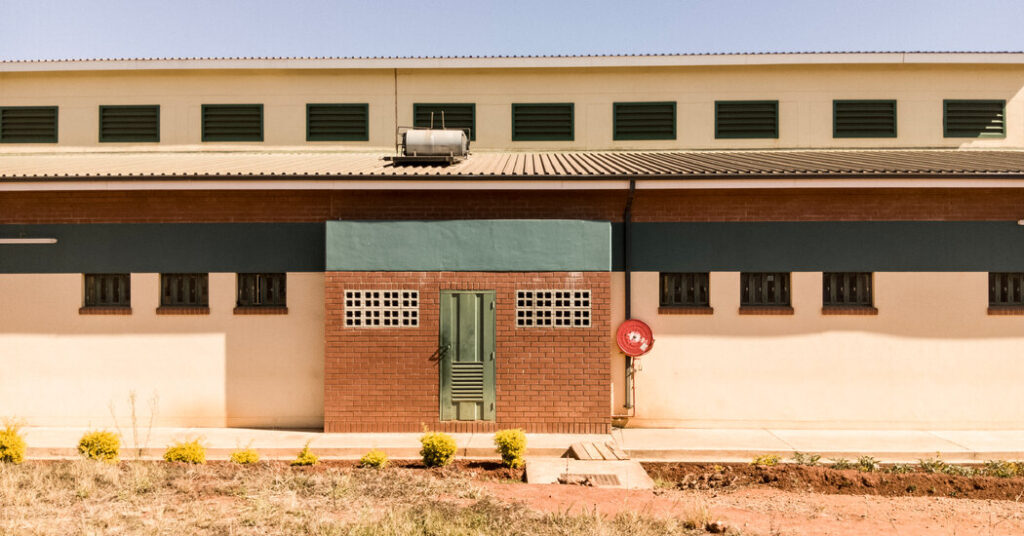
When a New York Times reporter called him in June 2026, Roberto Mosquera had already been in the Eswatini prison for 11 months.
Roberto, who came to the United States from Cuba in 1980, is one of a growing number of people deported by the Trump administration to countries with which they have no connection. He was picked up by an immigration agent in June 2025 when trying to renew his work permit. A couple of weeks later, a military cargo plane delivered him and four other men to a maximum-security prison in Eswatini, a tiny African nation with an absolute monarchy that received $5.1 million as part of a deal to accept America’s deportees.
There are no charges against Roberto, and he has no way to appeal. But remarkably, he has a cellphone — one that allowed him to share his story, and video from inside the prison courtyard, with Nicholas Casey, a staff writer at The Times Magazine. The two spoke numerous times over WhatsApp video calls. Nick shared more about his reporting, and the ethical considerations involved in interviewing someone in detention. Our interview has been edited and condensed.
You heard about Roberto’s case through an immigration lawyer who represents him. Did that lawyer reach out to you? What got you interested in Roberto’s story?
I’m old enough to remember when we started sending terror suspects to Guantánamo Bay after Sept. 11. Because people were kept out of the American court system, many couldn’t get out of detention. I wanted to know if something similar was happening to the deportees.
I called many, many lawyers. Some said they were so backlogged with cases of people they were trying to stop from being deported that they couldn’t keep track of those in the foreign prisons. But one attorney in the United States said she knew a man named Roberto Mosquera. He had been stuck for nearly a year in a maximum-security prison in Eswatini, an African country controlled by a king that bans political parties and has few press freedoms. The Eswatini government refused permission for me to enter the prison and never granted me a visa, for one. But Roberto had a phone.
You don’t usually see prisoners with phones. Tell me about that.
I was surprised by this too. There are six or seven prisoners in South Sudan in a similar situation whom no one has heard from for months. The fact that Roberto had a phone at all was kind of a miracle. Last year, he staged a 30-day hunger strike inside the prison, demanding to see a lawyer. He didn’t get a local lawyer, but he was offered a phone as a kind of concession.
His lawyer in the United States wasn’t sure if Roberto wanted to talk: She thought his year in jail without charges had made him at times depressed, not seeing any way to get out. But I recorded a two-minute video message on WhatsApp introducing myself, telling him I’d worked both in Cuba and Miami, and the attorney sent it to him. That same day, Roberto got back to me, saying he wanted to talk. The attorney gave me a number that began with +268, Eswatini’s country code. I called, and Roberto picked up.
The prison had a Wi-Fi network, probably set up originally for the guards, which made it easy to talk. Roberto would also pass around his phone to the other deportees so I could hear their stories. I got to know his cellmate, a 71-year-old Yemeni man named Kassim, and several others. When a new group of deportees landed in Eswatini in July, I called them on Roberto’s phone and immediately started to interview the new arrivals about how they had been treated by ICE.
How did you corroborate details about Roberto’s background, including his account of his deportation?
Like all of the deportees I talked to, Roberto had a criminal record. As a teenager he joined a Miami gang, and in the 1980s, he was accused of shooting a rival in the leg. He took a plea deal for attempted first-degree murder and received a nine-year sentence. I could check most of this in Miami court records.
As for his deportation, the Department of Homeland Security publicized it at the time on X, calling him and the others they deported to Eswatini “depraved monsters.” What they didn’t say was that the main charge against Roberto was from nearly four decades ago. That’s why going back to the court records is key, because there are dates.
And by talking to Roberto, I found out more: He’d become a born-again Christian and had four daughters, of whom he showed me pictures. I spoke to his sister, his girlfriend and his former boss. Through this I learned a surprising detail: Roberto had been a fervent supporter of Trump’s candidacy in 2024, like many Miami Cubans, and told his whole family to vote for Trump.
You’re a reporter, and he’s incarcerated in a foreign country. What ethical considerations are you thinking about as part of this reporting work? I imagine speaking to you could put his chances of freedom at further risk.
Roberto and I talked many times about the risks of speaking to a reporter. At one point, we had a long conversation about whether he wanted to go on the record about how betrayed he felt by Trump. He decided he wanted to speak out, regardless of how it would be seen by the government. I think he made the decision that the biggest risk was saying nothing at all. If no one knew about what was happening to him and others in Eswatini, he might simply be forgotten and remain in Africa for years.
Roberto had also spent enough years incarcerated in the United States to know that what was happening to him in Eswatini was not right. He had no local lawyer for 11 months. No charges against him. No way to appeal the situation. He grew up in America and believes strongly in free speech. I think he saw it as important to speak out.
He sent you video from the prison courtyard, which offered a rare glimpse of this facility. It seems counterintuitive that he was able to film there.
I was a bit surprised that they let him film the video. But Roberto hasn’t been charged with anything, and I suspect in Eswatini they know the prisoners don’t present much of a threat. So Roberto has some freedoms you wouldn’t expect, like being able to take pictures. He just can’t leave.
Roberto has a criminal history. What goes into responsibly reflecting the whole messy picture of a person?
I think some people see a different set of criteria to judge someone if they have a criminal history. I don’t. That might come from the fact that members of my own family have been incarcerated and I watched them come out of it and be better people in the end. I also grew up in a neighborhood where many of my friends and classmates’ families had come from Latin America without immigration papers. Many of them are doing great things.
Telling Roberto’s whole story was key to showing him in his full form, and to understanding the situation he now finds himself in.
On your very first call, Roberto asked: “Do you think I’ll ever get out of here?” What did you say?
I told him I hoped he would, but that I didn’t know. I was still a teenager when we started sending detainees to Guantánamo Bay. When I last counted, there were still more than a dozen there, and three who were never charged with anything. In spite of what’s happened to these detainees, people like Roberto still have rights — both under American and international law.
The post How Do You Interview a Deportee Being Held Inside a Maximum-Security Prison? appeared first on New York Times.