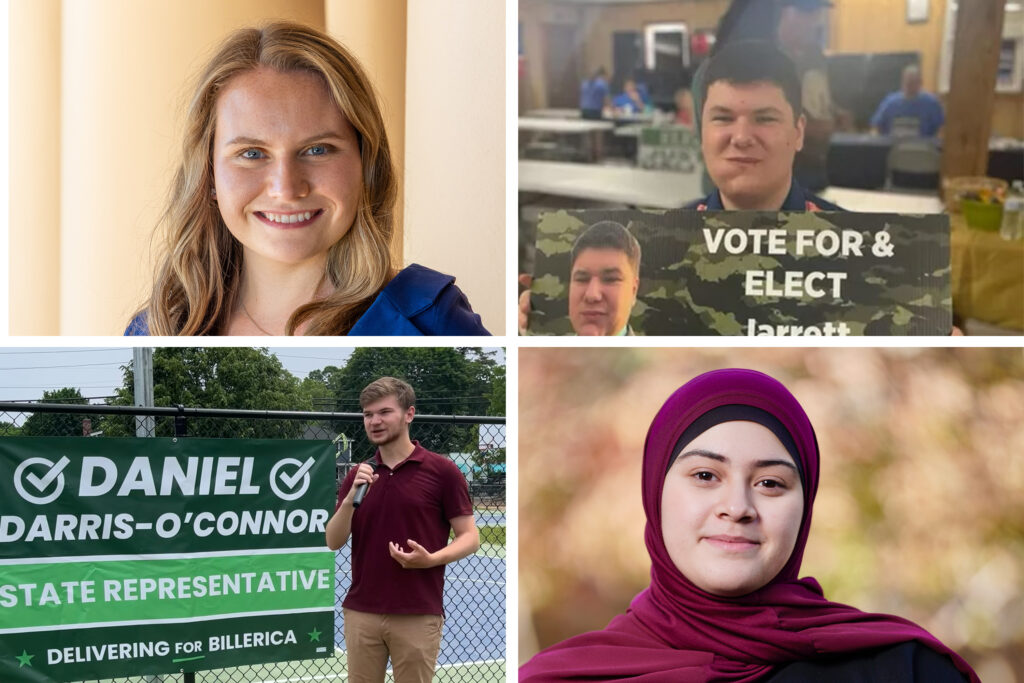
On election night, Daniel Darris-O’Connor watched the returns roll in from “Campaign HQ” — or, more precisely, his parents’ house in Billerica, Massachusetts.
The early numbers looked promising, but the 19-year-old Democrat was nervous. Billerica, about 20 miles northwest of Boston, leans more conservative than its neighbors; it narrowly backed Donald Trump in 2016. And Darris-O’Connor was up against Marc Lombardo, a 44-year-old Republican who’d held the Massachusetts House seat for 16 years.
By about half past midnight, all the precincts had reported. Some mail ballots still had to be counted, but the result was clear.
The teenager had unseated the longtime incumbent.
“It was definitely a sigh of relief,” Darris-O’Connor told The Washington Post. He popped a Diet Coke to celebrate.
Darris-O’Connor was one of several teenagers from both parties elected to state and local office across the country. They’re still too young to buy alcohol. In some cases, they recently graduated high school. In eastern Kentucky, a young man won a seat on his county’s soil and water conservation board five days after his 18th birthday. In New Jersey, an 18-year-old won a seat on a local school board. And in Arizona, a 19-year-old was elected clerk of the Superior Court in the nation’s fourth-largest county.
The victories, though relatively few, are part of a larger trend of rising Gen Z political engagement, some experts say.
The number of Gen Z candidates who filed to run for Congress almost doubled from 2024 to 2026, rising from 60 to 117, according to the nonprofit Future Caucus, which supports Gen Z and millennial policymakers. This year, 56 major-party nominees for Congress were 35 or younger, according to Rutgers University’s Young Elected Leaders Project.
Elizabeth C. Matto, who directs Rutgers’ Eagleton Institute of Politics, said she’s seeing more young adults run for higher office. Candidate ages are harder to track in local races, so it’s difficult to tell whether more teens are running nationwide. Still, Matto said, the teens’ interest in running fits with what she’s seen of Gen Z’s political engagement. In the 2022 midterms, 28.4 percent of Gen Z adults ages 18 to 24 voted, according to a Tufts University analysis of census data. At the same age, 23 percent of millennials voted in the 2006 midterms and 23.5 percent of Gen Xers voted in the 1990 midterms.
“It’s not entirely surprising that we are seeing young people running for office and meeting some success,” Matto said. “I think the desire to make a difference, the desire to be actively engaged in politics, has been reflected in various ways.”
Darris-O’Connor said he began following government closely during the pandemic, when he was in seventh grade, and his mother worked as an aide at a nursing home. “It was really an eye-opener to how a lot of the leaders in our government really are not doing what’s best for our country,” he said.
At 18, he won a seat on Billerica’s Select Board, where he helped secure investments in the town’s water infrastructure and hire key town staff. The following year, he decided to run for the state House.
“No one else was willing to step up and run,” Darris-O’Connor said, “and I wasn’t going to let that seat go uncontested.”
While Darris-O’Connor worried his age could work against him, he also knew his record on the five-member Select Board helped prove he was ready for the role. He said he knocked on well over 1,000 doors after the primary. A few voters mistook him for the candidate’s son or a campaign intern, he said, but even those conversations turned to policy. He ran on lowering the cost of housing, health care and energy.
“I wasn’t trying to be the young candidate. I wasn’t trying to be the 19-year-old,” Darris-O’Connor said. “I was trying to be the candidate focused on the issues that transcend generations.”
In Guttenberg, New Jersey, Sukaina Tehfa saw her age as part of what she could offer. The 18-year-old Rutgers—Newark freshman ran unopposed and became the youngest person elected to the town’s Board of Education, where she’ll help set policy and vote on the district’s budget.
At 17, she went to the town clerk with a question: “What age can I run for public office?” He told her 18. She knew a school board election was coming up and decided to run.
Tehfa had long looked up to Supreme Court Justices Sandra Day O’Connor and Ruth Bader Ginsburg and owns a copy of “Sisters in Law,” a book about both women. She said Ginsburg’s example helped inspire her to run.
Fresh out of high school, she wanted students to have someone close to their own age they could go to with concerns. She campaigned for higher teacher pay, and one voter told her they planned to vote for her because she stood up for teachers and they were glad to see someone so young run for office.
“It was always older people making decisions for us,” she said. “And don’t get me wrong, I think as a generation, we can learn from more experienced people. I think we can complement it. But I think we should still have a say in our own education.”
On Nov. 3, Jarrett Hardin had been 18 for five days when he won a seat on Breathitt County’s Soil and Water Conservation Board in eastern Kentucky.
The grandparents who raised him both worked in public service. His grandfather was a police chief in Jackson, Kentucky, and his grandmother is a nurse. Hardin, who works at a local funeral home and took agriculture classes in high school, saw the county’s soil and water conservation board as a natural place to get involved.
“I believe that we could use a lot of young people in local government,” Hardin said. “I believe we need it.”
Breathitt has lost many of its farmers, he said, and he supports the district’s decision to invest in local schools, where Hardin sees the next generation of farmers. He also promised residents he’d bring up ways to control kudzu, an invasive vine spreading across parts of the county.
In central Illinois, it was Ben Ackerman’s cousin, the Tazewell County clerk, who first asked him to run for office.
This year, a friend invited the 18-year-old to Springfield, where he and other teenagers held a mock legislative session and tried to pass bills.
Then his cousin called. A county board member was retiring. Would he be interested in running?
First, he said, he had to run it by his parents.
“My dad was very much like, ‘You should give it a go,’” Ackerman recalled. “My mom was a little like, well, ‘If that happens, what will that mean? What would you be doing?’”
Ackerman will serve on the board of the reliably Republican county while working part-time at Chick-fil-A and taking online classes at Liberty University in Virginia. He said he didn’t run on a single issue.
“I’m more keeping an eye out for things that I feel would hurt the district and Tazewell County as a whole,” he said.
As the newly elected teens prepare to take office, Valerie McDonnell remembers what it was like to walk into a room full of older colleagues.
She was 17 when she campaigned for the New Hampshire House and 18 when she won. Now 22, she’s in law school and just won a third term. When she first took office, she felt pressure to prove herself. She made a point of showing up to every meeting, on time or early.
“I stand out in almost every room that I enter,” McDonnell said.
But she also found that being young had its advantages and helped her connect with voters. Some of her classmates voted for the first time and held signs for her on the campaign trail. On the House education committee, former teachers, principals and superintendents often turned to McDonnell, fresh out of high school, for a student’s perspective.
McDonnell now hears from young people seeking advice about running for office. She encourages newly elected officials to ask questions and learn from their older colleagues.
“Be approachable. Be friendly, and be coachable,” she said.
And for the teens weighing the idea of running?
“I would just say go for it.”
The post Still too young to buy beer, these teens are winning elected office appeared first on Washington Post.