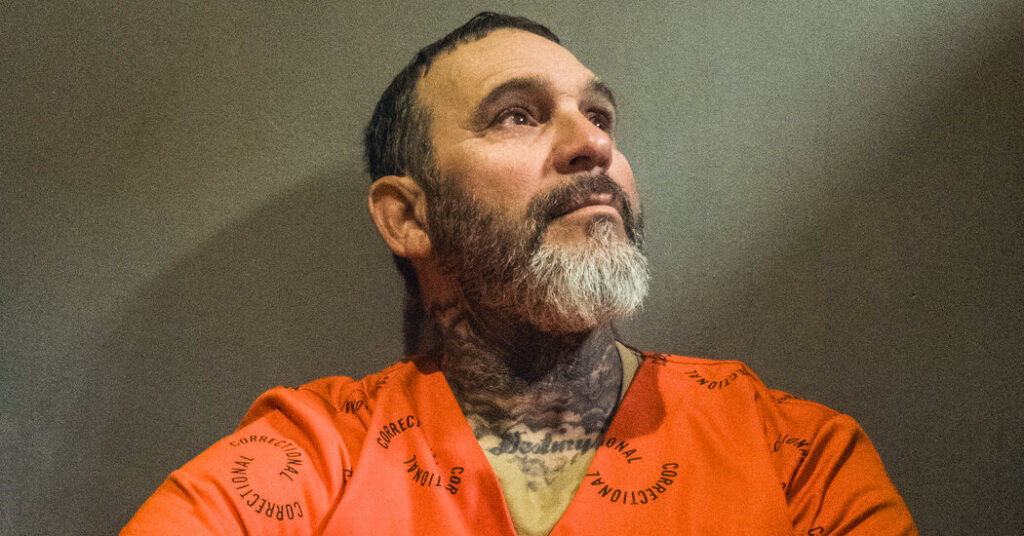
As he stepped out of the American military cargo plane, Roberto Mosquera still couldn’t tell where he was or why he had been taken there. When federal immigration agents forced him onto a secret flight 30 hours earlier, it was a hot July afternoon in Texas. Now, after traveling thousands of miles, he felt a cold winter’s morning in the air.
He was in the kingdom of Eswatini, a tiny, landlocked country in southern Africa that until recently was called Swaziland. Mosquera had never heard of it. He hadn’t set foot outside the United States since he was 12, when he arrived on a fishing boat as part of the 1980 Mariel boatlift from Cuba with his mother, a sister and her infant daughter. As a teenager, he joined a Miami gang, and in his 20s, he took a plea deal after being charged with attempted murder for shooting a rival gangster in the leg. That would have been grounds to deport him had he been from almost any other country. But Cuba wasn’t cooperating with the United States on deportations, so Mosquera was allowed to stay, provided he checked in with the authorities each year. He built a new life for himself, becoming a specialty plumber and a born-again Christian; he married and had four daughters.
Then one day in June of last year, Mosquera, who is 59, went to renew his work permit at an immigration office. The appointment was usually short; Mosquera had borrowed the company truck so that he could head to a job when he was done. But it didn’t turn out that way. An immigration official told him that his time in America was up. With President Trump now back in office, Mosquera knew these were not empty words. But if the United States couldn’t send him to Cuba, where would he go?
He was taken to the Krome Detention Center, a notorious holding facility for deportees in Miami, then to another in El Paso, Texas, where he was confined without being able to contact lawyers for nearly two weeks. Soon agents told him to get ready to move again. Mosquera was surprised when he was loaded onto a small luxury jet — it seemed to him more like something the singer Marc Anthony would rent, he told me. Along with him were four other detainees, from, as he would later learn, Jamaica, Laos, Yemen and Vietnam. They were transferred to a military cargo plane at a U.S. air base in the East African nation Djibouti, and more than a day later, the five men landed in Eswatini.
Before they could make sense of the situation, they were forced inside a metal cage that was fitted onto a transport truck and driven to the Matsapha Correctional Complex, Eswatini’s maximum-security prison. In a post on X, the Department of Homeland Security had called Mosquera and the four other men “depraved monsters” who were “so uniquely barbaric their home countries refuse to take them back.” Now they were met by dozens of guards wielding large sticks.
That was more than a year ago. Mosquera still sits in that same maximum-security prison with nowhere to go. No charges against him. No way to appeal his predicament. No sign that he will ever be freed. Cuba has not signaled any willingness to take him, and Mosquera says he has no desire to go there. Eswatini will not release him from prison, even though he served his time in the United States and committed no crime in Africa.
I first heard about his case through Alma David, an immigration lawyer at Novo Legal Group in the United States, who represents him. When I reached Mosquera on a WhatsApp video call in early June, he had already spent 11 months behind bars. The Eswatini government refused to let me visit him or any of the others detained with him, so WhatsApp video calls were our main means of communication. As we spoke, Mosquera squinted at me; in detention, he had developed glaucoma, and a doctor told Mosquera he had lost half his vision in one eye and 80 percent in the other. He has struggled to receive treatment for the condition.
“Can I ask you a question?” Mosquera asked me. Behind him I could see the green bars of his cell where he spends his nights and the silhouettes of some of the other prisoners.
“Do you think I’ll ever get out of here?”
Mosquera is one of a growing number of people whom the Trump administration has put into a global administrative limbo. For more than a year, it has been offering millions of dollars — often without disclosing the payments — to foreign governments to take immigrants the United States was having trouble deporting to their countries of origin. This includes not only people with criminal pasts like Mosquera but also deportees who were under court protections not to be returned to their homelands because they faced threats there.
The practice of deporting someone to a so-called third country isn’t new, but it used to be rare. In the past, the United States might deport someone to a place deemed safe — Canada, for instance — or to a country where they had dual citizenship. But in 2019, the first Trump administration began sending thousands of foreign nationals, including people from the Caribbean and Central America, to Mexico. In Trump’s second term, the practice has vastly expanded: At least 35 countries have made deals to take deportees, a list that includes nations as far-flung as South Sudan, Ghana, Palau, Uzbekistan and Moldova, according to Third Country Deportation Watch, a monitoring group that tracks the agreements.
The deportations bring up serious legal questions that have been the subject of multiple federal lawsuits. The removals — whether they involve immigrants with criminal histories or not — often happen before deportees can argue their cases before a judge. Some of the countries selected by the Trump administration don’t offer the basic legal protections to which the deportees would be entitled in the United States, such as access to a lawyer. And because they are foreign nationals, with no legal status in the countries to which they have been sent, the deportees generally remain under indefinite detention abroad, without charges and with little or no recourse in American courts. In a written statement to The Times, the Department of Homeland Security maintained that anyone who was deported received due process: “These third-country agreements, which ensure due process under the U.S. Constitution, are essential to the safety of our homeland and the American people.”
A number of the countries that have made the deals are unstable or autocratic and usually desperate for American cash. The Central African Republic is in the middle of a civil war. The Democratic Republic of Congo took 15 deportees shortly before the recent Ebola outbreak. Eswatini, which received $5.1 million in its arrangement with the Trump administration, is one of the world’s last absolute monarchies.
The deals first drew widespread attention when the autocratic President Nayib Bukele of El Salvador accepted a $6 million payment in March 2025 to hold some 250 Venezuelan immigrants in CECOT, his Terrorism Confinement Center, a megaprison he had recently built to house as many as 40,000 Salvadoran gang members. The Venezuelans were later flown home, and many claimed that they were abused and tortured by their prison guards while in custody.
The detention archipelago started growing last fall, when the Trump administration began directing flights to Ghana and Cameroon. Human rights lawyers said that this wave of deportees was made up of immigrants seeking asylum who were protected by court orders from being returned to the countries they had fled. Some were also covered under the Convention Against Torture, a United Nations treaty to which the United States is a signatory, which bans the deportation of people to a country where they were tortured or could face torture.
“They have legal protection which means they cannot be deported to their country of origin, and the U.S. is exploiting that protection by deporting them to other countries instead,” says Bella Mosselmans, director of the Global Strategic Litigation Council, a rights group that has filed multiple lawsuits in the United States and abroad over third-country deportations. “It is then enlisting those countries to detain and deport them back to their country of origin, where they face persecution, torture and worse.” This workaround, known in international law as chain refoulement, is banned under the Convention Against Torture.
But some never get out. They remain in the third countries to which they are sent, stuck in a kind of purgatory — a new class of prisoner created by America’s widening crackdown on immigration.
Human rights lawyers I spoke to have identified at least two dozen cases in which people have been in long-term detention: the 19 men imprisoned in Eswatini and another six or seven in South Sudan. Some were convicted of assault and murder decades ago and had completed their sentences. Some were living in the United States legally; others were not. Many of the cases had additional complicating factors. Mosquera is caught in a diplomatic quagmire that began with Cuba’s 1959 revolution. Others come from countries without a functioning government or with no diplomatic ties to the country where they are being detained. None of the detainees I interviewed had been allowed to collect passports or any other documents that could serve as identification before they were deported.
The situation, in some respects, has come to resemble a more famous case in which the United States sent detainees abroad in haste: the detention center at Guantánamo Bay. In the wake of the Sept. 11 terrorist attacks, hundreds of foreign nationals were kept out of the reach of American courts, spending years in prison without ever being charged.
Alma David, who now represents some of the other deportees in Eswatini in addition to Mosquera, compared the situation of the Eswatini detainees to a legal black hole. “It’s like you wake up, and you’re in this place, and there’s no way out,” David said. Once Mosquera was flown out of the United States, there were no options for challenging his detention in American courts, so David helped him find a local lawyer in Eswatini. (That lawyer was blocked from seeing Mosquera for nearly a year.) “People are disappearing into this no man’s land,” she said. “They have no connection to their new country, and they also apparently have no legal rights.”
Of the foreign prisons, the one in South Sudan is perhaps the most troubling. As of June, it had been months since anyone, even their lawyers, had heard from the people believed to be in detention there, men born in Laos, Vietnam, Cuba and Myanmar. The only person I found who was allowed to visit the prisoners was an American congressional aide who went last summer to Juba, the South Sudanese capital, to investigate detentions. Even so, the aide said, U.S. Embassy officials declined to accompany her to the prison. Now she is afraid for the fate of the detainees should South Sudan fall into another civil war.
The Eswatini government did not respond to a list of detailed questions I sent to the prime minister’s office about its arrangement with the United States. But my calls with Mosquera, who had obtained a phone with the help of a friendly prison guard, offered a view of a world where medicine was scarce, power outages were commonplace and food was purchased with money sent by relatives via Western Union to the prison warden.
Among those trapped with Mosquera was Kassim Saleh Wasil, arrested by U.S. Immigration and Customs Enforcement agents in Detroit more than a year ago. He arrived in the United States from Yemen in 1977 on an immigrant visa and became a permanent resident. He was convicted of second-degree murder in 1999, serving 20 years in prison. ICE said in a statement that he was one of “the many public safety threats and immigration violators that our officers work to take off the streets every day.”
When I met Wasil, who is now 71, over WhatsApp, I saw that he had lost weight in jail and appeared gaunt. “I thought I had paid my debt to society,” he said. He told me he has tried contacting diplomats from Yemen — which is ruled by dueling governments of civilians, soldiers and rebels — but he had not heard back. Wasil, who is Muslim, told me that his worst fear is that he will die forgotten in a Christian country where he will not receive a proper burial.
On another call, I reached Juan Carlos Font Agüero, another Cuban, who is 60 and has been held in Eswatini since last fall. Font told me he was released from a Florida prison in 2022 after serving a 17-year murder sentence, for killing someone during a fight. He showed me paperwork that he submitted during ICE detention, which showed that he had agreed to be deported to Mexico. He was sent to Eswatini instead, a country with no Cuban Embassy.
Font said he was ready to return to Cuba, and one of his daughters, still in Havana, has petitioned the Cuban government to allow his return. But so far there has been only silence. “I was kidnapped, pure and simple,” Font said of his deportation. “The only thing they didn’t do was put a blindfold on my face.”
In its statement, the Department of Homeland Security said the administration was “using every tool available to get criminal illegal aliens out of American communities and out of our country. Our message is clear: Criminals are not welcome in the United States.”
Mosquera arrived in America along with thousands of other Cubans, in Key West. His mother, Matilde del Peral, had been a political prisoner in Cuba, locked up for 18 months after she refused to attend meetings of the neighborhood Communist committee. Not long afterward, Fidel Castro, Cuba’s leader, declared that anyone who didn’t support his revolution was free to go, and President Jimmy Carter promised that the United States would welcome the refugees with “an open heart and open arms.” It was the beginning of an exodus of some 125,000 Cubans, including del Peral and all but one of her eight children.
The evacuation, however, was messy. Del Peral and her children initially were housed in a stadium, and like many of the other refugees, they left the matter of obtaining green cards for a later date as they struggled to start from scratch. Mosquera told me that while his mother fed the family and kept a roof over their heads, she didn’t understand that Miami was different from Havana, where the Castro government had all but eliminated petty crime. “Roberto was never a bad boy,” said his sister María Victoria de Ortíz, who lives in Miami. “It was the bad company that changed him, made him take another path.”
When Mosquera was about 14, he told me, another teenager started referring to their clique of friends as the Latin Kings. The name caught on, and Mosquera began to go by the nickname Power. At first, they were mostly playacting, Mosquera said, getting into fistfights and hiding from local beat cops they knew. But things changed when members of the real Latin Kings — a gang that began in the Puerto Rican community in Chicago — started to migrate to Miami. Suddenly, Mosquera found himself in the middle of a turf war, which began with tit-for-tat attacks between rivals before expanding into something much worse.
A raft of stabbings, shootings and car thefts ensued, with Mosquera and his friends often at the center of them. Mosquera told me that in 1988 he was ambushed at a fairground by rival gang members, who knocked his teeth out with a set of brass knuckles. (He still has rows of gold upper and lower teeth that flash as he speaks.) His gang decided to take revenge. One night in Coconut Grove, a neighborhood in Miami, they shot at a 16-year-old rival gangster, who survived the attack but was wounded in his leg.
Mosquera, who told me openly about many crimes he committed during his gang years, insisted he was not there that night. But fearing a life in prison if he stood trial, he took a plea deal for attempted first-degree murder and received a nine-year sentence. By 1996, Mosquera, then 26, had served his time. He thought he had a new life ahead of him, but as an undocumented immigrant, he was rearrested by immigration agents. Mosquera was caught in what is known as administrative detention — which, at the time, allowed immigrants to be held indefinitely before deportation. With Cuba still refusing to take deportees from the United States, Mosquera was held another six years, serving time in various prisons. A 2001 Supreme Court decision banned this practice, requiring the United States to release administrative detainees after six months if they cannot be deported.
It was during that time that the most brutal aspects of the American prison system came into focus for Mosquera. In 1996, he said, he and four other Cubans demanded a meeting with immigration authorities. Instead, he said, the guards assaulted them with pepper spray and tear gas. Later that night, he told me, a guard captain arrived with a group of subordinates, one of them wielding a metal pipe. Mosquera was beaten unconscious. As Mosquera and I talked, he lifted his right thumb, which is crooked. He hasn’t been able to move it since the attack, he said. (Human Rights Watch, which was alerted to the assault, reported that the men did not receive medical care for more than a week after the guards bludgeoned them.)
Mosquera was finally released in 2002 under an agreement that would allow him to remain in the United States and work, while maintaining regular check-ins with immigration authorities. Raised Catholic, he became a born-again Christian in prison. He also left his gang, even though others who tried to do so had been killed in retaliation, and started a family. As he spoke to me on a video call, he tilted his head back to show me the names of his daughters — Destiny, Faith, Monica and Cynthia — tattooed across his neck and chest.
But he still found his way into trouble. Around 2009, after being pulled over by a police officer while riding his motorcycle, he tried to flee, resulting in criminal charges and three years’ jail time. He told me that after his release, he was cited for two parole violations. But as time passed, he began to put all that behind him. In 2014, Mosquera took a temporary job at a Miami plumbing company.
He rose from apprentice to plumber and eventually to foreman; his former boss described him to me as a man who had turned his life around. “He wasn’t just a hard worker; he inspired the guys around him,” he said, speaking on the condition of anonymity because he employs other immigrants who could be targeted by ICE for deportation.
Mosquera had never paid attention to politics. But by 2024, as Donald Trump again set his sights on the White House, Mosquera was undergoing a political awakening. He saw himself as one of the working-class Americans whom Trump — long popular in Miami’s Cuban American community — said he would defend. Mosquera often went to work with a hard hat emblazoned with a bald eagle, his former boss told me. Mosquera’s sister de Ortíz told me she remembered Mosquera practically stumping for Trump. “He would sit on the patio and say, ‘Trump is going to change everything, you’ll see,’” she said. “He even told his daughter to vote for Trump.”
Still, as Mosquera’s annual immigration date approached last summer, de Ortíz had a bad feeling. It was clear to her that the president’s nationalist message offered no exceptions, not even for the many Florida Cubans who supported him in two victories. “I told him, ‘Don’t go.’ And he told me, ‘No, sister, nothing is going to happen.’”
At the maximum-security prison in Eswatini, the deportees were ordered to strip so they could be examined. Mosquera knew similar treatment from his years in American prisons, but this time he was indignant: He had committed no crime, he thought. The guards ordered a 24-hour lockdown for the prisoners. No calls, no lawyers. Their food was a small piece of bread for breakfast and a bare-bones lunch and dinner; a small piece of chicken was served once a week.
After the Eswatini prisoners were barred from calling their families for a month, the warden brought a phone for the prisoners to use. Mosquera called his sister in Miami. “We’d been looking for him everywhere, and then he tells us he’s in Africa,” she said. With the help of his niece, Mosquera made contact with David. “I could see he was somebody who spent enough time in the U.S. criminal justice system to have a concept of what his rights were, and there was a process that had to be followed,” David said. “He was like, You just can’t do this to me.”
One morning, according to Mosquera, an Eswatini general visited the prison and, along with the warden, demanded that the men all sign papers that the government had prepared saying they had declined legal counsel. The prisoners refused. At one point, the guards began to blast Christian music through loudspeakers and eventually demanded that the men, including Wasil, the Yemeni Muslim, stand outside in the yard and pray as the music played.
Mosquera reached a breaking point in October, he said, when a flight carrying 10 deportees arrived. People were coming in faster than they were going, and he had no answers about what would come next. “I said, ‘Lord, what is the way out?’” he told me. Mosquera told the guards he would not eat until he could see a lawyer and was told why he was being held.
At first, the prison guards ignored Mosquera, treating his hunger strike as a joke. At one point, Eswatini officials claimed in a statement that he was on a voluntary religious fast. As the weeks passed, the effects of the hunger strike became agonizing for Mosquera. He recorded his condition in a handwritten diary. “The kidney pains began, my arms and right foot began to fall asleep,” he wrote on Day 22. “In my body I have a headache and am very tired, a lot of dizziness.”
Mosquera sent me photos of his diary, and as I scrolled through the pages, I could see that he had spent much of the hunger strike writing about his 10-year-old daughter, Faith, whom he last saw a week before he was deported. (Mosquera and the girl’s mother are divorced.) “I miss Faith so much. When we would go buy you little clothes, we’d go eat at the mall that you liked so much, we’d go to the movies,” he wrote. “I felt like the happiest father in the world seeing you happy.”
After Mosquera had gone nearly a month without food, his lawyer, David, reached him through one of the prison guards’ phones, urging him to stop the fast. She said he needed to be strong if they were going to fight, Mosquera told me. Mosquera relented; the only other option was to starve himself to death, he said.
After he ended the hunger strike, the guards allowed him to purchase his own cellphone, using money he had been sent by relatives. It was a small victory, but far from the one he sought.
Only two deportees have managed to return to their countries of origin since arriving in Eswatini. One of them, Orville Etoria, the Jamaican man who was on Mosquera’s flight, was repatriated last year. Etoria, who had been a legal resident in the United States since age 12, had his green card revoked by an immigration judge who ordered him deported in 2009, while he was serving a 25-year sentence for a 1996 murder. After his release in 2021, immigration officials instead allowed him to stay in the United States, provided he made regular check-ins. It remains unclear why he was sent to Eswatini; the Jamaican government says it had not blocked his return, as the Trump administration asserted.
When I called him in the town where he had settled, he told me that being deported at age 62 left him feeling disillusioned by the place that once adopted him. “This administration went for people who had changed because they want to prove a point — that you could never change in their mind,” he said.
When I asked Mosquera to imagine some kind of life back in Cuba, what he conjured was grim. “I’m a loudmouth, as you can see when we speak,” he said. “If I was sent to Cuba, probably they’d lock me up too, just like they did to my mother.”
As we continued to send messages week after week, he told me about the end of his marriage, which came about after years of acrimony. His divorce was made official three days before he was deported, but he had always been close to his children, especially Faith. Now he had stopped calling even her. “I need to get the hell out of here,” he texted me one morning. “My life is passing.”
I asked Mosquera why he hadn’t talked to his daughter. He paused for a minute and then started telling me about the day of his ICE arrest. A judge granted him joint custody of Faith, and they were about to spend their first week together, he said. She was home waiting for Mosquera when he was detained. “And now she asks me, ‘When are you coming home?’ It is the greatest pain I ever had — I’ve cried like a child,” he told me. “I, who have been stabbed and shot, I never cried. If I let myself think of her, I will break.”
One day Mosquera mentioned that he had begun a long-distance relationship with a woman. I asked if I could speak to this new girlfriend, and he sent me a South Florida number with the name Ivy Mercado. When I called Mercado, who works for a health care company from her home in Jupiter, Fla., she told me that she met Mosquera in the 1980s when he was dating a friend of hers. They had fallen out of touch, but when word spread that Mosquera had disappeared into ICE custody, she said, “I cried like a baby, and I couldn’t understand why was this affecting me so hard.” A mutual friend sent her Mosquera’s phone number, and they had a long conversation late last year. Mercado called again. She soon realized she was in love.
If there was one thing that seemed to be sustaining Mosquera during his detention, it was his relationship with Mercado. Sometimes Mosquera would talk nostalgically with her about 1980s Miami. Mercado would often tell him about legal research she had done on his case. As we talked, Mercado told me that she was well aware that Mosquera’s imprisonment, which brought them together, is also the thing that keeps them apart. “I tell him: ‘It’s God’s orchestration. You know, we have to believe that,’” she said. “And he’ll say: ‘Well, it brought you to me. It brought us to each other.’”
One morning in July, my phone buzzed. I could see Mosquera had sent me several shaky videos he had just filmed from the prison courtyard. In one, there was a convoy of four vehicles, including what looked like a military truck, entering the grounds. In another, 11 people filed past, some wearing white uniforms. One of them raised his fist in a gesture of resistance. A new group of prisoners had arrived, the third since Mosquera’s flight last year. “No cubanos,” he wrote to me. “One Belize. One Jamaica  the rest from Africa.”
I called Mosquera, and he began handing the phone to the new arrivals. They looked nervous on the video call. Like Mosquera, they said they had not heard of Eswatini before they arrived. All of them said they had criminal records — some for violent crimes — that had led to their deportations, but they had not expected to be sent to this corner of Africa. Several of them told me they were under protective judicial orders that barred them from being returned to their home countries, where they would be at risk of persecution. They now feared Eswatini would simply forward them to the places they had fled.
One of them, a 64-year-old pastor from Jamaica, named Junior Alves, told me a judge had barred him from being deported to his country because of threats to his family. He said he first came to the United States in 1982. He was arrested on various drug charges when he was a young man, he said, but he had since turned his life around.
Alves handed the phone back to Mosquera. Until now, it had been months since the United States sent new deportees to the prison, but Mosquera was sure there would be more — the guards had been clearing more space, giving everyone new bars of soap.
Now Mosquera had work to do. He needed to show the new arrivals how to get money sent from home. Where they would wash their clothes. What to do when the power went out.
But what everyone really wanted to know was how long Mosquera had been in Eswatini.
“I tell them a year,” he said. “And they get sick to their stomach.”
Nicholas Casey is a staff writer for the magazine based in Madrid.
The post He Was Deported to a Country He’d Never Heard of. He May Never Go Free. appeared first on New York Times.