There’s a glorious Latin expression for the benefits of taking a hike — solvitur ambulando: “It is solved by walking.” Is something fuddled in your mind? Searching for an idea? Wishing for clear skies, fresh air and broad sunlit uplands? Then lace your boots, leave the house and set off alone, and chances are you’ll find the answer on the way. This remedy (attributed variously to Diogenes the Cynic and St. Augustine) is one that all true pilgrims know, and in many respects serious hikers are the modern embodiment of medieval pilgrims.
England now has the longest organized coastal footpath in the world for anyone wishing to test this maxim.
The path’s formal origin dates from 1935, when the British Ramblers Association dedicated itself to “removing barriers so everyone can enjoy walking in green spaces.” I was well aware of barriers when I decided in 1982 to travel the entire coast of Britain — on foot, on trains and buses — for my book, “The Kingdom by the Sea.” Long stretches of the coast were then forbidden to hikers; many beaches and shorelines were private; and there were fences, coils of barbed wire and walled-off farmland that prevented access. Now and then, a tetchy resident would wave me away with a forbidding finger. My circumambulation of the kingdom involved detours, improvisations bordering on fancy footwork and, in some cases, covert trespassing. All for the sight that lifts my soul when I’m next to the sea — a glimpse of infinity.
Now, as a coronation gift to the new king, the whole coast of England is open to hikers: 2,689 miles of continuous trails, inaugurated by Charles III himself in March as the King Charles III England Coast Path. Anyone who is physically able can sling on a backpack in the far northeastern town of Berwick-upon-Tweed and, following signposts, walk uninterruptedly south by the sea, rounding the bulge of the Forelands, following the southern coast to Cornwall, then heading north (skipping Wales) to the uppermost limit of the western path, ending close to the Scottish border near Gretna.
Studying the maps on the path’s website, I devised an itinerary that would allow a sampling of three portions of the path: one on the Isle of Wight, a stretch on the Yorkshire coast south from Whitby, and the northern path out of Dover. In other words, downland, meadowy headlands and the White Cliffs, along with towns and villages, and tussocks of grass on one side, and the immensity of sea on the other, treading a narrow trail in the late June sunshine.
The Isle of Wight
After landing at Heathrow Airport, I made my way to the Isle of Wight via buses, ferry and train, arriving in Ventnor, which I had previously visited for my book, in time for lunch. I was staying at a cottage around the corner from the house where Karl Marx enjoyed several bourgeois winters, seeking the fresh air he was denied in befogged London.
To my surprise, Ventnor was mostly unchanged from my last visit 44 years ago. It is a steep layered town, with terraces of houses from cliff to cliff, unusual in England for its mild climate — temperate enough for palm trees and banana groves in the gardens of Victorian and Edwardian villas. My neighbor had spotted a pod of dolphins near shore that morning.
The following day I took a bus west to Freshwater Bay. Alfred, Lord Tennyson, “a compulsive walker,” as he is described on the website for his house, Farringford, visited Freshwater in 1865 out of curiosity and was so bewitched by its beauty he decided to live there for the next 40 years. Julia Margaret Cameron, the pioneering Victorian photographer who portrayed him, also decided to make her home in Freshwater. When she showed Tennyson his portrait (wild hair, rumpled cloak) he called it “The Dirty Monk.”
You can visit Tennyson’s Farringford and Cameron’s house, Dimbola, near the beginning of the footpath. Up a long meadow, past browsing cows, the path led through dense woods, where I came upon Mike Dennis. He was 87 and had lived and hiked on the Isle of Wight since 1963 when he’d left his native South Africa.
“I was against apartheid. I needed to leave,” he said. He expatriated himself and after retirement walked even more.
He was headed to Tennyson Down a mile off — through moorland populated by rabbits and ravens and blurred by blowing fog, which made it very eerie, across wind-flattened grass with the hint of a path. Other walkers emerged, making their way west through the fog — Andrew and Sarah and their teenage daughter June, who’d traveled from Devon in their camper van for the Isle of Wight music festival that was starting in a few days, and Gillian and David, backpackers from Bournemouth, and a heroic old woman hitching herself forward with the use of two trekking poles.
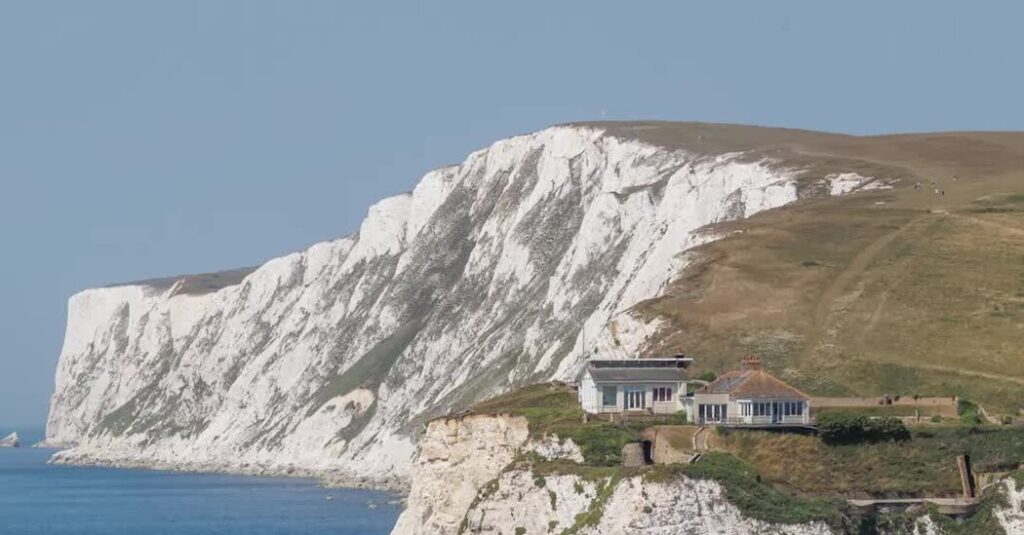
I now had a glimpse through gauzy fog of the cliffs ahead, and after a while, past the hilly meadows, I saw a sheer wall and beyond it the chalk-white Needles, eroded fragments of the bluff, like a row of half-submerged molars extending seaward. In a level area below me the path passed a cluster of gift shops and cafes, accessible by road, visited by busloads of tourists and school children. Serious hikers stopped for a cup of coffee and proceeded onward for a closer look at the Needles.
Paul Philbrow, whom I met near the Needles, was also a bird-watcher who urged me to look for kestrels and sea eagles. He was born on the Isle of Wight — his mother’s family had lived there for generations, he said, “from the mists of time.”
A dedicated hiker, he welcomed the footpath, saying, “The thing about footpaths is they have a degree of legal protection here. Once established as a right of way, they are difficult to do away with. Which is a good thing.”
He agreed that not much had changed on the island. “More people, better restaurants, no fast food.”
Enid, who worked in one of the cafes, said, “No fast food, because local people wouldn’t eat it, would they?”
I said that for my return on the path back to Freshwater Bay, I wanted to be nearer the edge of the cliff.
“The path is just past that upper gate,” Enid said. “It’s wet today and the cliff is steep. Be careful. If you fell to your death, I’d never forgive myself.”
In any event, the visibility was so poor, I stayed clear of the edge, and so did Roger, a man of about 60, not here for the hike but headed inland, and looking as though he’d had a rough passage — wild hair, torn jacket, muddy shoes.
“Because I live in a cave,” he said. “There’s caves all along this coast. People don’t know about them. I could show you some huge ones.”
He laughed and vanished into the fog.
“What you walked is one of the best paths on the island,” said Simon Ayres, my neighbor in Ventnor, who’d showed me Karl Marx’s house. He suggested extending the walk by starting from Blackgang and then hiking via Freshwater to the Needles, 13 miles of cliffs and sea and gull-clawed sky.
From Whitby to Scarborough
It was easy enough to return to the Portsmouth railway station, and London, where I stowed my bag. I simplified my gear to fit into a small backpack — a change of clothes and assorted necessities, all I would need for a four-day hike from Whitby to Scarborough.
From King’s Cross Station, I traveled north, changed trains at Northallerton and Middlesbrough, and took the train to Whitby. In 1982 I feared this branch line would be abandoned, but it was still in use, creeping through the valley of the River Esk, stopping at tiny villages, going past shapely hills, hedgerows and Yorkshire moorland, some of the stops no more than isolated platforms embowered by fuchsias in bloom.
From my hotel room on Whitby’s West Cliff I had a view of the high cliff on the far side of the harbor and Whitby Abbey — in ruins because Henry VIII ordered this Gothic masterpiece demolished in 1539. Skeletal, blackened and hollowed out, it called to mind lines in the Shakespeare sonnet, “Bare ruined choirs, where late the sweet birds sang.”
St. Hilda established the abbey in 657. Captain Cook was born nearby, and J.M.W. Turner made three visits and painted seascapes of Whitby. Billy Bennett, a man of about 60, had been camping up and down the coastal path for the past five years, after he ditched his job at a bank in disgust: “I’m a wanderer now” he said.
Rugged up in heavy clothes, a wool cap and speaking through a dense reddish beard, he said he spent his nights under a “basha” — a simple tarp — and had humped his gear that morning from a campsite on the coastal path.
“What do you do about bathing?”
He smiled. “It gets to the point where it doesn’t matter,” he said, and shared his hiker’s wisdom: “If you go far away you come back a different person.”
John Cross, down from Derby to fish for cod, agreed with that. He was 75, retired from the Rolls-Royce factory, a lifelong climber of cliffs in Derbyshire, El Capitan in Yosemite, and Peril Rouge in France. He was a supporter of the coastal path, too. “People retire and sit in front of the TV all day. That’s not for me,” he said.
In sunshine, I continued seven miles along the cliff path to Robin Hood’s Bay, much of it level, but with declivities so steep that ladderlike stairs had been cut into the valley walls. Young Ben, a techie from Coventry, passed me, a heavy rucksack on his back — he had walked almost 20 miles from Scarborough, and when I marveled at that, he said, “I walk fast.”
“You might see puffins,” Sue Knapton said, seeing me admiring flocks of terns and gulls nested in crevices in the outer cliffs. She had come down from Leeds with her husband, Andrew, who said, “There seems to be something special about walking near to the sea. It appears to lift people’s spirits.”
We walked together, and at one point I mentioned that I saw mainly older people on the coastal path.
“Here’s what I think,” Andrew said. “Older people are tougher” — and his Yorkshire accent was emphatic, toofah — “tougher than the young. They’ve been through a lot. They grew up without the social media that softens people up.”
After a few miles, the tile roofs and brick villas of Robin Hood’s Bay appeared far below at the stony seafront of a deep valley. I’d planned to stay the night and continue on the path to Scarborough the next day, but the few hotels were full. I idled in this lovely former fishing village, then caught a bus, and rode 15 miles to Scarborough.
The next day, a hot Sunday, Scarborough was thick with visitors seeking ice cream, cold beer, fish and chips, and picnics on the beach. A number of swimmers braved the cold water. Scarborough has been an English seaside destination since the 18th century — and though a bit faded now is still vital. Its local playwright Alan Ayckbourn (still active at 87) was to premiere his 92nd play in September at Scarborough’s Stephen Joseph Theater.
The following morning, I took the King Charles III England Coast Path past Scarborough Castle, along the seaside and the elegant Victorian-era Scarborough Spa, onward and upward to Wheatcroft and rural Osgodby, to Cayton Bay and Filey. On my way, I met Brian Hallet, a retired printer from Derby, taking the air.
“This is my 50th visit,” he said. “Scarborough’s a classic Victorian resort.”
“A bit decaying in places, though?”
“That’s part of its charm!”
The White Cliffs of Dover
Welcome to France, I saw on my cellphone — a Verizon message.
But I was on the outskirts of Dover, England — 21 miles across the English Channel from France — as a coda to my other hikes, climbing to the edge of the White Cliffs, following the directions of a woman I’d met who had introduced herself as Twigs Redman — “Twigs is a made-up name,” she said. “I hate my real name. I’ve been Twigs since I was a little girl.”
At Dover Station I took Dame Vera Lynn Way to Marine Parade and up to East Cliff, “There’s all sorts of caves there,” Twigs had told me. “During the war the children who were evacuated came back and lived in those caves. They were known as ‘the Uneducated’ because all the schools were closed.”
At the cliff top, I had lunch at the National Trust Visitor Center Cafe, chatted with Mary and Greg, travelers from Athens, Ga., and set off across the White Cliffs. Through the sea mist, France was a dim shape, so near, migrants cross on small boats, almost a thousand had been intercepted in the Channel that week and brought to Dover for processing.
This was the busiest section of the coastal path I’d taken — hikers from Germany and Canada; Kelvin and Tom from Hong Kong; many young families; about 20 small boys in yarmulkes and their three black-clad teachers from a shul in London. And young Lola sitting on a bench, admiring the jackdaws strafing the cliffs, celebrating her birthday by hiking the path alone, a day off from her work at the National Crime Agency in London. “I wanted to do something special,” she said.
I was with my son, Marcel, who tramped down a precipitous path to the beach at Langdon Hole and reported there was a wrecked ship under the cliff. Then we talked about children, books, favorite movies, food, travel, memories of other walks and certain family issues, aided by solvitur ambulando.
This undemanding round trip to the South Foreland Lighthouse is enhanced by the brilliant whiteness of the chalk cliffs that endows the eight-mile stretch of the coast with almost edible beauty — like traversing a wedge of wedding cake, a chunk of ice cream, or a slab of Stilton cheese, depending on the variations of marine sunlight.
This Dover path can be extended northeast to Deal or west to Folkstone. I had no time for that now, but with several thousand miles untrodden, I promised myself I’d return, to paraphrase the poet Philip Larkin, to swagger the nut-strewn paths.
Paul Theroux’s new travel book, “True North: On the Road in Canada,” will be published in September.
Follow New York Times Travel on Instagram and sign up for our Travel Dispatch newsletter to get expert tips on traveling smarter and inspiration for your next vacation. Dreaming up a future getaway or just armchair traveling? Check out our 52 Places to Go in 2026.
The post A Coastal Path Fit for a King, Now Open to All appeared first on New York Times.