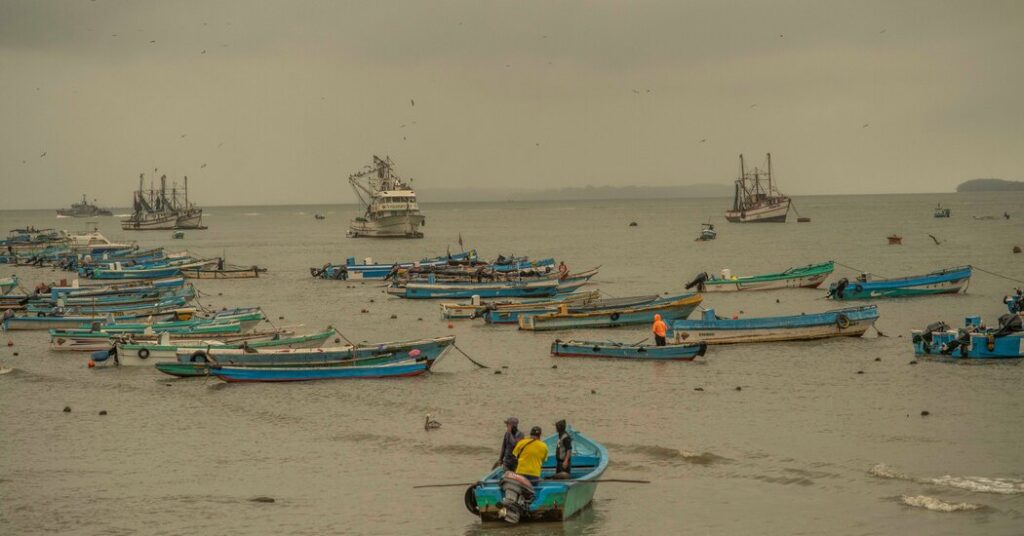
Far out in the Pacific Ocean, Ecuadorean fishermen have been attacked by unidentified “gringos” using drones, survivors say, spurring a mystery over whether the American military, the armed forces of another country or private military contractors were behind the strikes.
One fishing boat has been lost at sea since January, the U.N. says, with eight people still missing and presumed dead. The survivors of two other vessels said they came under attack in March by English-speaking assailants wearing matching uniforms with American flag patches, but without any clear insignia to link them to an official government force.
Some of the surviving fishermen said they had been hauled out of the water, questioned and then handed over to El Salvador’s navy before being released. The Pentagon has denied involvement, as has the U.S. Coast Guard.
Survivors have also said that a plane followed and seemingly surveilled them before the strikes.
The New York Times analyzed flight data and found that a maritime patrol plane — based out of a military base in El Salvador — flew in the direction of all three boats in the days before they were attacked. The pilots onboard spoke English with American accents, according to air traffic control communication recordings.
And as the boats moved through the ocean, the plane’s course also shifted to remain pointed at each of them over several days, The Times analysis found. Flight tracking data shows that the plane flew toward the boat that went missing in January, the Fiorella, on four different days, including on the day it disappeared.
But the plane does not appear on the Pentagon’s lists of active aircraft. Instead, it was registered last October to a company that lists its address as a private mailbox in a UPS store in Richmond, Va., according to Federal Aviation Administration records.
Since the Pentagon started blowing up boats in the Caribbean Sea and Pacific Ocean last September, accusing them of being used for drug trafficking, dozens of vessels have been attacked, killing at least 221 people.
Washington has not been shy about claiming the strikes, often publishing footage on social media of tiny fishing boats cutting through the water before being obliterated by American munitions.
These attacks, however, have gone unclaimed.
It is certainly possible that the U.S. or some other military has conducted clandestine attacks on boats in the region. But the many lingering questions surrounding the fishing boat attacks have led some experts to wonder whether a private military contractor has been hired by the U.S. government or one of its Latin American allies — possibly El Salvador, where the plane has operated.
“It would be one thing if the U.S. didn’t have an overt maritime strike campaign, but they do, and they’re posting snuff films of boats going up in flames regularly. And that’s what makes this even more squirrelly,” said Brian Finucane, a former State Department lawyer who specializes in the laws of war. He worked in the Obama and Biden administrations, as well as in the first Trump one.
“Who are these people that are operating, and under what authority?” Mr. Finucane asked. “And they are using a UPS store as their company address? Come on.”
Ecuadorean and Salvadoran officials did not respond to requests for comment.
In November, the plane that tracked the courses of the fishing boats was flown from Tennessee to El Salvador and stationed on the military side of an airport there, flight data show. During that time, the Pentagon began increasing its air assets at another nearby airport in El Salvador to support its counternarcotics campaign in Latin America.
Air traffic controllers told the patrol plane to park at the “military apron.” A satellite image from January shows the plane parked near military aircraft, hundreds of yards away from the closest civilian craft, and images taken from the ground show that the plane’s tail is adorned with the flag of El Salvador. Still, it is unclear what role, if any, the plane played in the attacks on the fishing boats.
The Trump administration has made Latin America one of its top foreign policy priorities, to try to stem the flow of migrants and the region’s drug cartels.
Some private military contractors have shifted in kind.
Earlier this year, the Trump administration discussed issuing “letters of marque,” which were used by the U.S. government during the 18th century, before the nation had built up its navy. The letters would allow the U.S. government to contract private security forces with maritime capabilities to protect Washington’s interests at sea and to detain vessel crews.
The letters, according to three people with knowledge of the discussions, were circulated among various agencies for their input in May and were supposed to complement the Pentagon’s boat strike campaign in the Pacific Ocean and Caribbean Sea.
Discussions around letters of marque seemed to stall around June, and the Pentagon would not say whether any have been issued. When asked about the attacks on the fishing boats, it said, “We have no knowledge of, nor were U.S. Southern Command forces involved in, the incidents described.”
Private military contractors have been active in the hemisphere. Erik Prince, whose firm Blackwater was a notorious private military contractor hired by the U.S. government in Iraq, began touring Latin America in the lead-up to the 2024 election. Mr. Prince has met with the leaders of El Salvador and Ecuador to discuss regional security, although details of those conversations are unknown.
One of Mr. Prince’s security firms was contracted by the Haitian government last year to fight the gangs, a deal the State Department authorized. As part of that contract, Mr. Prince’s company offered maritime services to patrol Haiti’s coast, according to an official in Haiti familiar with the contract.
A spokesperson for Mr. Prince said that “neither Erik Prince nor any entities affiliated with him have any relation to these events” involving Ecuadorean fishing boats.
While the Pentagon’s strikes use sophisticated equipment, including attack planes and MQ-9 Reaper drones, the attacks on the Ecuadorean fishing vessels have been carried out by rudimentary drones fitted with explosives and deployed from a vessel manned by “gringos” with American-flag patches who never identified themselves, a lawyer representing some of the fishermen said.
Ever since the Pentagon began striking boats last year, Ecuadorean fishermen say they have been scared to go out onto the water. But the crew members of the Negra Francisca Duarte II had bills to pay and mouths to feed, they said, so they set out to sea in early March.
Satisfied with their catch, they said, they headed back to the mainland, entering Ecuador’s territorial waters in mid-March. That morning they were stopped by the nation’s coast guard, inspected and then cleared for passage, according to interviews with five of the crew.
That afternoon, they said they noticed they were being followed by a blue boat on the horizon. About an hour later, drones flew toward them and then dropped explosive devices onto their ship, injuring several crewmen and engulfing their vessel in flames.
“The boys were there, hurt and scared. Some got a fire extinguisher to try to put out the fire, but there were too many flames,” the captain of the Negra Francisca, Hernán Flores, told The Times.
As the fire grew, some of the crew members dived into the ocean while others jumped into smaller boats attached to the Negra Francisca. They headed toward the blue ship that had been following them, hoping to be saved.
“We were really scared,” Mr. Flores said.
As they approached the blue vessel, the crew members onboard ordered the fishermen to raise their hands, communicating through a translator, the fishermen said. They said they were then bound, hooded and held on deck overnight, receiving no medical attention even though some were badly injured, with open, bleeding wounds.
The men, who were armed, questioned the fishermen, asking whether they were carrying anything illegal. When an injured fisherman replied that they had been inspected by the Ecuadorean Coast Guard shortly before the attack, the men began arguing among each other, seemingly worried, the fishermen said.
The next morning, the fishermen said, they were transferred to the Salvadoran Coast Guard and taken to a naval base in La Unión, in El Salvador, where they were treated well. The Salvadoran authorities told them that when they received the Ecuadorean crew, the armed men described their captives only as shipwrecked fishermen. They were then released to the capital, San Salvador, with no charges, the crew members said.
What struck Mr. Flores was his inability to identify the group of men on the blue boat, he said. For decades, he said, he had interacted with the navies and coast guards of Ecuador, the United States and other nations that patrol the waters around Ecuador, one of the world’s biggest routes for the illicit cocaine trade. They often sailed boats that clearly identified what branch of government they belonged to — like the Navy or the Coast Guard — and wore uniforms with insignia to match, the fishermen said.
But these men wore just the American flag patches, and their vessel did not fly a flag or have other markings on it, the fishermen’s lawyer said.
A U.S. Coast Guard spokesperson said in a statement that the Coast Guard cutter Bertholf, participated in a search for the Negra Francisca, as it was only about 70 miles from the fishermen. It said it had found debris from the boat but no survivors and suspended the search after 12 hours. The Coast Guard and Pentagon denied any knowledge or involvement in the attack.
While it remains unclear who carried out the strikes, they came as the Pentagon stepped up its cooperation with allies across Latin America to combat the drug trade. In May, the Pentagon applied pressure on Guatemala to agree to joint U.S. airstrikes and other military action inside its borders, to target suspected drug groups. Ecuador agreed to a similar deal earlier this year.
Last week, U.S. Southern Command announced Joint Task Force Western Hemisphere, setting up the infrastructure for the more ambitious, Latin American-wide expansion of its war against drugs in cooperation with regional allies.
The attacks on the Ecuadorean fishermen should be a wake-up call for Latin American governments, argued Juanita Goebertus, who leads the Americas division at Human Rights Watch, which published its own report on the strikes.
“The U.S. government is prioritizing operations based on weak intelligence and with illegal use of force,” she said.
Eric Schmitt contributed reporting from Washington, and Gabriel Labrador from Mexico City. Map by Daniel Wood.
The post They Spoke English, Wore U.S. Flags and Attacked Fishermen. Who Were They? appeared first on New York Times.