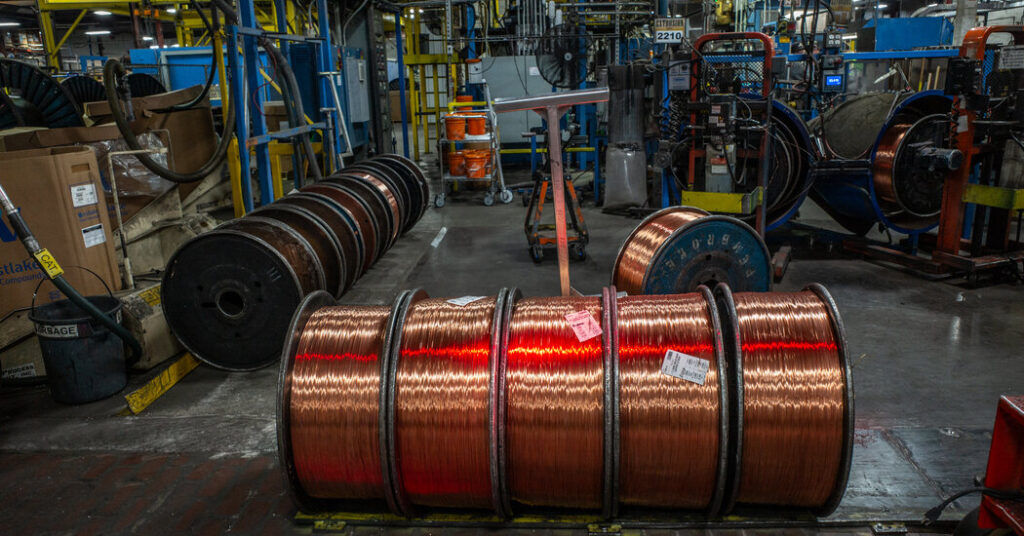
At Northern Cable, the machinery that churns out steel-clad cable runs 24 hours a day, seven days a week. The push isn’t driven by a flood of new orders. It’s driven by fear.
The Canadian company is rushing to fill warehouses across the United States. It is one of many businesses making goods in Canada for U.S. customers that now face pressure to move their factories south of the border to avoid President Trump’s 50 percent tariffs, which are scheduled to start next week, on their products.
Mr. Trump’s latest tariff salvo hits particularly close to home for Northern Cable. Its factory, partly housed in a former Coca-Cola bottling plant, sits about 2.5 miles north of the invisible line dividing Ontario and New York State along the St. Lawrence River.
With half of its business coming from the United States, the company is now considering a move south. It would be a striking reversal for Northern Cable, which was founded in 1996 to keep cable-making in Brockville, Ontario, after a U.S.-based company closed its plant there and shifted production out of Canada.
But if Mr. Trump’s tariffs on a wide range of goods, including electric cable, take effect as planned on Aug. 19, Shelley Bacon, the company’s chief executive, said that he and Todd Stafford, its president, will have to start looking for an American factory.
“Todd and I are going to have to to go down and go shopping,” Mr. Bacon said, seated at a boardroom table where short lengths of cable made at the factory were displayed under glass. “We have too many jobs at stake here to just do nothing.”
Northern Cable normally divides production of its armored electrical cables — which power everything from office towers to underground mines — evenly between Canadian and American customers. But to stock its U.S. warehouses, about 80 percent of the cable now being wound onto spools that weigh up to 12,000 pounds is being made to American electrical standards. Mr. Stafford estimates that the U.S. warehouses will be emptied within two to three weeks.
Northern Cable, which has 320 employees, is not alone. A survey of 275 manufacturers conducted by the polling firm Angus Reid for KPMG found that 29 percent had moved some or all of their production to the United States since Mr. Trump started his trade war with Canada. Another 13 percent more were considering it. (The survey was conducted in May before Mr. Trump announced his latest 50 percent tariffs.)
“If the trade and tariff uncertainty continues and if there is not a focus from the government on some of the systemic issues that impact manufacturing in Canada, these manufacturers may not have a choice but to start moving to the U.S.,” said Anamika Gadia, KPMG’s national leader for industrial markets in Canada. “It’s not necessarily their desire. But they may be left with little choice.”
In Ottawa, Ambico makes highly specialized doors — bullet-resistant, blast-resistant, soundproof, fireproof and eavesdropping-proof — found in buildings, including the Pentagon and the Eisenhower Executive Office Building at the White House complex. Jack Shiner, the company’s chief executive, once had no idea where the steel arriving at his factory was made; it simply came flattened and roughly cut from a processor in Montreal.
But after the United States imposed a 25 percent tariff on products made largely from steel or aluminum, Mr. Shiner made sure that the supplier sent only U.S.-made steel, cutting the effective tariff rate on the company’s doors, which cost roughly $5,000 to $20,000 each, to about 10 percent.
“So I’m not going to be susceptible for the moment,” Mr. Shiner said. “The problem is what happens when the administration changes its mind tomorrow afternoon or next month or in three months? Nobody knows.”
Ambico, started by Mr. Shiner’s father and uncle in 1955, initially only sold metal doors and frames around Ottawa before expanding into Montreal and Toronto. After Mr. Shiner returned in 1980 from university and theological studies in the U.S., he pushed to expand into upstate New York. It was an unconventional idea at the time for a small Canadian manufacturer outside the auto industry, years before Canada and the United States signed their first free-trade agreement in 1989.
“I had this comfort with doing business in America, just 45 minutes from here, ” Mr. Shiner said. “Then we realized that there was a lot more business in the upper-tier states than there was in Ontario and Quebec — and there wasn’t the competition.”
About two-thirds of Ambico’s business now comes from the United States. Still, Mr. Shiner said, he will not move the company south.
“The 120 people that I employ here know that I’m not,” he said. “But how am I going to sustain my business is really the question.”
A few years ago, Ambico explored opening a second plant in upstate New York but abandoned the idea after concluding it could not find enough workers. Instead, Mr. Shiner plans to license some of the company’s technology to American door makers and expand into Europe, where Ambico is now certifying its doors for European standards. He expects that market to replace only about 15 percent of the company’s business.
He said that he expects the company may lose money for one or two years because of the tariffs. “I think we can weather the storms,” he said. “I do. Maybe I’m being naïve.”
Northern Cable is also eyeing Europe, though the path is harder. European electrical standards do not currently allow armored electrical cable to be used as industrial wiring, so cables must be threaded through steel pipes instead. Mr. Stafford said the company is seeking approval to change that, but expects the process could take 15 years.
Mr. Trump is not Northern Cable’s only trade headache. Mr. Bacon said that after the United States imposed steep tariffs on electrical cables from China, those products began flowing into Canada.
China exported about 538 million Canadian dollars worth of wire and cables to Canada in 2024, up from 327 million dollars in 2015. (In 2024 Canada imported 872 million dollars in cables from the United States and shipped cables worth 704 million dollars to American customers.)
“We’re getting hammered at in Canada by Chinese imports,” Mr. Bacon said, adding that he’s frustrated by what he views as a lack of interest in the Canadian government about the situation, although Canada recently imposed tariffs on some smaller cables from China, a minor product in Northern Cable’s portfolio.
Like Mr. Shiner, Mr. Stafford said he was worried about finding enough workers for an American plant that would not entirely escape tariffs. Canadian companies would still need to import large amounts of aluminum because the United States has limited capacity to produce the metal. Right now that aluminum faces a 50 percent tariff.
But if new Trump tariffs take effect on Aug. 19, Mr. Stafford said the company will move quickly.
“We’re going to have to go into overdrive to figure out: Where can we get some space, where can we put some machines? How can we start this process?” he said. ”We’ve started now, but just quietly right now.”
The post Trump’s Tariffs Force Some Canadian Companies to Consider Moving South appeared first on New York Times.