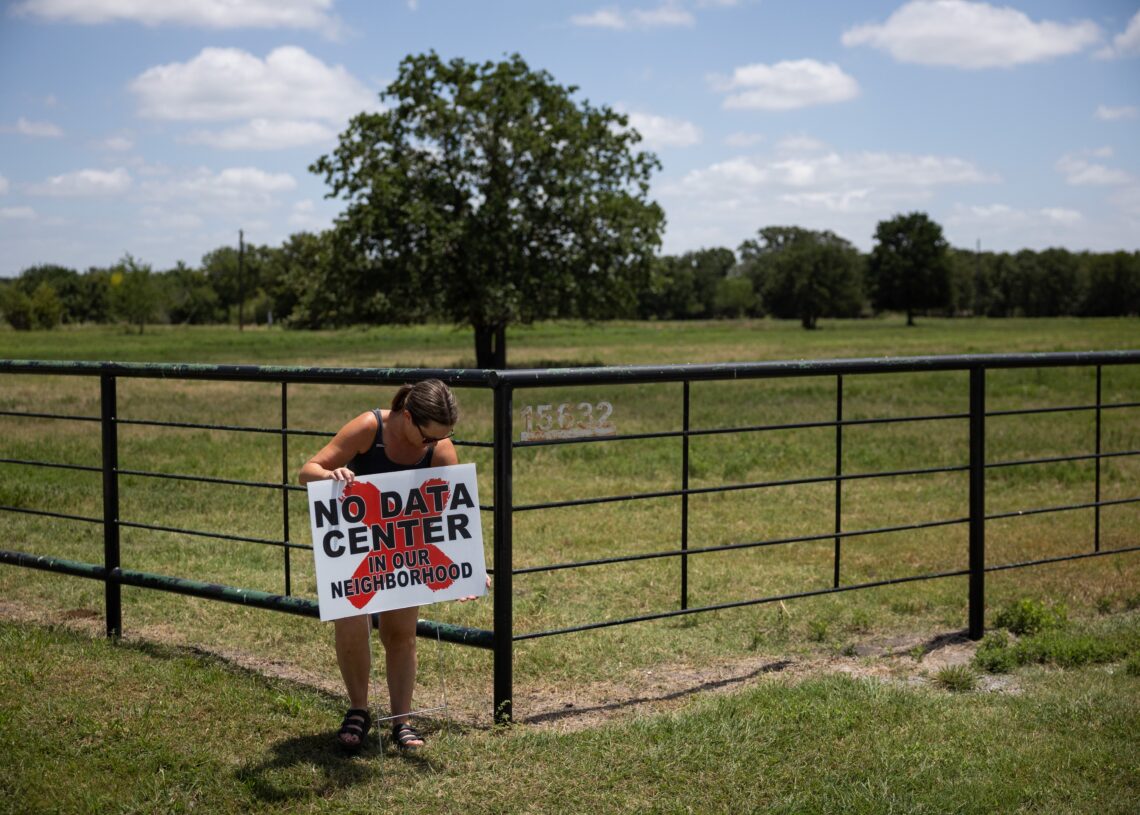
CENTERVILLE, Texas — Nikki Meador grew up here in East Texas. She’s a lifelong conservative and a three-time Trump voter unaccustomed to activism. That’s mostly because there’s never been much to protest in rural Leon County.
That changed when the nurse practitioner heard data centers were coming.
“We are the people who built this community, and we intend to pass it down to our children. We deserve protection, not to be sacrificed for outside investment. Industrialization is irreversible,” said Meador, 43.
Meador, wearing a camo green T-shirt bearing the state’s unofficial motto, “Come and take it,” was among several dozen attending the county commissioners’ regular meeting on a recent Monday.
“We’re asking you to consider the long-term cost to taxpayers, the environmental and safety risks, the permanent loss of what makes this place home,” she said.
Texas conservatives love free markets, the energy industry, development and small government. But in scores of deep-red Texas communities such as Leon County, longtime Republican voters are setting aside those principles to battle an onslaught of data center projects that pro-business GOP leaders initially welcomed.
Opposition to data centers has been notably bipartisan in communities across the country. But the fierce pushback from conservatives in Texas has required no help from liberal groups, and it has been felt everywhere from the state GOP’s new party platform to the campaigns of Lt. Gov. Dan Patrick and Gov. Greg Abbott, Republicans who now support varying degrees of increased data center regulation.
At the GOP convention in June, the platform included a new plank that would require data centers to disclose and finance infrastructure needs without shifting costs to residents; prioritize the use of reclaimed water; and protect aquifers and the state’s electrical grid.
Patrick, a staunch Trump ally, has made AI regulation a priority for the next legislative session in January.
On the campaign trail, Abbott and other elected officials speak openly about restraining data centers. On Aug. 3, Abbott announced he is requiring audits of every data center seeking power from the Texas grid before they can connect. On Thursday and Friday, he announced that several data center companies had agreed to state audits.
“I established clear guardrails to ensure data centers protect our electric grid, conserve our water, respect our neighborhoods and pay their own way,” Abbott said in a Monday post on X, noting OpenAI had agreed to comply with the new Texas standards. “They must not pass costs on to Texas families or interfere with their quality of life.”
Still, Meador said Abbott has not done enough to stop data centers.
“He’s just trying to scramble because he realizes he’s basically making rural Texas mad, and that’s where a lot of his votes come from,” she said, dismissing the governor’s audits as “very vague.”
Meador said she won’t vote for Abbott and instead might vote for a Democrat for the first time — Gina Hinojosa, a state representative from Austin and South Texas — because “she’s against data centers in rural areas.”
In Leon County, population 17,000, where 88 percent of voters like Meador chose Donald Trump last election, residents have been frustrated to learn how little their local GOP elected officials can do to stop the projects being proposed. Until now, the largest industries Leon County had were oil and gas, a steel plant, and chicken farms, which drew much less opposition.
Last month, commissioners refused an application from Crusoe Technologies for tax breaks for its proposed 800-acre, $34 billion data center, citing an incomplete submission. But Crusoe can reapply or build without the tax breaks, and commissioners said they’ll be helpless to block the project because the county — unlike many cities — has only narrow zoning authority to regulate places like landfills, liquor and adult video stores.
Commissioners attempted to reassure residents that they, too, were troubled by the Crusoe project, which is expected to break ground within a year and cost the county $4 million to $5 million in added services.
Commissioner Thomas Jefferson “T.J.” Foley noted that he is responsible for the volunteer fire department, lives within 600 feet of one of the proposed power plants expected to fuel the data center, and worries about how the county will cope with their increased demand for resources and services, especially if there’s a disaster at the massive sites.
“Leon County and no rural county is prepared to handle this,” he said. “Until there is a catastrophe and one of these things blows up, there’s probably nothing we can say.”
“That’s not very comforting,” a man shouted from the audience.
Leon County GOP Chair Carol Milder is emblematic of the shift among conservatives when it comes to opposition to data centers.
The retired real estate appraiser’s father worked on an oil rig. Growing up in Houston, she saw the oil and gas industry build the middle class. But attending a panel on data centers at the state GOP convention in June in Houston awakened her to the differences between the industries.
Panel experts, including her neighbor Michael Rice, 46, who used to work at an Austin data center, explained that unlike oil rigs and refineries, data centers bring few jobs — 40 proposed so far in Leon County — and even those are often staffed by workers from elsewhere. Milder and others at the commissioners’ meeting said they resented paying taxes only to see data centers initially get tax exemptions, effectively subsidized by residents the way manufacturing and solar industries have been.
She told the commissioners: “We’re being held hostage for the money for them to build.”
“We’re trying to be as prepared as we can,” said Commissioner Kyle Workman, a construction consultant. He said that unlike in Texas cities, the unincorporated community’s limited government — which many in the audience historically favored — left commissioners with few tools to block the data centers. “Leon County has kept government down over the years,” Workman said. “There’s limits to what we can do.”
Residents said they thought that was precisely why data center companies were targeting rural areas. Of the nearly 248 data center projects proposed statewide, nearly half are in unincorporated rural areas where zoning and other restrictions cannot be used to block them.
And residents worried that any state legislation that might help defend against the projects would not pass until late next year — too late to block the data center proposed by Crusoe and others expected to follow. Belltown Power has proposed building a 900-acre data center in Leon County, and Black Mountain — another North Texas-based company — bought property and announced plans to build a massive power plant there.
Milder said she alerted an adviser to the governor this year about growing local opposition in counties such as Leon. She reminded him that a majority of the state’s 254 counties are rural and that they are a key part of Abbott and the GOP’s conservative base.
“Texas is red because of rural Texans, and we need to be listened to,” Milder told him. “You need to be concerned with what concerns us. And we’re being raped and pillaged.”
Texas is poised to overtake Virginia as the nation’s top data center hub by 2030. A recent poll found 56 percent of Texans oppose data centers being built in their communities.
“They love our farmland because it’s flat, it’s clear, there’s water and electricity there, and they can just come in and start building,” GOP Agriculture Commissioner Sid Miller said at an anti-data-center protest outside the state Capitol in Austin recently. The small crowd chanted, “Special session now!”
After hailing Texas as “the epicenter of AI development” last fall, Abbott recently reversed course as he campaigns for reelection to a record fourth term, urging state lawmakers to repeal the centers’ sales tax exemptions and regulate where they can be built. Last month, he ordered the state Public Utility Commission and council managing the electrical grid that covers most of the state to enforce restrictions on data centers, including requiring them to “fully fund the costs of electric infrastructure.”
“We must prohibit them from building AI data centers in rural Texas neighborhoods,” Abbott said at a campaign stop about 90 miles north of Centerville on June 30.
By the end of July, the governor announced that the state had “begun sweeping changes to how data centers pay for the infrastructure needed to serve them, ensuring data centers do not shift those costs onto everyday Texans or place unnecessary strain on our state’s resources.”
But Miller and Leon County conservatives said those stepped-up regulations are not enough. They want Abbott to call a special legislative session — as he has in recent years for conservative priorities such as school vouchers, congressional redistricting and property tax cuts — to pause data center development and increase regulations and oversight.
A spokesman for the governor declined to comment about whether Abbott will call for a special session on data centers.
“Governor Abbott has been clear that data centers cannot come before Texas families,” spokesman Andrew Mahaleris said in a statement, noting that the state regulators’ new requirements “protect Texans from higher costs and negative impacts on their communities.”
Daniel McCoslin, 48, is a retired railroad engineer who fought with the Marines in Iraq. He ranches land that’s been in his family since the 1800s that abuts the proposed Belltown data center site. A relative’s ranch borders the Crusoe site. That’s why McCoslin — a libertarian who voted for Trump three times — organized a local anti-data-center group to educate neighbors.
McCoslin dismissed Abbott’s recent data center regulations as “pandering.” That’s why in November he plans to vote for a Democrat for the first time in his life. Clayton Tucker, a rancher running for agriculture commissioner as the anti-data-center candidate, has called for a data center moratorium.
When data center companies started offering neighbors up to $50,000 an acre — “life-changing money” — McCoslin recalls talk at the feed store turning to whether folks would take the millions. McCoslin was adamant he would not.
“Family means a lot more than money,” he said.
The evening after the commissioners’ meeting, McCoslin helped organize a town hall to update neighbors. The crowd that settled into folding chairs at a local community center included plenty of retirees, at least one of them in a MAGA hat. There were also workers, some in volunteer firefighter T-shirts, others in straw cowboy hats and boots with spurs.
Organizers used a projector to display maps of the proposed data centers and power plant and fielded questions about potential environmental and economic effects: How many jobs will they bring, and for whom? Will they pollute the ground and water? Are they expected to decrease property values? Can they be stopped?
Organizers displayed phone numbers and emails for Abbott and other state and local GOP lawmakers. They urged residents to contact the officials with data center concerns.
“We’ll be calling,” said Mandy Williams, 46, as she left the meeting with her husband and towheaded 4-year-old daughter Violet in a “Cowgirl forever” T-shirt.
The couple live on the eastern side of the county on a cattle ranch of more than 200 acres. Stephen Williams’s ancestors settled the land when Texas gained independence from Mexico in 1836, nine years before it became a state. Like many other Texans, owning land is part of his identity, a birthright he feels a duty to steward.
“Hopefully we get enough pressure on him,” Stephen Williams, 46, said of the governor.
When commissioners met Monday, they did not take action on the tax breaks and told residents Crusoe had yet to reapply, Milder said.
Back at his modest ranch house, McCoslin pointed to turn-of-the-century black-and-white portraits of his ancestors taken under the oaks just steps away.
“At night, you can hear how quiet it is and see so many stars,” he said, describing his evening routine of settling outside to smoke a cigar and sip bourbon, his only soundtrack the crickets, frogs and occasional coyote. “We don’t want 24-hour industrial hum and lights destroying the sky. If I wanted that, I’d live in Houston.”
The post Rural Texas conservatives love free markets but not when it comes to data centers appeared first on Washington Post.