Calling a work of music a museum piece can be a compliment or an insult, depending on who’s talking — or on what kind of museum we’re talking about. Strong curation can expand understanding, provide context for new works and recontextualize the canon.
Jonathon Heyward, closing out his third year as the music director of the Festival Orchestra of Lincoln Center (and his second as its artistic director as well), is a strong curator. Across two concerts of premieres and perennial favorites recently, he refined a formula and invited audiences into the program.
With strong communication skills and an unassuming manner, he at once catches you off guard and puts you at ease. He began each concert at David Geffen Hall with brief introductions to the pieces, articulating the program’s ideas and offering unobtrusive suggestions to directing your attention. Then he turned to cue the orchestra and conducted with shrewd musical and dramatic instinct, inspiring an orchestral sound that was confident and nuanced, while also relaxed.
The first program, called “A Mother’s Love” (July 31-Aug. 1), began and ended with lullabies. The concert opened with William Grant Still’s “Mother and Child,” for string orchestra, which introduced a tender, undulating melody that swelled and rocked atop plush harmonies and that had hints of the blues. In Heyward’s hands, you get the sense of catching the tune in drifts in the early morning: a mother humming the previous night’s song to herself.
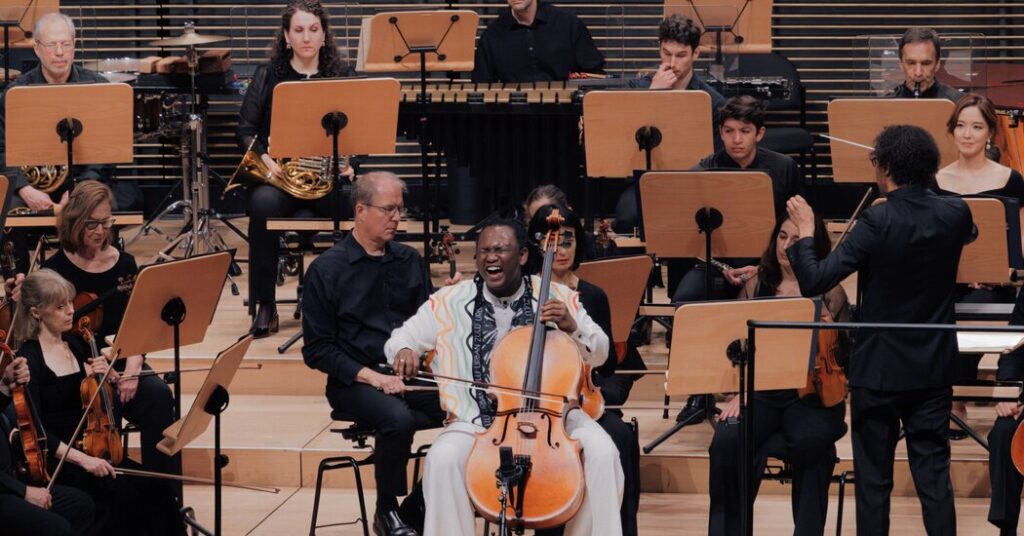
Jessie Montgomery’s cello concerto “These Righteous Paths,” in its New York premiere, addresses the death of her mother, Robbie McCauley, the playwright, director, activist and poet, whose words provide the titles of the concerto’s three movements. Montgomery and the cellist Abel Selaocoe carefully turn grief over like a stone in the hand, feeling its sharpness but noting its stark beauty. In the first movement, “All the Ancestors and I,” Selaocoe doubled cello with his voice in an incantatory melody that rose above shimmering vibraphones, rich in longing and reaching for something beyond words. Elsewhere, virtuosic, yearning cadenzas for Selaocoe wove in and out of rich orchestral textures rendered by muted tubas, tinkling harps and roiling percussion that conveyed a changing landscape of loss before a solo section of lonely, laborious double stops suggested visceral contractions of grief.
Snippets of McCauley’s poetry occasionally appeared in Selacoe’s vocal line, emerging as if suddenly remembered, but much of the singing is wordless. In ethereal falsetto, mouth percussion and throat singing, Selaocoe’s voice offered astounding timbral variety, enough to match his textured playing. At times, his voice sounded like an echo of itself.
Singing almost as much as he played, Selaocoe built upon Montgomery’s material, improvising with a virtuosity born of both technical skill and something more — empathy — which infused his gestures with a haptic immediacy, reaching both ear and soul.
Brahms’s Second Symphony closed the loop on the lullabies, with its first movement taking up his famous cradle song. Here, Heyward brought such sensitivity and precision that you could almost hear a catch in the breath between the tune’s phrases. After “Mother and Child” and “These Righteous Paths,” the music came across as uneasy and more adult, and the triumph of the final movements felt more satisfying for being harder won.
The second program, “New Beginnings” (Aug. 7-8), featured works about spring and, more generally, firsts: one composer’s first symphony, another’s first double concerto and the first performance of a piece.
Frederick Delius’s “On Hearing the First Cuckoo in Spring” opened, migrating a Norwegian folk song into a luxuriant landscape dotted with cuckoo calls (represented by a mellow oboe) and plush, almost overripe harmonies. It was followed by the program’s buzziest work and only misstep: the New York premiere of Billy Childs’s concerto for flute and clarinet, “A More Perfect Union.”
The Constitution-quoting “Union” is not only national, but familial: This concerto was written for the brothers Anthony (principal clarinet of the New York Philharmonic) and Demarre McGill (principal flute of the Seattle Symphony). In the first movement, Childs quickly established contrasts between blaring brass fanfares and shapely melodies for the soloists, and in the second, he darkened the mood with a pensive duet. But by the third, his structures became expected: Appearing throughout but without developing sufficiently were countless scalar runs for clarinet and flute; disjointed, angular figures; and a heavy dose of brass bombast. Childs often seamlessly melds jazz and classical idioms in ways that enrich both traditions, yet “A More Perfect Union” didn’t elucidate its premise or cut through pastiche. The McGill brothers are razor-sharp musicians, even if the concerto was less than the sum of its parts.
After intermission, the program snapped back into focus with the world premiere of Hannah Ishizaki’s insightful “Change Thy Course,” which reimagines elements from Robert Schumann’s First Symphony (sometimes referred to as simply “Spring”) for the era of climate change. The brass fanfare that open’s Schumann’s symphony reappears in Ishizaki’s piece, but amid sliding microtonal figures and while seeming to melt after being stripped of a triumphant cadence.
Elsewhere, Ishizaki breaks apart a chord progression from the Schumann and transforms it into glacial soundscape. Ambient strings are subsumed by wobbling vibrations from single musical glass, giving the impression that the sound is clipping out. Schumann’s spirited woodwinds appear throughout as ghostly breaths and wheezes through the same instruments. “Change Thy Course” is as much a fascinating reflection on the past as it is an elegy for the present.
Schumann’s symphony, when it followed, was all the more pleasurable because of Ishizaki’s premiere. Written early in Schumann’s marriage, it reads as a portrait of someone in love to the point of bursting into laughter or tears. The figures familiar from “Change Thy Course” sounded almost unnaturally colorful, the vision of spring more dizzying in high definition. Heyward conducted this, like every work, with clarity of purpose and aplomb.
Even top orchestras can struggle to balance competing demands for new works and canonical favorites. At worst, premieres can seem like a bone thrown to those seeking diversity and relevance; classics, like the sugar to help the contemporary music medicine go down.
However corny the program titles may be, Heyward has found a formula for “museum pieces”: nestling new pieces alongside favorites and highlighting smaller gems around themes that encourage listeners to savor connections across styles. Heyward makes it look easy, but that’s no small feat.
The post Lincoln Center’s Orchestra Makes Creative Programming Look Easy appeared first on New York Times.