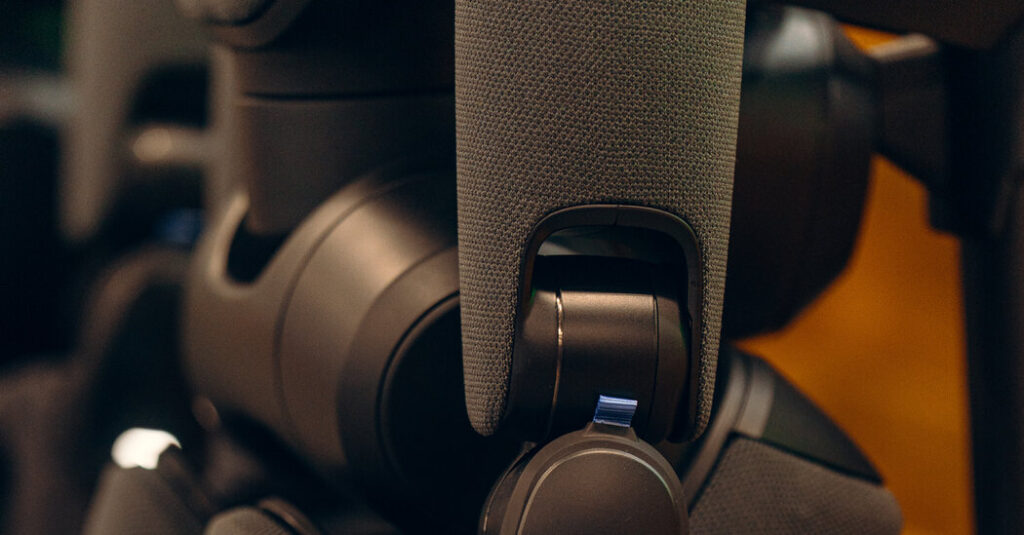
At a BMW factory in South Carolina, a human-shaped robot with a screen for a face recently stepped from a charging station toward a stack of green plastic boxes. It grasped an auto part from one of the boxes, pivoted, placed the part in a trolley, then pulled the trolley across the floor.
The robot’s slow, stiff movements suggested a worker with a bad hangover rather than a technological revolution.
“They’re still slower than humans,” Ulrich Wieland, a BMW vice president in charge of logistics at the factory, in Spartanburg, told reporters invited to see the robot in June. But, he added, “they’re advancing fast.”
Automakers have used robots for decades, but they are usually powerful, one-armed machines that are fixed in place and perform repetitive tasks like welding body frames or applying adhesives to door panels.
Now, most major automakers are betting that robots designed to resemble human beings, known as humanoids, will usher in a new wave of automation and efficiency. Equipped with artificial intelligence, they are expected to move around and do tasks now done by humans without any modifications to factories or heavy equipment.
Unlike most of the robots now in use, humanoids would respond to voice commands and theoretically solve problems and react to unforeseen events. They would never take a lunch break, join a union or require health insurance.
To optimists, robots could rescue U.S. manufacturing by increasing productivity, solving shortages of skilled workers and giving Western carmakers a fighting chance at competing with Chinese rivals that enjoy lower costs. Boring but important jobs like sorting parts would be done by robots, freeing humans for more interesting and specialized work.
But many experts who have studied the use of robots and other automation tools caution that there is also a gloomier scenario.
“With any kind of automation, you generally reduce the amount of labor you need per widget that you make, and that’s generally a gain for society,” said Susan Helper, a professor of economics at Case Western Reserve University who testified on robotics before a congressional committee in April.
“But,” she added, “how do you use that extra time that’s freed up? You can use it to just take away the interesting work and leave the human workers with the boring work. And have fewer workers that you pay less.”
And Chinese companies already have a head start after their government made robot technology a national priority. Robot makers in China can draw on a network of suppliers for actuators, a part that enables movement, and sensors that are hard to find in the United States.
“The cost of deploying a robot in China is just a fraction of what it is to deploy a robot in the U.S.,” said Ben Armstrong, the executive director of M.I.T.’s Industrial Performance Center. “They have this extremely dense ecosystem of toolmakers and equipment providers.”
The Federal Communications Commission last month banned the import of humanoids and other advanced robots from China.
Automakers already use conventional robots more than other industries and are likely to be among the biggest users of humanoids.
Hyundai Motor is one of the companies pursuing robotics most aggressively. At the company’s factory about half an hour from Savannah, Ga., autonomous carts have largely replaced forklifts for moving materials around the plant. Four-legged robots that look like dogs search for flaws by peering under car bodies. Flat, wheeled robots the size of queen beds slide under Ioniq 5 or Ioniq 9 electric vehicles as they come off the assembly line, lift them from below and transport them to testing stations.
In most car factories, workers drive the vehicles to testing. Being human, they occasionally drive into pillars and other objects. That’s not a problem with Hyundai’s transport robots, said Jerry Roach, a senior manager in charge of general assembly at the Georgia factory, which began producing cars in 2024.
“We’ve never hit a pole,” he said.
In 2021 Hyundai acquired Boston Dynamics, which is developing humanoid robots that the carmaker plans to use initially for arranging components in a specified order for humans to install in vehicles.
That is the same basic task that the BMW robot, made by Figure AI, demonstrated in Spartanburg. Mercedes-Benz, which is testing robots made by Apptronik in Austin, Texas, also plans to use them for handling and sorting materials. Carmakers say they have trouble retaining workers to perform such basic tasks.
Brent Stubbs, chief administrative officer of the Hyundai factory, is adamant that robots will create better automotive jobs, especially for young people raised on video games. The company has established an apprenticeship program in robot maintenance that Mr. Stubbs said would lead to high-paying jobs.
“That presents a unique opportunity now for more people to get involved in manufacturing, where a lot of the stereotypes of who it fits are totally out the door,” Mr. Stubbs said.
Labor representatives are extremely skeptical of such claims and fear that robots will simply replace humans. Hyundai workers in South Korea went on strike last month, demanding a voice in how the company uses robots.
Shawn Fain, the president of the United Automotive Workers union, has called humanoid robots and artificial intelligence a “profound threat” to workers and a tool that will make billionaires richer. “The human race has to master technology and not let it master us,” he told delegates to the union’s annual convention in June.
Experts who have studied the history of automation say its effect on jobs is complex and hard to predict. And, they add, so is its effect on efficiency and corporate profits.
“If this is done in a way that is just pushing a fad, the risk is that it’s lowering productivity,” said Laurence Ales, a professor of economics at Carnegie Mellon University who studies labor and technology. “You get a displaced worker, and it’s not clear I made the process more productive.”
Companies are most successful when they develop the skills of their workers as they deploy new technology, Mr. Armstrong of M.I.T. said. Firms that combined worker training with automation achieved the greatest increases in productivity, according to his research.
There are often simpler and less expensive ways to automate basic tasks like sorting parts than with humanoid robots, Mr. Armstrong added, saying, “Humanoids are a million-dollar solution to a one-hundred-dollar problem.”
Car factories are already highly automated, he said, so automating the remaining tasks may not yield big cost savings or increases in production. “The prospect of humanoids to change the game in automotive is quite small.”
The most prominent robot enthusiast in the auto business is Elon Musk, the chief executive of Tesla. He has made humanoid robots a central part of the company’s strategy to remake itself as an artificial intelligence powerhouse. The company has developed a humanoid called Optimus that it plans to use in its factories and to sell to other businesses and consumers.
Optimus robots have been used at the Tesla Diner in Los Angeles and to serve drinks at company events. Mr. Musk has said they will someday be able to perform surgery and babysit children. This year Tesla stopped producing the Model S and Model X cars in a California factory to make room for Optimus production.
“Optimus will be the biggest product ever,” Mr. Musk said during a conference call with investors and analysts last month. But he has also acknowledged challenges.
Among the most confounding is how to duplicate the dexterity and sensitivity of the human hand — a problem that has long stumped robotics experts. “The more you study the human hand, the more you realize how amazing hands are,” Mr. Musk said.
Automakers have already seen the limitations of artificial intelligence and robots. Ford Motor used A.I. as part of a drive to improve the quality of its vehicles and reduce the number of recalls. But after discovering that the A.I. system it was using made mistakes, the company wound up hiring 350 experienced engineers, including some who had retired from Ford.
“We didn’t pay as much attention as we should have to the experience of our most knowledgeable engineers that have been with us through many product cycles,” Charles Poon, Ford’s vice president of engineering, told reporters in June.
With the help of the human experts, Ford was recently the highest-ranked mass-market auto brand in JD Power’s most recent study for the quality of new cars soon after they are bought.
Not all automakers are on the humanoid robot bandwagon. General Motors is experimenting with what the company calls cobots, short for “collaborative robots,” which have arms and hands but no legs. They are more flexible than the robots typically found in factories, but decidedly not human shaped.
While hands are very useful in a car factory, “it’s not clear that legs are,” Sterling Anderson, chief product officer at G.M., told reporters last year, adding that wheels can be much more useful.
“We don’t need to replace the humans,” Mr. Anderson, a former Tesla executive, said. “What we need to do is make their job better, make it easier, make our products better and more efficient.”
The post Robots That Walk and Talk Are Coming to Car Factories appeared first on New York Times.