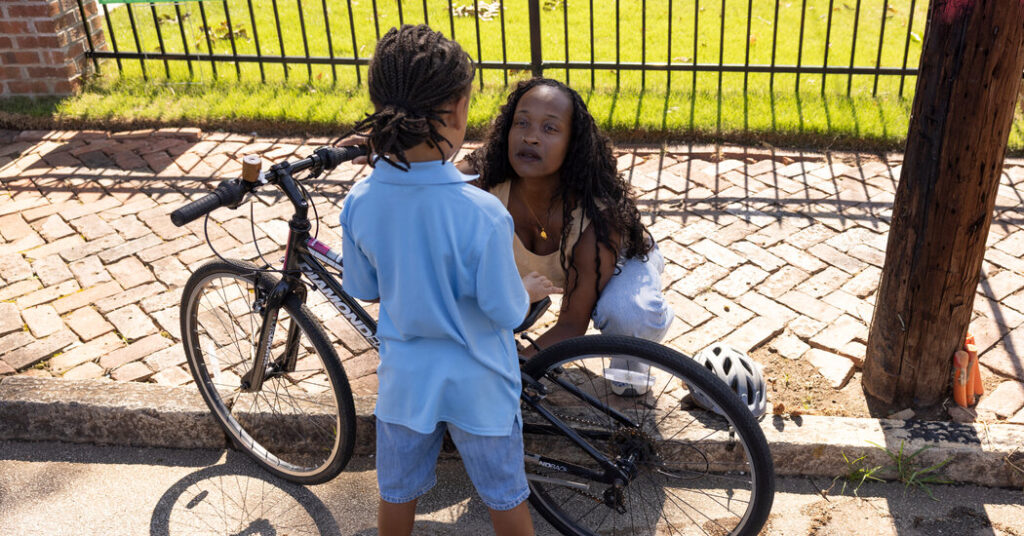
Mallerie Shirley knew something was wrong the second she saw her then-6-year-old son walk through the front door. It was November 2025, and he had just returned from riding his scooter to a playground about a quarter of a mile from their home in Atlanta, Ga.
Ms. Shirley remembers how he looked: shoulders slouched, eyes cast downward. She asked him what happened. He explained that a woman stopped him on his way home and demanded to know his age, why he was alone and where he lived. Scared, he ignored the woman and continued on his way.
Ms. Shirley and her husband, Christopher Pleasants, believed in instilling a sense of independence in their two children, and they had recently started to give their son opportunities to do things unaccompanied, like asking him to find items in the grocery store. Typically, after he explained to concerned adults that he had permission from his parents, people felt reassured.
But this woman’s concern felt more accusatory than empathetic. “I think she followed me in her car,” Ms. Shirley remembers her son telling her.
She didn’t think much of it until two days later, when a case manager from the Fulton County Division of Family and Children Services showed up at her house. Ms. Shirley was not home, but Mr. Pleasants was. The case manager explained that a complaint had been filed, and that she would need to inspect their home and interview their son at school. (The conversation was recorded on the family’s Ring camera.)
“When we were growing up, our parents would be like, ‘Oh, you know, go ahead, it’s fine,’” the case manager said, “but now he would have to be, like, 13.”
“13?” Mr. Pleasants said. “Is that the law?”
“I mean, they are going to consider that inadequate supervision for him to go completely by himself,” the case manager said. “Because anything could happen, right?”
“He’s extremely vulnerable at that age,” the case manager added.
In recent years, in places like Baldwin City, Kan. and Silver Spring, Md., parents have been investigated — or even arrested — for letting their children walk to the store, play in the park or ride their bicycles unsupervised. Proponents of childhood independence say it’s beneficial for kids to have autonomy; others see this approach as potentially dangerous. And vague child-neglect laws force law enforcement to make difficult judgment calls regarding whether a child is in legitimate danger.
But as the stories of well-meaning parents have gained attention, the way lawmakers think about child independence is starting to change: All told, 13 states have either created new, less restrictive child-neglect laws or amended existing ones. A bipartisan federal bill, the Promoting Childhood Independence and Resilience Act, was introduced in the House of Representatives in May.
Despite the shift, some parents are still finding themselves in the government’s cross hairs.
“I was so naïve,” Ms. Shirley said of the investigation into her family. “I thought that nothing was going to come of this. But I was mistaken.”
A Self-Fulfilling Prophecy
Two forces — fear and control — have systematically reduced childhood independence over the past four decades, said Sarah Schoppe-Sullivan, a professor of developmental psychology at Ohio State University.
First came a newfound worry about child abductions and “stranger danger.” In 1979, the disappearance of 6-year-old Etan Patz in New York City drew widespread media attention. Congress passed the Missing Children Act in 1982 and, two years later, missing children’s photos were put on milk cartons nationwide. Inflated statistics on abductions, with estimates sometimes as high as 50,000 minors annually, underpinned the discourse. (In reality, authorities estimate that closer to 100 children are kidnapped by strangers each year.)
These events were contributing factors “in cultivating a sense of fear and a need for more protection,” said Aliza Pressman, a developmental psychologist and co-founder of the Mount Sinai Parenting Center in New York City.
Then, in the early 2000s, helicopter parenting started to take hold, particularly in middle-class families. Parents began to control many — or even most — aspects of their children’s lives in order to prepare them for an increasingly competitive society.
“It was a concern with protection, and then a concern with producing successful children,” Dr. Schoppe-Sullivan said. “This leaves children with little time to themselves, and often involves things that are scheduled by adults.”
In a recent Harris Poll of children from 8 to 12, 62 percent said they had never walked or biked somewhere without an adult.
“We’re not allowing children to learn that they’re both physically and psychologically tough,” said Peter Gray, a research professor of psychology and neuroscience at Boston College and the author of the forthcoming book, “Restoring Childhood: How to Set Kids Free in the Age of Anxiety.”
“We assume they’re fragile and it becomes a self-fulfilling prophecy,” he said.
Dr. Gray pointed to more than a dozen studies that draw an association between overprotective parenting and increased rates of anxiety and depression in children, adding that independence increases a child’s self-reliance and self-worth.
It’s not that parents are oblivious to the benefits of giving their kids autonomy. According to a 2023 poll by C.S. Mott Children’s Hospital in Ann Arbor, Mich., 84 percent of parents of children from 9 to 11 said kids benefit from having free time without adult supervision. But in that same poll, only 50 percent of parents said their child would go to find an item in a store when the parent is in a different aisle.
“There is no way for a child to feel capable and competent without being given space to make survivable mistakes,” Dr. Pressman said. “You want the child to stretch and bend, but not break. That’s the premise of healthy child development.”
Mallerie Shirley said that her son was more fulfilled when she let him do things on his own. But with the D.F.C.S. investigation looming over their family, Ms. Shirley kept her son indoors. “We were afraid of being arrested,” she said. “His mental health really struggled.”
In late December, the agency notified Ms. Shirley and Mr. Pleasants that the complaint against them of child abuse and neglect had been substantiated. The couple hired a lawyer and filed an appeal. They also discovered that the law was on their side: Georgia had recently narrowed the definition of child neglect to give children the right to engage in independent activities, including playing outdoors alone.
Ms. Shirley raised this during a recorded phone call with a D.F.C.S. supervisor. The supervisor responded, “Logically speaking, policy or no policy, let’s just talk about being a parent. This baby is 6 years old. How is he able to self-protect at 6 years old?” The exchange gave Ms. Shirley the impression that the supervisor’s personal feelings could be influencing her work on the case.
The Georgia Department of Human Services, which oversees Fulton County’s D.F.C.S., declined to comment on the investigation into Ms. Shirley and Mr. Pleasants, but in a written statement, they said, “We take seriously every report that might be made to the agency and work with law enforcement when appropriate to ensure the safety of Georgia’s children.”
‘Free-Range Kids’
In 2008, Lenore Skenazy, a mother living in New York City, wrote a column for the New York Sun about why she allowed her 9-year-old son to ride the subway alone. The article went viral and Ms. Skenazy went on a media blitz, explaining why she thought it was detrimental for parents to make judgment calls based on long-shot what ifs.
“I call it worst-first thinking,” she said in a recent interview. “We’ve all been trained as parents to go to the worst-case scenario first and proceed as if it’s likely to happen.”
Ms. Skenazy coined her belief in reasonable childhood independence the “free range kids” movement, and she began to call attention to cases where free-range parenting collided with the law. Eventually, state laws about child neglect began to change.
After attending one of Ms. Skenazy’s parenting lectures, Connor Boyack, the founder of a libertarian think tank, helped conceptualize the nation’s first law on childhood independence, passed in Utah in 2018. It specified that neglect does not include “permitting a child, whose basic needs are met and who is of sufficient age and maturity to avoid harm or unreasonable risk of harm, to engage in independent activities.”
Georgia revised its bill last year after Brittany Patterson, a mother of four, was arrested and charged with misdemeanor reckless conduct for allowing her 10-year-old son to walk alone to a nearby dollar store. When deputies from the Fannin County Sheriff’s Office came to her house and handcuffed her, “I was livid,” she said. She added that her arrest, and the subsequent media attention, were more traumatizing to her children than anything that had ever happened to them while they were unsupervised. The charges were eventually dropped.
This January, Kansas amended its child-neglect law after Shaley Knickerbocker, of Baldwin City, was twice reported by a neighbor for allowing her preteen children to play outside unsupervised. Both times, law enforcement came to Ms. Knickerbocker’s house. “I feel a lot of relief to now have a law that protects those decisions,” she said.
Some experts point out that preventable accidents can occur when a child is given too much independence, and that the new laws could make protecting children more challenging. Last May, a mother and father were charged with involuntary manslaughter after their 7-year-old son was hit by a car and killed while crossing a busy road with his 10-year-old brother in North Carolina. “In such cases, adults must be held accountable for their responsibilities to ensure a safe environment for their children,” the Gastonia Police Department said in a statement. The couple pleaded guilty and received probation.
Karen Ruskin, a family psychotherapist based in Scottsdale, Ariz., said a law’s specificity might make law enforcement more hesitant to approach a child to confirm that they are safe: Is a child riding her scooter one mile, two miles, four miles? If a child is home alone, what time will the parents return?
Jason Baron, an assistant professor of economics at Duke University who studies child welfare systems, agreed that the concept of child protection is ambiguous and nuanced.
“You can imagine these types of laws having unintended consequences, just like you could imagine it helping a few families that got tangled up with the system that maybe shouldn’t have,” he said. “The question we have to ask as a society is: Do we want to err on the side of caution or do we want to err on the side of not bothering parents?”
As for Ms. Shirley, in January the Georgia Department of Human Services sent a letter stating they did not agree with Fulton County’s finding of neglect and that the allegations would be labeled unsubstantiated. Ms. Shirley and Mr. Pleasants were cleared.
Soon after, they allowed their son to once again ride his scooter to the playground alone. “He was overjoyed,” Ms. Shirley said. “That’s all we want as parents, feeling like he is capable of taking care of himself.”
The post Should Letting Children Play Alone Outside Be a Crime? appeared first on New York Times.