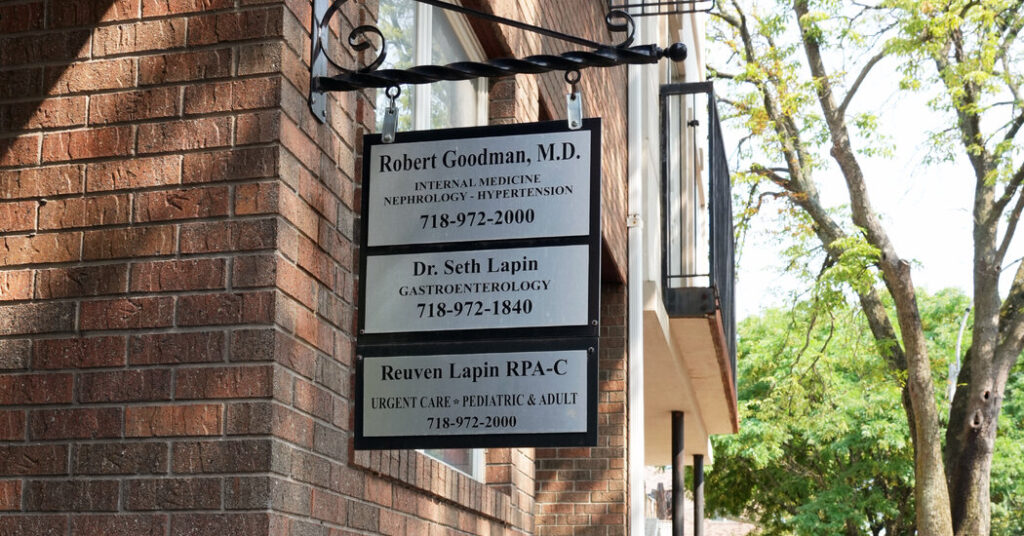
Over the four decades that he practiced medicine in Brooklyn’s Borough Park neighborhood, Dr. Robert Goodman built a reputation as a dependable physician.
He forged close relationships with members of his office’s surrounding community, particularly its Orthodox Jewish enclaves. Some there said he offered flexible payment options for his patients who struggled to afford their visits and made house calls where necessary. He also held admitting privileges at nearby Maimonides Medical Center, and some said he was known to go above and beyond for his sickest patients. His primary care practice thrived.
But on online forums, by word of mouth and, eventually, in two lawsuits, several of the women he treated shared a vastly different experience. Behind the often locked doors of his examination rooms, some of the women said, Dr. Goodman used their visits as pretexts to touch and talk to them inappropriately.
Some of the accusations stem from visits that occurred decades ago but were not brought to light at the time. Many of the women, themselves Orthodox Jews, were reluctant to come forward, according to the lawsuits, fearful that they would be ostracized for trying to expose a man who was a trusted community member.
The lawsuits offer accounts of Dr. Goodman groping his patients’ breasts without consent and making sexual comments about their appearance during exams. One of his former patients claim he texted them outside the office about matters unrelated to their health.
Dr. Goodman, who disputes all claims of wrongdoing, also faces a state health investigation into his conduct. The State Board for Professional Medical Conduct has charged Dr. Goodman with multiple counts of gross negligence and moral unfitness; a ruling, which is expected this year, could result in the loss of his medical license in New York.
But Dr. Goodman also holds a medical license in New Jersey, according to an online filing from the state’s division of consumer affairs, which maintains a database of all professional licenses in the state. He has made plans to open a new practice in the heavily Orthodox Jewish community of Lakewood, N.J., in July, according to an advertisement, though it is unclear if he has done so. Some plaintiffs said they feared for the safety of future patients.
“There’s a lot of innocent people that could potentially become victims,” said Mazal Felsenstein, a plaintiff in one of the cases against Dr. Goodman who said he abused her when she lived in Borough Park nearly 30 years ago. “Because clearly the authorities above him aren’t doing anything about it — they’re giving him a license.”
Ms. Felsenstein, who was a new wife and mother in her early 20s when she first started seeing Dr. Goodman, said he touched her or spoke to her inappropriately during more than five different visits. It wasn’t until she heard from a neighbor who had similar experiences that she realized it could be a more widespread problem, she said.
Andrew Zwerling, a lawyer for Dr. Goodman, emphasized his 40 years of medical practice in Borough Park and said he has “a stellar reputation in the community he serves.”
“The claims now brought against him — which involve alleged events that were not reported for decades — are false and motivated by monetary gain and/or a bias against the Orthodox community,” he said in a statement. He pointed to one woman’s voluntary withdrawal from the suit and the accusers’ decision to withdraw a motion that would certify the lawsuit as a class-action suit as evidence of “the falsity of their initial claims.”
“Filing a lawsuit with unsupported allegations does not create a reality, and Dr. Goodman will continue to prove the baselessness of these claims,” he added.
The women in the suits said he regularly sexually assaulted them and other patients for more than 15 years, and fault him for violating their trust and privacy hundreds of times. One lawsuit also cites Maimonides for not adequately protecting its patients, despite his employment by the hospital. It claims that the hospital failed to report him to the state medical licensing board.
Sam Miller, a Maimonides spokesman, said in a statement that the hospital would not comment on pending litigation “except to say that we look forward to the full dismissal of all claims directed against Maimonides.”
Asher Lovy, the director of ZA’AKAH, a New York-based organization that fights sexual abuse in Orthodox Jewish communities, said he had heard complaints about Dr. Goodman from women in Borough Park “for years” but was not surprised that they had not publicly surfaced until recently.
“As a general matter of policy, the community’s opposed to reporting sexual violence and to pursuing anything in any secular court, whether it’s civil or criminal, about sexual violence,” Mr. Lovy said. “But with someone like Goodman in particular, he enjoys the position of esteem in the community, so they’re even more inclined to protect him.”
Dr. Goodman has been licensed to practice in New York since October 1983, according to the state’s Department of Health. His New Jersey medical license was issued in November 2024 — a full year after the first lawsuit was filed.
Representatives for the New Jersey Board of Medical Examiners did not respond to a request for comment.
Since Dr. Goodman announced plans to open a new practice in New Jersey, ZA’AKAH has tried to publicize the lawsuits against him. One flyer on its Instagram page warns Lakewood residents against using his services, citing the active litigation. And some residents who have moved to Lakewood from Borough Park have spread the word about the claims against him.
The first lawsuit was filed in 2023 under the Adult Survivors Act, which opened a one-time window for survivors of sexual assault to file civil suits outside of the statute of limitations. The plaintiffs are seeking financial damages but said in interviews that they hoped the legal actions would lead to Dr. Goodman losing his ability to practice medicine.
“I hope that people see this and are scared of abuse — and are scared of the consequences,” said Alanna Kaufman, a lawyer who represents four of the women suing Dr. Goodman. “Light is going to be shed on abuse one way or another and it’s not going to hide forever.”
Some local leaders made efforts to report Dr. Goodman, with few results. Dov Hikind, a former New York state assemblyman whose district included Borough Park and who retired in 2018, said that while he was in office, more than a dozen women came to him with allegations about Dr. Goodman.
“It was clear to me that something had happened,” he said.
In August of 2018, he wrote a letter to state health officials requesting an investigation. In 2020, the Office of Professional Medical Conduct ruled there was insufficient evidence to charge Dr. Goodman with medical misconduct, according to correspondence shared with The New York Times.
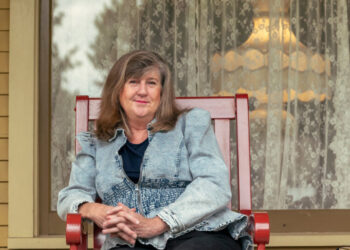
Not all of the women who say they were assaulted by him are members of Orthodox Jewish communities. Audrey English said she started seeing Dr. Goodman in the early 2000s because he accepted her health insurance. After a car accident left her in a wheelchair for nearly a year, she asked Dr. Goodman for a doctor’s note. During the visit, which did not require a physical examination, she said he reached down and grabbed her breast.
She confronted him in the moment and told his receptionist at the time before abruptly leaving, she said. After finding out about the lawsuit against him and recalling her own experiences, she said she felt compelled to join it — to find resolution both for herself and for others who may have felt uncomfortable reporting their experiences.
“I know that a lot of women probably would not come forward, so I said that I could be a voice for them because he does need to lose his license,” she said. “He’s a predator and obviously he has a persistent pattern.”
Hurubie Meko contributed reporting.
The post They Accused a Brooklyn Doctor of Abuse. He Got a License in New Jersey. appeared first on New York Times.