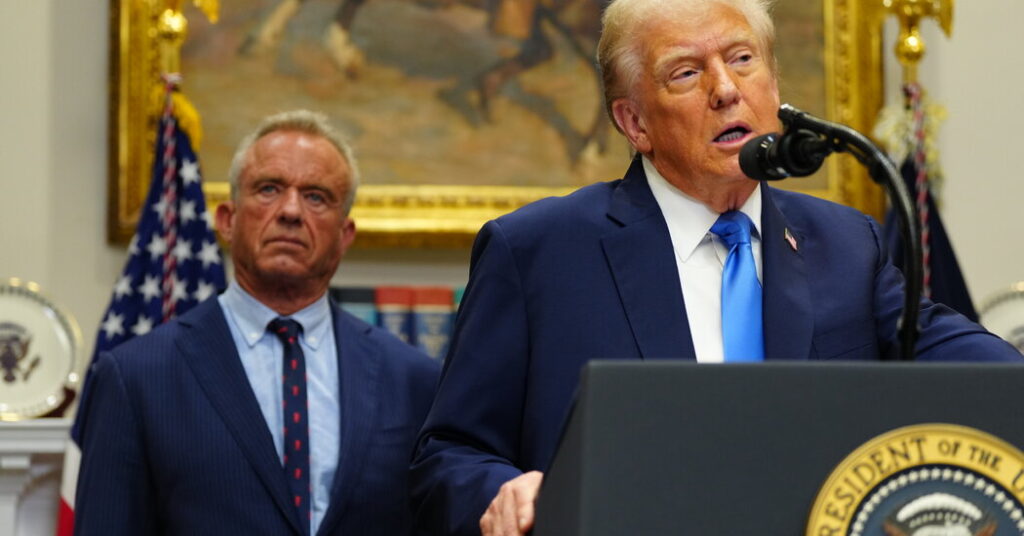
For the third time in less than a year, President Trump on Monday issued an executive order that calls for American children to be routinely immunized against fewer diseases, as they are in countries like Denmark.
The latest version embraces more explicitly than its predecessors a revised schedule that recommends immunizing children against 11 diseases, rather than the 17 that are currently recommended by the Centers for Disease Control and Prevention. The order also “directs the attorney general to advance legal challenges against states that violate children’s rights to religious or medical vaccination exemptions,” Mr. Trump said.
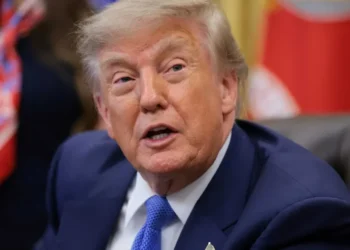
Speaking in the Oval Office before signing the executive order, Mr. Trump said he was motivated in part by concerns over whether vaccines were tied to autism, even though dozens of studies have found no link between autism and vaccines.
It is unclear whether the order has any legal power. Vaccine recommendations in the United States are made by a committee of experts who advise the C.D.C., and are then adopted by the agency’s director. But only states can require vaccinations for children to enter school or day care.
The administration’s previous attempt at implementing a shorter vaccination schedule was already frozen once by a federal court. That ruling is part of a continuing lawsuit, brought by medical organizations, that argued that the administration did not follow proper procedure and that it made “arbitrary and capricious” decisions. A judge agreed with that claim, saying the government had bypassed the careful, evidence-based practice that has traditionally underpinned vaccine recommendations.
“This is not likely to address the court’s concern, and is not a legally valid way to fill the statutory requirements about vaccine recommendations, it’s just not,” said Dorit Reiss, an expert on vaccine policy and law at the University of California College of the Law, San Francisco.
The president cannot legally circumvent the Advisory Committee on Immunization Practices, which is empowered by Congress to make vaccine recommendations, she said. Attempts to enforce the order are likely to run into the same legal challenges, Ms. Reiss said.
“There’s no science behind these recommendations,” said Dr. Michael Osterholm, who directs the Center for Infectious Disease Research and Policy at the University of Minnesota. “It’s all about ideology.”
The order signals the administration’s enduring interest in the theory that some childhood vaccines may cause more harm than good, at least for some children, and that American children get too many shots. Mr. Trump said one-year-old children should have five separate visits for vaccines rather than getting them all in the same day.
And it seemingly contradicts reports that the White House has urged Health Secretary Robert F. Kennedy Jr. to shift his focus away from vaccines and toward diet and other issues less likely to alienate voters in the midterms.
The executive order also emphasizes parental consent, stating that federal programs should support “maximal parental choice.” Pediatricians are already required by law to provide information about the benefits and risks of vaccines before administering the shots. And states require vaccinations for school because decades of research has shown that such mandates are an effective way to protect communities from vaccine-preventable diseases. .
Mr. Trump said the executive order recommends splitting the vaccines for measles, mumps and rubella into individual shots, rather than administering them in combination as is now the case. “Together, there could be a possibility they’re quite lethal, and separately, it looks like they are not at all lethal, but just very effective,” Mr. Trump claimed on Monday.
There is no evidence that the M.M.R. shot is lethal, and many decades of evidence for its overall safety. The combination shot has been associated with a small risk of seizures if a child develops a fever, but that type of seizure does not cause long-term harm, according to the C.D.C.
Individual vaccines are available in some countries, but would need to be tested in the United States before they can be administered.
The order also urges officials to explore alternatives to aluminum, which has been added to vaccines for decades to strengthen the body’s immune response. Mr. Kennedy has frequently questioned the safety of aluminum as an additive, despite studies showing it is safe.
Mr. Kennedy said at the event on Monday that American children get up to 94 jabs. In fact, most states mandate that children receive about 20 shots to enter school, but those shots include serial doses of only eight or so vaccines (depending on which combination vaccines are used) that together protect against a dozen diseases.
The new order echoes the truncated vaccine schedule introduced by Mr. Kennedy and his appointees in January. It recommends that all children be immunized against only 11 diseases, including measles, mumps, rubella, polio and chickenpox, aligning the schedule with that of Denmark’s.
But it only recommends other vaccines, including shots against respiratory syncytial virus, hepatitis A and hepatitis B, for certain high-risk groups. (The order does not specify what constitutes high risk, but the revised schedule released in January outlined the criteria.) For those not at risk, the new order recommends that some shots be given only when accompanied by “shared decision-making” conversations between doctors and parents. Those shots include vaccines against Covid-19, the flu, rotavirus, meningococcal disease, hepatitis A and hepatitis B.
Although the schedule laid out in the new order mimics that of Denmark, it is a country with a population the size of Wisconsin’s and universal health care. Denmark also recommends fewer shots than many of its European peers, including other Nordic nations. While the United States is on the higher end in the number of vaccinations it recommends, its schedule is closely aligned with those of Canada, Britain, Australia and Germany.
In the months since the government’s attempt to upend the childhood vaccine schedule, the American Academy of Pediatrics has released its own vaccination schedule, urging parents to ensure their children receive the previously recommended shots.
The post Trump Signs Executive Order Calling for Fewer Childhood Vaccines appeared first on New York Times.