A reader wrote in this week to challenge a recent column of mine about Gen Z and their spending habits. Essentially, aggregated Bank of America credit card data shows this supposedly deeply-anti-capitalist generation is very fond of consumer capitalism. But is that really hypocrisy?
“A worker can oppose capitalism while still being forced to sell labor and buy necessities,” the reader wrote to me, “just as a prisoner can oppose incarceration while remaining confined.” Buying a secondhand jacket or a $5 treat—or waiting on a long line in a bout of “democratized snobbery” or “conspicuous waiting”—doesn’t abolish wages, rent, debt or the fact someone else owns the means of production. It just changes how a person survives inside a system they have no way to leave.
He’s right. Just because you spend money in capitalism doesn’t mean you love it as a way of organizing economic life. What’s interesting to me, though, is every generation since the original countercultural capitalists—the baby boomers—has expressed some version of this antipathy. What’s changing is what happens to that opposition afterward, as a generation grows up, gets a mortgage and a career, and joins the masses. Even if you think generational framing is like financial astrology, these dynamics reveal something genuine about the evolution of society—and business’ role in it.
Up until now, this tension has more or less resolved itself as generations grow up and grow less radical as the fruits of their labor are recognized. But economic data increasingly suggests this mechanism may be breaking down. And maybe, to paraphrase a cultural critic who still haunts these times, Gen Z is responding to a future that has slowly been getting canceled for a long time.
The prison that doesn’t need bars
The reader’s prisoner metaphor is useful beyond the economics. The British writer Mark Fisher, aka “K-punk,” spent much of his career arguing capitalism’s most effective tool isn’t coercion—it’s the capture of the imagination. His term for this was “capitalist realism“: the system’s capacity to make itself feel like the only conceivable arrangement. He built on Frederic Jameson‘s quote that “it is easier to imagine the end of the world than the end of capitalism” to argue it’s easier to imagine the end of capitalism than whatever comes afterward. To paraphrase my reader, the prison works not because the bars are strong, but because the prisoner can no longer picture the outside. Opposition persists; the idea of an alternative doesn’t.
Fisher’s related concept—”the slow cancellation of the future“—extended this to culture. Since the 1990s, he argued, art and music had been stuck recycling the past not because nothing was happening, but because the culture had lost the capacity to imagine a future meaningfully different from the present. The music critic Simon Reynolds reached the same destination from a different direction in his 2011 book Retromania: Pop culture had become addicted to its own past, the internet making all of recorded music history simultaneously accessible and paradoxically producing less genuine innovation rather than more. Where previous generations related to a specific, bounded nostalgia, the post-internet era recycled everything at once, all decades available for simultaneous revival, none of them pointing forward.
The writer Freddie deBoer has argued something compatible but distinct, what he calls “the long boring“: the stagnation isn’t a recent phenomenon. The American cultural and technological landscape has been flat since at least the 1970s, he contends—predating both 2008 and the internet—and most of what reads today as political urgency is really just content, media cycling through moral controversies that generate engagement but no leverage. Economic historian Marc Levinson offered up this thesis in book form with An Extraordinary Time, which argued everything following the 1970s in American culture and society has reflected a less innovative, less productive economy. Brad DeLong also took a spin on the subject in book form, arguing for a productivity boom in the 1990s, petering out by 2008.
Here is how the last four generations have weathered this great economic slowdown, and how it shaped their attitudes down to the present.
1971: the revolution’s own verdict on itself
In 1971, Pete Townshend wrote arguably the sharpest line the counterculture ever produced about itself. “Won’t Get Fooled Again” arrived on The Who’s classic album Who’s Next after Kent State, after the peak of New Left radicalism, and its refrain—meet the new boss, same as the old boss—was a warning revolution doesn’t touch the underlying structure of power; it just replaces the faces at the top. The man who had previously written the line, “hope I die before I get old” rode that message to massively lucrative rock stardom in his own old age and world tours that lasted until 2025, at the latest count.
Townshend’s cynicism proved prescient as the generation that marched, occupied, and dropped out in the late 1960s spent the 1970s watching the New Left splinter. Tom Wolfe caught the pivot in real time: His 1976 essay “The Me Decade” argued postwar prosperity had given ordinary Americans, for the first time in history, enough surplus wealth and leisure to stop thinking about collective politics and start thinking about themselves. Est, primal therapy, encounter groups—the communal energy of the 1960s didn’t die so much as it privatized. By the 1980s, the generation that had once marched on the Pentagon had become the yuppie class—homeowners, 401(k) pioneers, the cohort that built the modern investor class. Oliver Stone made Gordon Gekko a villain in 1987 and watched a generation decide he was actually the hero for saying “greed is good.”
Youthful radicalism wasn’t crushed so much as absorbed—capitalist realism operating exactly as Fisher would come to describe it, the system making ownership feel not just desirable but natural, inevitable, the only sane endpoint for a person who had been young once and was now just practical. Pew’s long-running surveys showed roughly seven in 10 baby boomers holding a positive view of capitalism as of 2022—the highest of any living generation. (More recent data, from Gallup, shows a decline in this faith, but doesn’t break out along generational lines.)
Baby boomers’ advice to their children was almost always the same: “Follow your heart and your intuition,” as Steve Jobs put it in the 2005 Stanford commencement address that became the most-watched graduation speech in history—and it likely stemmed from the fact it paid off for all the hippies-turned-stockbrokers and tech moguls just fine.
Generation X’s quieter dissent, and the decade that punished it
Generation X never got its own Kent State. Its anti-establishment current ran through grunge, slacker cinema, and the “sell-out” stigma that governed 1990s indie culture—a real skepticism of consumer capitalism that dissolved more often into irony and withdrawal than organized action. Kurt Cobain wrote the generation’s self-critique into the opening line of In Utero, his last studio album: “Teenage angst has paid off well / Now I’m bored and old.” He died at 27 the following year, which meant he never had to figure out how to age into the system the way Townshend did. The one moment it did mobilize at scale, the 1999 Seattle protests against the World Trade Organization, came right before the internet boom and bust reshuffled the economy again.
Then came 2008. They were 28 to 43 years old when the housing market collapsed—precisely the years most people buy their first homes and build retirement savings—and studies of the Great Recession found Gen X suffered the deepest home-equity losses of any cohort, with net worth down roughly 40% at the crisis’ trough. They did eventually recover, becoming the only generation to fully regain its lost wealth by the mid-2010s. But the recovery came through rising asset prices, not rising wages, and Gen X now carries the highest average credit-card debt of any generation. They didn’t get out from under capitalism’s demands. They got pulled back in on worse terms.
The fork in the road
The recovery from the 2008 crisis grew the value of assets—homes, stocks, and portfolios—faster than it grew wages or employment. Economists studying the post-recession years have found this asymmetry systematically rewarded people who already owned capital before the crash and penalized everyone who didn’t yet have any.
That single fact splits the four living generations into something more complicated than a clean divide. Baby boomers got out before the door closed; most had already built home equity and retirement savings by 2008. Gen X got hurt badly but had enough of a head start to claw back through the same asset appreciation that was leaving wage-earners behind. Older millennials appear to have caught the last window: In their late 20s and early 30s as the recovery took hold, many were able to lock in 30-year mortgages at 3% or 4% before the rate spike that followed—the final cohort to ride low interest rates into something resembling the asset-building ladder their parents climbed.
Younger millennials and Gen Z weren’t so lucky. They graduated into the worst hiring market in decades, and research on recession-era graduates shows that each additional point of unemployment at graduation costs a worker years of depressed wages. By the time they had saved enough to buy in, both prices and rates had moved against them. Gen Z arrived even later, inheriting a labor and housing market already reshaped by that double squeeze.
Gallup’s trend data captures the result. Compared with the same age bracket in 2010, today’s under-50 adults are dramatically less likely to hold a positive view of capitalism, while opinions among older Americans have barely moved. Some see it as just the way life goes; others see it as something more like a prison you can’t escape.
Millennials organized. Then the door stayed closed
Millennials did organize, chaotically, around this dynamic. Occupy Wall Street, in 2011, was the largest anti-capitalist mobilization in decades, and it put “the 99 percent” into permanent political vocabulary. It assumed, explicitly, the terms were negotiable—that naming the asymmetry loudly enough would compel the system to address it.
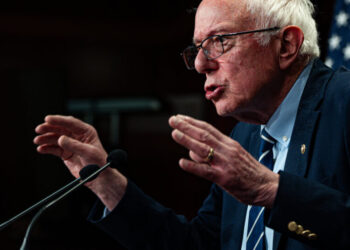
Five years later, Sen. Bernie Sanders (I-Vt.) converted that same energy into something the political system could almost absorb: a primary campaign that came closer to a major-party presidential nomination than any explicitly anti-capitalist candidate in a century. His platform—Medicare for All, student debt cancellation, and a wealth tax—was radical by American standards and entirely conventional by the standards of most rich democracies. It lost twice, on controversial terms some still debate. What followed wasn’t another organizing cycle; it was a slow dispersal of that energy into causes more legible to existing institutions, or into exhaustion.
Student debt remains a hot-button issue for the younger generations, as it both encouraged organization, preserved relative impoverishment, and fueled lingering resentment. You can’t become a homeowner-investor and a debtor simultaneously, not when housing prices are moving the way they have. Millennials spent the decade after 2008 demanding a fairer system while still trapped inside it.
Gen Z’s different starting point
Gen Z’s opposition looks different from the start, and the difference shows up in trust data before it shows up in memes. A Gallup and Walton Family Foundation survey found Gen Z’s confidence running low across most major institutions—just 16% in the news media, 17% in technology companies, and 23% in the criminal justice system—while Pew Research has separately found adults under age 30 consistently less confident than older Americans across a wide range of institutions, from the military (69% vs. 92% for those 65 and older) to police and religious leaders.
The phrases that followed—bare minimum Monday, quiet quitting, and “Gen Z does not dream of labor“—are not demands. They are descriptions: work as a transaction to be minimized, not a system worth arguing with. It’s a fitting takeaway for a generation whose childhood was defined by the “jobless recovery” of the 2010s.
The unsettling part is this isn’t only a story about 2008. It’s happening again, right now, without a recession to explain it. Labor force participation—the share of Americans age 16 and older working or actively looking for work—fell from about 62.5% last November to 61.4% in July, the lowest reading outside the pandemic in roughly 50 years, as Michigan State professor Jason Miller pointed out on LinkedIn after dramatically disappointing jobs report data.
Economists at the St. Louis Fed have flagged the speed of the drop as unusual: Participation had held in a narrow band for nearly three years before suddenly falling off, with the steepest declines concentrated not among retirees but among workers age 25 to 54—prime working age. That rules out the comfortable explanation older Americans are simply retiring early on appreciated stock portfolios. The people leaving the labor force are the people who are supposed to be building careers, buying homes, and raising families—the ones who need to see capitalism as a solution, not a prison.
Unemployment, meanwhile, sits at a placid 4.1%, and GDP growth remains modestly positive. Economists disagree about why. Some point to a genuine shortage of available workers as immigration slows and the population ages, others to discouraged workers giving up the search. But either explanation describes an economy quietly closing doors rather than opening them.
Layered onto this is a second problem: The productivity boom that AI enthusiasm has assumed is coming may not arrive on schedule. The U.S. has produced only two sustained productivity booms since World War II, in the 1960s and the 1990s, and both rode alongside above-trend growth in real GDP and the labor force itself. Most current forecasts, including Goldman Sachs’ and the Wharton Budget Model’s, project AI’s contribution to productivity as gradual—a percentage point or two of GDP over a decade, not a 1990s-style surge—because a shrinking, disengaged labor force can’t generate the kind of broad-based growth that made past booms feel real to ordinary workers.
A productivity gain achieved by fewer people working, rather than by more people working more effectively, won’t feel like prosperity. It will feel like exactly what the last two years have felt like: a healthy economy on paper, and a shrinking set of paths into it in practice. The future: still canceled.
The post ‘A prisoner can oppose incarceration while remaining confined’: The paradox of Gen Z, capitalism, and consumption appeared first on Fortune.