Just over a month ago, on a steamy night in London, the pop-country megastar Shania Twain finished a performance at Wembley Stadium, changed out of her hot pants and stilettos and retired to a dressing room with her tall, dashing husband. She never eats solid food before going onstage — “Otherwise, I get burpy” — so now she could enjoy a plate of fruit and cheese, pouring Veuve Clicquot into champagne flutes and sharing bits of Cheddar with her Pomeranian, Sapphire.
She was spending a stretch of the summer in London as the opening act for a record-breaking 12-date residency at Wembley. The headliner: Harry Styles, a pop star nearly 30 years her junior. The two met in New York in 2017 and traded numbers, she told me. Styles asked her for a favor: Could she make a happy-birthday call to his mother, a longtime fan? A few years later, when Styles was the big Friday-night headliner at the Coachella festival, he invited Twain to perform two songs with him and, flashing his famous dimples, gave her this introduction: “In the car with my mother as a child, this lady taught me to sing. She also taught me that men are trash.”
Twain has now met both of his parents. “It breaks down the fame element of things — there’s nothing ‘industry,’” she said. Their fan bases intersected, she said, in the form of “the groups of girls” — “Harry really has the groups of girls, you know what I’m saying?”
At Wembley there were indeed gaggles of girls of all varieties: moms and daughters, dads chaperoning bunches of friends, roving packs of glitter-covered teenagers, young professional women in fannish cosplay. I saw plenty of Styles-inspired fashion — heart sunglasses, feather boas and “Respect Your Mother” T-shirts, shorthand for the kind of Forever 21 feminism that’s part of his lingua franca. But there was also plenty of the leopard print that’s a Twain signature. “We cross audiences,” she said. “We definitely do.”
Granted, Twain’s audience is immense: Her 1997 LP, “Come On Over,” remains the best-selling country album of all time and the best-selling studio album by any female artist, ever. Still, you might not expect her to be thrilling young pop audiences at this stage in her career, and at 60 years old. Styles isn’t sharing Wembley with any of the other women who dominated late-1990s radio; teenagers do not seem this excited about, say, Faith Hill or Celine Dion. If you had imagined, 20 years ago, what Twain’s audience would look like today, you might have pictured something more middle-aged — not, say, the 20-something lesbian couple I saw at Wembley, one in a leopard minidress and cowboy hat, one in a leopard ascot and backward baseball cap, going hoarse screaming along to “Any Man of Mine.” Or the scene later described to me by the writer Liana Satenstein: a Manhattan party where the Gen-Z crowd went wild upon hearing a Twain single, not long after a spin of the theme song from “Hannah Montana.”
Part of this is thanks to the younger musicians who have spent years telling fans that Twain is a crucial touchstone. Styles is not alone: Rappers and indie-rockers and pop stars call her an influence, a dream collaborator, even a blush-inducing crush. Post Malone says he primarily listens to Twain before going onstage. Rihanna ranks her alongside Whitney Houston and Mariah Carey in her pantheon of divas. Diplo described meeting her as “face-melting.” The singer-songwriter Maggie Rogers has praised the instincts Twain brought to conceiving her videos, including the indelible image of Twain in a barren desert, in head-to-toe leopard print with matching suitcase, in “That Don’t Impress Me Much” — a song now regularly covered by the pop trio Haim. Sabrina Carpenter, who has also covered Twain, invited her to appear as Mrs. Claus in a 2024 Christmas special. And on July 4, Twain left her final performance with Styles and crossed London to appear with Mumford & Sons at Hyde Park, where Marcus Mumford described her from the stage as “my [expletive] hero”: “You don’t understand. You don’t get it. This is a very big deal for me.”
There’s nostalgia involved: Millennials were children when Twain conquered radio, introducing some of them to pop the same way SpongeBob introduced them to television. There’s also a question of style. Twain and her husband at the time, the hard-rock producer Mutt Lange, made pop-country engineered to cross over to the mainstream — an achievement that has since moved from rare to practically the definition of pop music. (Taylor Swift says it often: Shania Twain paved her way.)
But the most striking reason is cultural: Twain’s young acolytes often see her as a glamorous, self-actualized champion whose songs are explicitly feminist statements. That was the image captured in a 2017 Rolling Stone article about how Twain “empowered an unlikely group of female artists.” It has younger musicians calling her a “feminist icon” (Kalie Shorr) and saying childhood memories of dancing to her music are “among the earliest I have of testing out my own variety of ‘girl power’” (Caitlin Rose). The singer-songwriter Kelsea Ballerini — who has said her own drive to write female authority into every song traces back to Twain — told me the singer was “on the Mount Rushmore of showing women you can be bold, sassy, smart, sexy, strong and soft, all at the same time,” and that her music offered “the most empowered gift in the world.”
There’s only one wrinkle: Shania Twain does not entirely identify with all of this. It’s exciting, she told me, to see new generations embrace her music — to hear stories from fans who, like Styles, first heard her on their mothers’ stereos. Sometimes, she said, she even wonders: “What was I doing when Harry was born?” But she has never felt comfortable with the idea of herself as a feminist hero. She has not always had an easy relationship with being a woman, let alone a liberated superwoman. And when I mentioned Styles’s Coachella introduction — “she also taught me that men are trash” — she laughed, but hastened to correct the record: “I didn’t ever say that.”
Twain explained more fully from a luxurious, velvet-swathed sitting room at her West London hotel, over cups of builders’ tea.
She wasn’t too far from home: She has lived in Switzerland since 1999, when she moved there with Lange. (About a decade later, the two would separate amid a made-for-TV tangle: Lange married Twain’s close friend and assistant, Marie-Anne Thiébaud, while Twain ended up marrying Marie-Anne’s ex-husband, Frédéric Thiébaud.) Along with that Alpine home, where she keeps horses and dogs, Twain has a ranch in Nevada — purchased during a series of Las Vegas residencies — and a mansion in the Bahamas. She still scans, though, more like a tough country girl than a wealthy diva. When I said I heard she’d been out riding for a photo shoot in Hyde Park, she was quick to reject it as not really riding, just “a lovely bridle path.” She was wearing an upscale version of an equestrian’s kit — khaki pants with subtle knee patches, tall brown boots, Thom Browne Oxford shirt, hair pulled back through a tan baseball cap — but apart from the blingy earrings she seemed a lot like the women who ran the stables where I learned to ride as a child: petite, strong eye contact, throaty laugh, nails refreshingly unmanicured.
This was late in June, in the middle of a historic European heat wave. The previous week, Twain had encountered some mild backlash after telling The Sunday Times that she didn’t see herself as a feminist. In about a month, she would release a new album that had her singing directly, for the first time, about her own origins. Its name, “Little Miss Twain,” came from the introduction she used to hear when she was 8 years old, taking the stage at dive bars in Timmins, Ontario. “For once, I just wanted to describe the setting of it so that people could taste it,” she said. “So they could imagine where Little Miss Twain was. It was winter. It’s winter a lot of the time where I’m from.”
She outlined the story. Her mother, Sharon Edwards, moved to Timmins after a divorce from Twain’s biological father, when Shania was 2. Edwards was soon remarried to the man Twain considers her father, Jerry Twain, an Ojibway Indian born into the Mattagami First Nation. The family struggled. In a 2011 memoir, Twain described lining winter shoes with plastic bread bags and getting by on bowls of boiled milk, bread and sugar that her family called “goulash”; she was, she told me, “that kid that went to school with greasy hair because we didn’t have shampoo. I was probably smelly.”
She loved music, and amazed adults with her singing, but had little interest in performing. “My mother really wanted me to be on the stage,” she said. “So she got me up there very, very young. Too young.” Twain would be dragged out of bed so she could perform after the bars’ last call, when children could enter; the money she earned often paid for gas and groceries. Edwards fixated on dreams of her daughter’s stardom, a mental escape from deep depression and a violent home: Twain remembers getting caught in the physical and verbal abuse between her parents, and one gruesome moment in which her father smashed her mother’s head against a toilet basin and tried to drown her.
Twain’s public image has always read as confidently, assertively feminine, but she spent the first decades of her life resenting being a girl. She saw herself as a tomboy or a lone wolf — someone who relished skinned knees, playing football with her brothers and being the only girl working a reforestation service crew with her father. She has said that she did not feel safe being a girl; she has also described being touched inappropriately by a trusted neighbor and by her father. In London, she remembered a conversation she had at 8 years old. One of her mother’s friends asked her: If she didn’t turn out to be a singer, what would she want to be? “And I said, ‘Well, I want to be a bodybuilder.’ I even said, ‘I want to be a man.’ I thought being a girl was a real [expletive] deal.” She wanted, she said, to be the Incredible Hulk, not Wonder Woman. Puberty felt like a threat that would leave her compromised and vulnerable: “If I could have just stayed 8, that would have been perfect.”
As a teenager, she moved to Toronto to build a singing career. But in 1987, when she was 22, both of her parents were killed in a head-on collision with a logging truck, leaving her to care for the three children still at home. She was back in Timmins, overwhelmed with grief and responsibility, when a friend told her that a resort called Deerhurst was looking for a singer. For the next four years, Twain would support herself and her siblings working at a vast lakeside vacation spot for Toronto’s upper middle class. When a Nashville lawyer flew up in 1990 to scout the woman who would make history’s best-selling country album, he found her dressed as a poodle in a revue-style adaptation of “Cats” called “Dogs” — “and it was in French, so I’m singing in French.”
Deerhurst was an accidental combination of boot camp and finishing school. Twain learned the grunt work of show business, performing multiple times a day, on multiple stages, in wildly different genres. She also trained in femininity. “I learned how to walk in stilettos,” she said. “I learned how to work in a gown that weighed 25 pounds. I learned how to wear makeup” — everything down to the ways stage lights played on different fabrics.
The job of being a girl came with as many downsides as preteen Shania had feared, but dealing with them now felt like honing a skill. “Sexism was just rampant around me, which did make me withdraw,” she said. “I was very experienced with it by the time I went to Nashville. I was insulted, I was patronized, all of it. But I was also like: ‘I’m from a life and a place that you guys probably have never even imagined, so you know what? It’s OK. I can handle the insult.’” She went on. “There’s no man in this room — no matter what way you look at me, or even if you touch me inappropriately — that is ever going to make me feel like I don’t belong here.” Also: “You’re not going to intimidate me. That’s not even possible.”
She had spent decades in a state of subtle resistance to her own gender. But in Nashville, as she crafted her songs and her image, something shifted: “I started taking ownership.” It was videos in particular that, as she put it, “freed” her. As she chose her look and wardrobe, she saw how taking charge of her femininity transformed it from a liability to a strength — something she could embrace “without feeling shame or feeling like I have to hide it for the sake of my talent.” From then on, she said, “the songs just because more and more about that liberation, and about making statements with a smile. Because I wasn’t angry at anyone. I was just, like, Wow, it’s time to celebrate being a woman. This is really, actually great.”
Is that a tale of heroic feminism? For Twain, it is not. She agrees with the principles of feminism, she told me, but rejects the label — a common enough framing among women who remember a time when identifying as a feminist felt self-marginalizing. But with Twain it seemed more pointed. Her life was marked by a scrappy optimism. Her music celebrated the idea of a woman being free, triumphant, powerful, playful. Nineties fans received it as obviously liberationist; there was even concern at her record label, she has said, that she would alienate men by seeming too opinionated. (Or alienate women by seeming too seductive.) And her brand of femininity, with its assertive confidence and perfect red lip, almost exactly forecast the aesthetics of millennial pop feminism. Doesn’t it feel possible, I asked her, that she shaped a generation’s idea of what female empowerment looked like?
“You know, it does,” she said, petting Sapphire and nodding. But a few minutes later, she paused and sighed, as if searching in vain for the right words, and said: “I was just somebody standing up for myself.”
At Wembley I kept looking at the “groups of girls” around me and wondering how their worlds compared with Twain’s. One night, just before the chorus of “Man! I Feel Like a Woman!” I watched three young women in jean shorts and cowboy boots — heads together, iPhones outstretched, Instagram Live rolling — lean back to sing along about Twain’s great subject, the performance of femininity: Go totally crazy, forget I’m a lady. Men’s shirts, short skirts. Color my hair, do what I dare. Oh, I wanna be free to feel the way I feel. The song was inspired by a younger Twain’s male friends in Toronto, who taught her the pleasures of dressing up to go dancing at gay bars. She learned early on to perform femininity for a living, but stardom arrived when she started to convey an explosive, celebratory joy and power in it. Some of the fans at Wembley may have had easy paths to experiencing that joy, and others may have been struggling their way there as Twain did — but they all seemed to be looking to her, as much as to anyone in their own generation, for an excuse to revel in it.
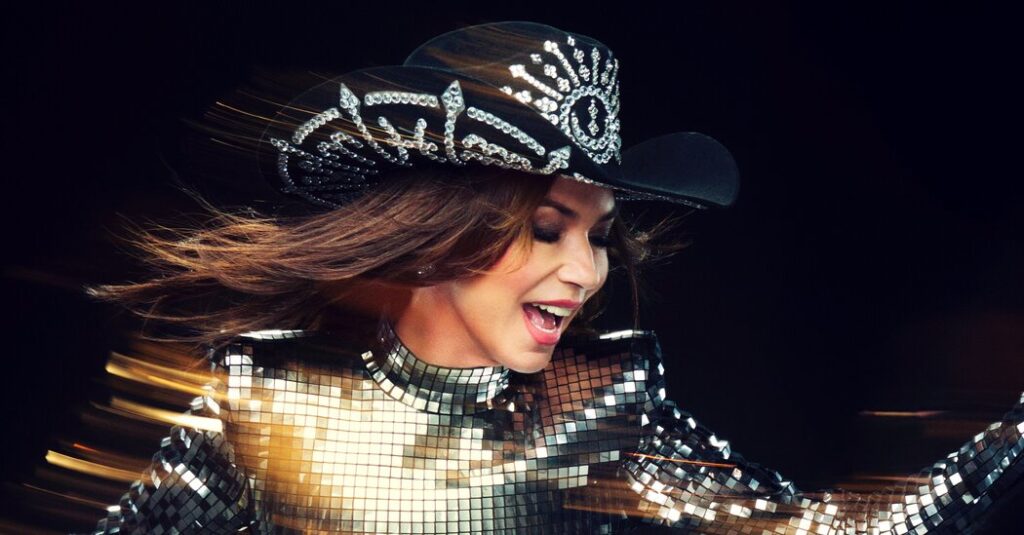
Even during the heat wave, the stadium was already surprisingly full whenever Twain took the stage. Her sets — performed against backdrops of mock bedroom walls covered in leopard-print wallpaper and Shania posters — were full of unabashed, Dolly Parton-level camp, but also serious musicianship and vocal power. Twain contracted Lyme disease in the early 2000s and later discovered that it had caused nerve damage to her vocal cords; two stabilizing surgeries, in 2011 and 2018, left her voice more gravelly and, she says, less dependable. “I lost my voice as I knew it,” she says, comparing it to singing “with a limp”: “You never know when it’s going to give out.” She sounded nearly perfect in every show I saw.
In fact, it was at a moment of peak vocal vulnerability that her sets would go from good to great: a cover of Styles’s “Falling,” performed alone on a stool with her guitar, delivering a fragile ballad to 80,000 people with this voice she describes as a “moody friend.” She didn’t always play it; fans never knew for sure whether it was coming. When it did, the crowd rippled in response. Audiences, she said, enjoyed the realism, the intimacy. The song also offered something to her as the opening act. “I’m the guest, right? But I was able to at least just say, OK, I’m just going to take one little moment and indulge in Little Miss Twain.”
Twain’s famous for this kind of indulgence — “the prerogative to have a little fun,” as she famously sang. It’s the driving force behind every smash she’s written, she said, along with the excruciatingly direct songs on her new album. Her megahits, she acknowledged, were about empowerment. And they were also about being a woman. But they were not, for her, about female empowerment: “It wasn’t meant to be a feminist message.”
Among her proudest moments, she said, were those when she’d see men in pickup trucks singing along to “Man! I Feel Like a Woman!” The song wasn’t, as she saw it, some feminist plaint: There was “no anger in it,” she wasn’t “saying it as a sexist person” — men didn’t even have much to do with it. “I was just owning and celebrating what I think I waited too damn long to celebrate,” she said. “People want to celebrate who they are, and what they are, and they don’t want to be criticized for just being themselves. And I think that is a liberty that we all deserve. I certainly waited way too long to give it to myself.”
Lizzy Goodman is a contributing writer for the magazine and the author of “Meet Me in the Bathroom,” an oral history of the rebirth of rock music in New York City from 2001 to 2011.
The post How Shania Twain Won Over Gen Z appeared first on New York Times.