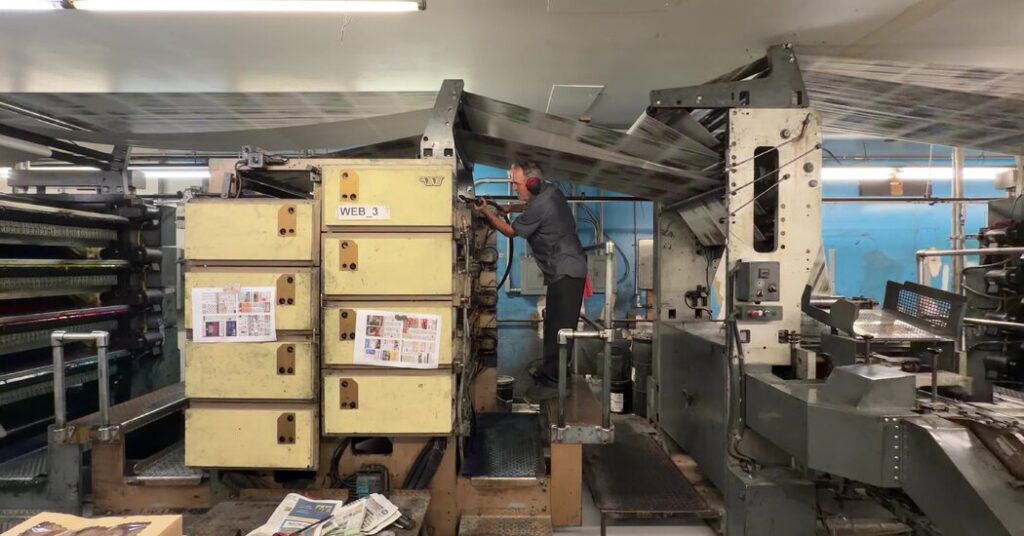
Those who say print is dead should make the delivery rounds on Thursday mornings with Mark Frost, founder of The Chronicle of Glens Falls, N.Y.
As Mr. Frost drives around in a Subaru Forester packed with bundled newspapers, the faithful stand waiting at drop-off points. One of those spots is a Hannaford grocery store where William Norton, 74, waits in his maroon Chevy Silverado, ready to grab 40 copies of the free weekly for his neighbors in Stony Creek, a twisty and tenebrous ride from Glens Falls.
“That’s all they got to read over there,” said Mr. Norton, by way of explanation.
People running off with stacks of Chronicles is common enough that Mr. Frost has taken to quizzing them on their intentions. Printing is expensive, after all, and he wants each copy to reach a reader. “Had a guy actually tell me the other day, ‘I’m packing some glass,’” Mr. Frost recalled. He took the papers back.
Mr. Frost’s travails are common to a plucky category of publications sprinkled across the country. Though nearly 3,500 newspapers have ceased publication since the mid-2000s, about 2,250 publications like The Chronicle — independent, sometimes family-owned weeklies — have been “relatively resilient,” said Zach Metzger, director of the state of local news project at Northwestern University. Large newspaper chains, the ones prone to consolidation, can’t be bothered with them.
Shoe leather is a key factor in that resilience. Mr. Frost has spent decades cultivating readers face to face, often while replenishing newspaper racks. He thanks everyone he sees taking a copy of The Chronicle. “Just think of the impact of that,” Mr. Frost said.
“I would say the majority of outreach I get from engaged citizens are from people who say they read something in The Chronicle,” said Diana Palmer, the mayor of Glens Falls. Advertisers report a similar dynamic.
All that earned influence hangs in peril. The Chronicle has repeatedly grazed the line between a going concern and going under. The pandemic just about sunk the whole enterprise, forcing a round of layoffs that, along with a resignation, reduced the staff to four from 12.
As the newspaper’s advertisers have bounced back, so has The Chronicle, which now has a staff of seven employees. A high school graduation issue in June, at 44 pages, was the beefiest in six years. “Somehow,” Mr. Frost said, “we’ve managed to slip through time.”
46 Years a Booster
If there is one thing Mark Frost’s Chronicle will not countenance, it is an affront to the civic pride of Glens Falls, a city of roughly 15,000 that earned the moniker “Hometown, U.S.A.” from Look magazine in the 1940s.
When the 2013 film “12 Years a Slave” premiered to critical acclaim, Mr. Frost bashed it for failing to highlight the role Glens Falls played in the life of Solomon Northup, a free Black man who was kidnapped and sold into bondage before returning to freedom and writing an 1853 memoir.
“Saratoga Springs gets all the huzzahs, when all that city did was introduce Solomon to his eventual kidnappers,” Mr. Frost wrote.
The studied provincialism has an origin story. Mr. Frost was born at Glens Falls Hospital, went to Glens Falls schools and started writing for the now defunct Glens Falls Times in junior high school in the mid-1960s, at a rate of 12 cents per column inch.
After hopscotching among journalism gigs in Baltimore and at The Post-Star, the area’s establishment daily newspaper, Mr. Frost, then in his late 20s, founded The Chronicle in 1980 with an investment of $1,700.
A hometown sensibility took root right away. In a regular feature titled “School Views,” The Chronicle asked children to respond to a question. The first was whether they liked school. One third grader wrote in: “Mark did you like school when you were nine years old?”
“School Views” endures. Sadie Palmer, a recent graduate of Glens Falls High School and daughter of the mayor, remembers being “super excited” when the paper published her snippet in elementary school. “We would get The Chronicle and cut out the story and put it on the fridge,” Ms. Palmer recalled.
Schools are a mainstay of The Chronicle’s journalism, along with town-hall meetings, local business happenings and, of course, parking. The front page of a recent issue featured the decision of Finch Paper mill, a cornerstone of the region’s economy, to stop making its own pulp and an article on staffing at the county jail. Each edition carries a quirk factor too, with a bulletin on the latest rattlesnake attack or front-page feature on butchering a deer.
Another standby is sunny coverage of the openings of restaurants, bars and shops. The Chronicle’s boosterism also applies to The Chronicle, which is big on anniversary editions in which its advertisers pay to congratulate The Chronicle.
“Our newspaper is more interested in who’s making progress than who’s screwing up,” Mr. Frost wrote in 2020.
Sometimes those cohorts overlap. In June 2003, a summer intern named Jimmy Vielkind covered a press event inaugurating the “Canyon Blaster” roller coaster at a nearby amusement park. After some promotional chatter from officials, reporters climbed aboard the roller coaster. It stalled just before reaching the track’s heights. “The ride broke on the first run with all the TV cameras going,” recalled Mr. Vielkind, who moved on to a career covering New York State politics. “The guy next to me has a panic attack and they had to literally walk us off.”
The item got full-page treatment — but on page 22.
Mr. Frost isn’t above indulging a publisher’s privilege or two. When F.W. Webb Company, a plumbing supply giant, sought to locate a facility near his house, he published a letter opposing the project — from his wife and assistant publisher, Sandra Hutchinson. In his weekly column, Mr. Frost acknowledged this as an “ethical question” that he left “for your consideration.”
The Chronicle formula isn’t for everyone. Ken Tingley, a former top editor at The Post-Star, said he believed The Chronicle was too cozy with its advertisers and lacked credibility. Mr. Frost said that the paper had lost advertisers on account of its coverage and that businesses paid for ads because they worked.
Stephen Thurston, a local native and longtime journalist, encouraged Mr. Frost to weigh in with journalistic solidarity after The Post-Star reported that a man at a 2019 pro-Trump rally had pointed a toy gun at one of its reporters and used threatening language. He was disappointed when Mr. Frost did not.
Mr. Frost said, “It was not something I chose to invest in.”
In his editorializing, Mr. Frost appears intent upon frustrating any attempts to categorize his political views. Before the November 2024 presidential election, for instance, Mr. Frost declined to endorse either Kamala Harris or Donald Trump, and tried to steer a middle route through the divisive national discourse. “At least everyone agrees on the big issue: Our democracy itself is in danger,” he wrote. “But who poses the bigger threat?”
“If you were to ask me what is Mark’s political affiliation, I just don’t know,” said Elise Stefanik, the six-term Republican representative whose district includes Glens Falls. “It is not straight party line.” Mr. Frost did repeatedly endorse Ms. Stefanik in her congressional runs, but not before backing a Green Party candidate in her 2014 campaign.
A Precarious Business Model
The paper’s advertisers are local businesses, and each week, their ads are distributed in 20,000 dead-tree copies and a digital replica version that gets blasted out to 20,000 email recipients. “People come on Thursdays to sit and eat a hot dog and read The Chronicle,” said Alexandria Gazetos Mineo, who helps manage her family’s eatery New Way Lunch.
Through the years, Mr. Frost has turned down overtures to replicate The Chronicle in other communities. “My commitment is here,” he said, noting that his “ambition is to build — keep building one great newspaper.” Mr. Frost has done every job at the paper except for bookkeeping and I.T.
But Mr. Frost is 75 years old, meaning that his ambition will soon be someone else’s responsibility. It’s here that newspapers in The Chronicle’s niche quite often stumble, Mr. Metzger of Northwestern University said.
“No one’s really stepping up to take over or buy” the papers, he said.
The Chronicle may just be an exception. Zander Frost — the 34-year-old son of Mark Frost and Ms. Hutchinson — saw his career at a Los Angeles comedy group hit pause during the Covid shutdowns. So he returned to his hometown, where he witnessed his nearly 70-year-old father driving solo on an exhausting delivery route. He volunteered to ride shotgun on Thursdays.
From there, he threw himself into whatever needed to be done at the newspaper, which turned out to be a lot. He sold ads, starting with $49 promos for the Chronicle’s high-school graduation issue. He overhauled The Chronicle’s technology for processing ads and keeping the books; he wrote and edited stories; and he worked with his mother, Ms. Hutchinson, whom he credits with doing the painstaking, detail-heavy work — human resources, legal, hiring — that keeps the paper humming.
His parents tiptoe around the topic of The Chronicle’s future, mindful not to pressure their son. “When you’re in a multi-generational family business, it’s, like, super deep,” Zander Frost said.
Still, the expectation at The Chronicle is that he will some day take over. “The succession plan,” he said, “is me.”
Kirsten Noyes contributed research.
The post Here’s a Man-Bites-Dog Story: A Newspaper That’s Doing Well appeared first on New York Times.