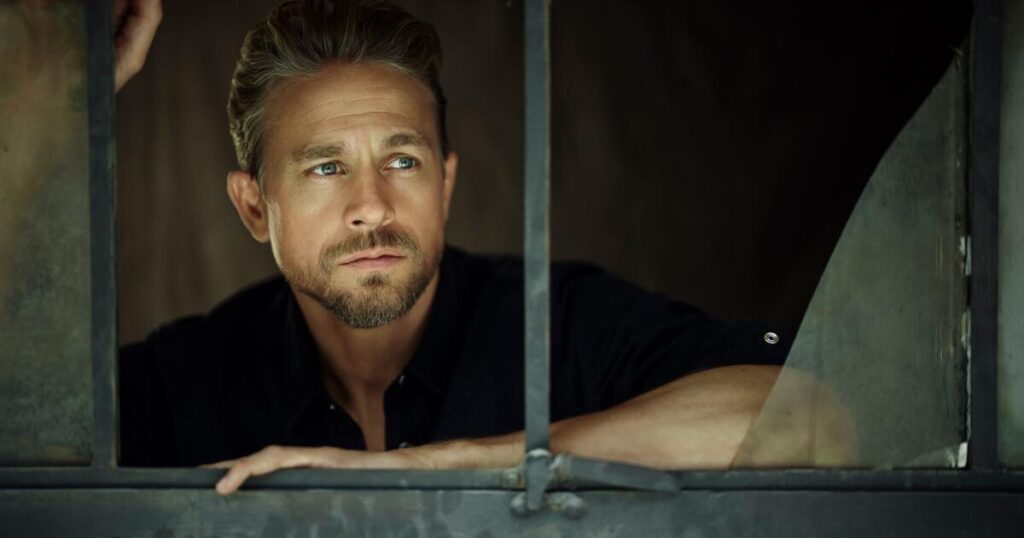
Before committing to a new role, English actor Charlie Hunnam reads the script up to five or six times. A self-admitted overthinker, he considers every variable ad nauseum.
But when TV mogul Ryan Murphy suggested during their first meeting that Hunnam should play Ed Gein, the notorious serial killer who inspired Norman Bates in “Psycho” and Buffalo Bill in “The Silence of the Lambs,” the actor agreed on the spot.
“There I was without reading a word of it, just said yes, and then had to actually show up and do the job,” Hunnam, 46, says during a video call from Prague. He’s made it inside just in time to escape the rain, droplets from the downpour still visible on his white T-shirt.
It was hearing Murphy speak of his creative process that bewitched Hunnam into that “Yes.” An aspiring screenwriter himself, Hunnam has penned a project for Max Winkler, who’s also the main director on “Monster.”
The resulting performance in Netflix’s “Monster: The Ed Gein Story,” an equal parts disturbing and humanistic portrayal of an abused and mentally ill man, earned Hunnam his first Emmy nomination, for lead actor in a limited series or TV movie.
Intending to become “the world’s authority on Ed Gein,” the actor read numerous books on his character. Most of them, he says, are “sensationalist catalogs of his darkest misdeeds.” Gein murdered at least two women, as well as illegally exhumed and mutilated multiple corpses, in the 1940s and 1950s. He was arrested in 1957.
“When I started doing my research, I got really panicked and thought that I’d made a horrible mistake and this was just going to be impossibly dark,” Hunnam recalls.
Getting access to Gein’s medical records represented a turning point for the actor. These documents depicted a person suffering from schizophrenia who had endured neglect and isolation at his mother’s hands; the clarity that Gein attained and the remorse he felt once on medication at a mental health institution are illustrated with devastating emotion in Episode 7, which Hunnam believes encapsulates the thesis of the show: Are monsters born, or are they made?
“It is an interesting question to ponder,” he says. “What makes certain people go to really extreme behavior like that? And if it is something broken in them, in their psyche, or if it’s a collection of experiences within their life that manufacture a broken psyche.” Hunnam believes that in Gein’s case it was a combination of nature and nurture that shaped him.
The episode ultimately sees Gein learning his diagnosis and breaking down uncontrollably. “I cried the first time I read that scene,” Hunnam recalls. “It was so beautifully written, and I just held onto that scene and said, ‘This is the show that we’re making. This is what we’re building to.’ And it was a really beautiful anchor.”
As part of his prep work, Hunnam tried to obtain the tapes from an interview conducted with Gein soon after his arrest. It was not until a week before shooting — after he had already conceived the character’s voice — that he finally gained access and heard Gein’s speech.
“I had a big decision to make in that last week if I was just going to scrap what I had planned to do and go back and parrot what I had heard on the tapes,” he recalls. “I spent a couple of days doing that and then ultimately decided that what I had constructed reflected more readily my interpretation of who this character was, so I stuck with it.”
Hunnam’s take on Gein’s voice is based on information that described him as having a very young mental age and on his mother’s insistence that she wished he’d been born a girl. The tone is soft and childlike.
Hunnam is conscious that his turn in “Monster” differs from the men audiences have come to expect from him in shows like “Sons of Anarchy.”
“Our industry really celebrates reinvention, and yet it’s incredibly hard to do. People think of actors and writers and directors in a certain category,” he says. “And one starts out somewhat arbitrarily in one’s career down a path of playing certain types of characters.”
Playing tough guys early in his career, Hunnam says, was his way of trying to bridge the gap between him and his father, to prove he could be like him, even if only in fiction. “I admired him for how tough and stoic he was,” he says. “And I felt like I was way more fragile and sensitive and kind of hated that about myself as a kid.”
That sensitivity is reflected in the adorable strategy Hunnam employed to detox from playing Gein throughout the production.
Near the set in Chicago, there was a kitten cafe full of some 60 rescue cats seeking a home. Against his better judgment, Hunnam says, a visit to give the kittens a “little cuddle” resulted in him adopting two of them. “I was going and playing Ed Gein all day and then going back to my suite at the Four Seasons Hotel at night and playing with kittens for four hours,” he says smiling. “That was really a nice way to decompress and reframe my experience.”
To fully exorcise himself of Gein after completing the show, Hunnam traveled to Plainfield, Wis., to visit his grave site and say a final goodbye.
“‘We didn’t set out to exonerate you for your crimes,’” Hunnam recalls saying. “‘That’s not what I was here to do by any means, but I hope we at least told the story honestly. I’m going to continue on my journey now, and I’d prefer it if you didn’t come with me.’”
The post How Charlie Hunnam reinvented himself with ‘Monster: The Ed Gein Story’ appeared first on Los Angeles Times.