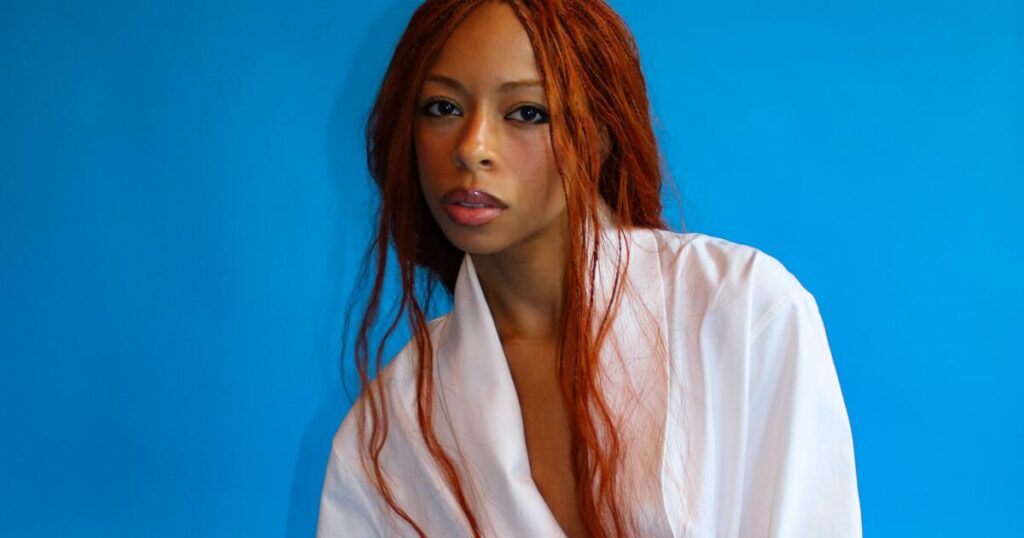
Inside her studio, nestled deep in the San Fernando Valley, songwriter Ravyn Lenae admits she’s at a loss for her next line. As such, she turns to her most trusted counsel.
“Hey, Po-po,” she said as her grandfather picked up the phone. “I’m calling to ask grandma for help on this song.”
A recorded snippet from this call appears at the end of “Never Let Me Go,” a song that pulses with a thrum of the bass and sparkling guitar riff that evokes a ’90s R&B girl group classic. The song is a highlight on her new album, “Blue Island,” which came out Friday on Atlantic Records.
Po-po asks if her albums are “selling OK.”
“Yeah,” she said, laughing. “The last one did real well.”
She was arguably underselling it. Her last album, “Bird’s Eye,” precipitated what Lenae describes as “one of the craziest moments of my career so far.”
Now 27, the R&B and pop singer-songwriter began releasing music at 16 and tirelessly worked her way up from Chicago’s Southside to touring with SZA and Sabrina Carpenter. Yet, her real lightning-in-a-bottle moment came with her 2025 single “Love Me Not,” a viral hit that skyrocketed the artist from a music lover’s well-kept secret to the No. 5 on the Billboard Hot 100.
Amid the gold rush, she had already been piecing together her next album. “Blue Island” departs from the earthy meditation of “Bird’s Eye” and soars into a more experimental realm. She delves into her newfound confidence with more intimate lyricism, dance breakdowns and collaborations with Dominic Fike and Doechii.
“It was a lot of me writing in between running around the world, singing ‘Love Me Not.’ On my off days, I was trying to make sense of it all, getting all the validation I was looking for, for so long,” Lenae tells De Los inside the L.A. Times office, while lounging on a velvet couch. “My [recording] sessions served as therapy sessions in a way, as I was thinking through and talking through what was happening.”
As her reality shifted — and her stages grew from cozy theaters to playing for thousands of festivalgoers at Lollapalooza and Coachella — Lenae found herself wanting to decorate her home. She’d just moved into a new place in L.A.; though Lenae usually kept her living spaces bare, something about this chaotic time made her want to line the hallways with family photos.
“Being far away from home was hard, especially when you’re so close to your family and identify so much of yourself with them,” says Lenae.
Having grown up in a third-generation immigrant household, Lenae says her relationship to her Panamanian grandparents is one of the most treasured in her life.
She remembers the smell of simmering platanos and bistec picado emanating from her grandmother’s kitchen — and hearing stories of her pastor grandfather’s short-lived doo-wop band in Panama, the Dominoes. His striking soprano may have foreshadowed her own music career, but their experiences didn’t inspire her to fully embrace her heritage until much later.
“I think the older I get, the more I understand how important it is to have something to be rooted in,” Lenae says. “Getting older, and now having moved from my home, it gives me an understanding of how really crazy it is to leave where you’re from and everything you know.”
After so many years identifying with the Southside’s Black American culture, Lenae meditated on the assimilation her mom experienced and wondered if Afro Latina was an identity she could claim for herself. Her music reflects a similar journey.
“I’m trying to make sense of who I am as an artist and what space I want to occupy,” says Lenae. “And the examples before me showed [that] Black women occupy a certain space. And I think I felt like I had to limit or simplify what I’m into and what I listen to to be digestible.
“The more confident I got in what I’m into as an artist, the more I felt like I could show the whole coloring book,” she adds. She runs her fingers through her orange braids as she hummed one of her favorite reggae en español tunes.
“What’s that one song? It goes like, ‘No lo trates no…’” she sings, her notes ringing out clear as a bell as she recalls the old-school chorus of “Rica y Apretadita,” the shameless 1991 Latin reggae-rap fusion by Anayka and Panamanian trailblazer El General.
“I sent that song to [producer] Dahi and said, ‘I love this energy so much.’ One day I want to do something like that,” Lenae said. “Panama’s dance music, that love for movement, inspires me a lot.”
The spirit of “Rica y Apretadita” that spoke to Lenae — namely in the sweaty, carefree club memories it calls to mind — came alive in her “Blue Island” dance cuts.
On “Saturday Night,” the third single from “Blue Island,” she shimmies away from someone trying to take her home over bouncing synth-pop instrumentals. Later in the album, “Potential” deconstructs itself into a glitchy breakdown, in which Lenae’s voice hovers ghostlike as a creaking, steely crunch effect crackles over the beat.
“I’m comfortable reminding people that the music is mine,” Lenae says of the album’s sonic direction. “I find so much freedom and autonomy and joy in it. For me as an artist, what makes it fun and interesting is if I continue to poke and prod at it. If I stop doing that, it’s not fun anymore.”
Her authenticity is what Lenae protects closely — and it’s what also drew her to working with Doechii on the song “Babygirl.”
“When Doechii won her Grammy, I literally cried,” says Lenae. “It showed me that it was possible to be exactly who you are and be rewarded for it. Something about that signaled freedom and being rewarded for freedom.”
In “Babygirl,” the light and feathery timbre of Lenae’s voice is offset by Doechii’s warm, grounding cadence as they reflect on the unpredictable trajectory of their careers — and the conviction that held them together through it.
The two first collaborated on Lenae’s debut 2022 album “Hypnos” for “Xtasy Remix”: a holy trinity moment between Doechii, Lenae and Grammy-winning producer Kaytranada. Lenae was “always a fan” of Doechii, namely of the Florida native’s “conviction” and her connection to her family.
“I love Doechii, that’s my sister, she’s a big inspiration. I love girls who are real,” says Lenae. “When I made ‘Babygirl,’ I needed someone else who understood that same perspective, of working really hard at something and feeling like there’s no space or lane for you.”
In ‘Blue Island,’ Lenae decides she’s had enough of waiting for her space. Nowadays, she’s spending four to five days a week in the dance studio, practicing choreography for her upcoming North American tour, which kicks off Sept. 15 at Channel 24 in Sacramento and comes to the Greek Theatre in Los Angeles on Oct. 21.
Lenae said she never thought she’d be an artist “who could do that.” She’s running as she sings, figuring out the physical language of performance that she once thought only Beyoncé could do.
“I want to be the biggest artist in the world,” she said. “I want to do everything.”
The post Ravyn Lenae connects with her Panamanian roots, joins forces with Doechii in new album ‘Blue Island’ appeared first on Los Angeles Times.