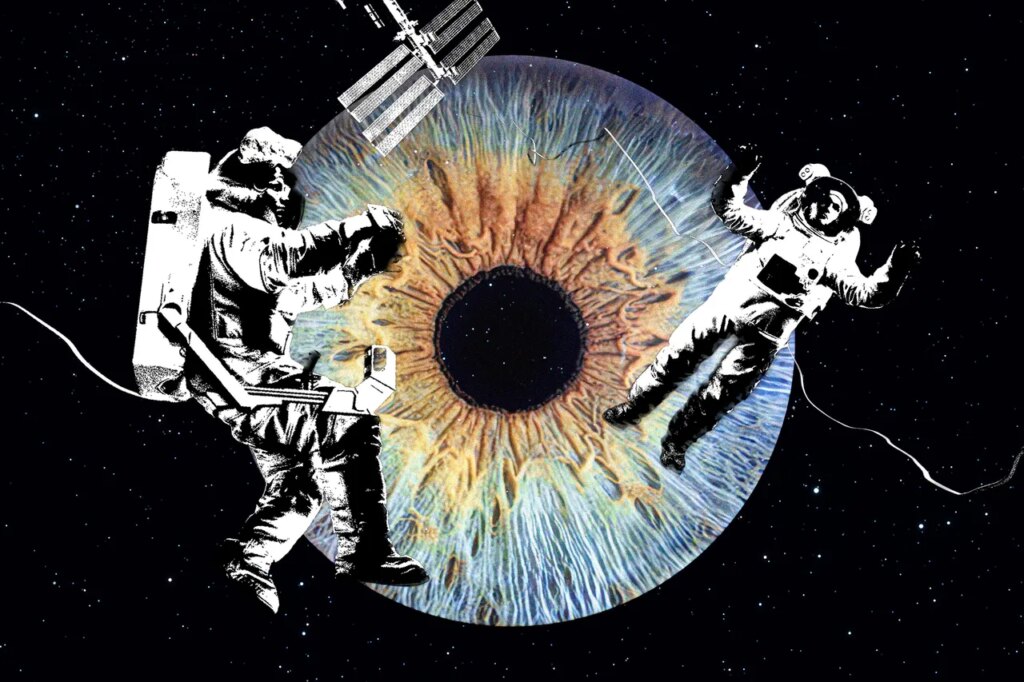
The European Space Agency is trying to understand why astronauts lose their eyesight in space, in the hope they can figure out how to treat—or even prevent—the condition as looming longer spaceflights heighten the risk of permanent vision damage.
The agency has commissioned British eye-scanning startup Siloton to develop a solution ahead of the international Artemis flights to the moon and other deep space missions. The health tech uses quantum technology to shrink core components used in eye-testing equipment found at optometrists to fit on a photonic chip smaller than a coin.
Founded by physicists in 2020, Siloton is currently working with the UK’s National Health Service to enable patients with retinal conditions to self-scan at home. “The ESA pretty much has the same requirements,” says cofounder and chief technology officer Euan Allen. “It’s just in a totally different environment.”
Spaceflight-associated neuro-ocular syndrome (SANS) is a collection of eye and brain changes caused by spending prolonged periods in a low-gravity environment, and it impacts around 70 percent of astronauts on the International Space Station, according to NASA. One of the starkest cases is that of NASA astronaut John Phillips, who launched to the ISS in 2005 with 20/20 vision, and splashed down six months later with his vision at 20/100—what’s considered a moderate visual impairment. While he was in space, bodily fluid, uninhibited by gravity, built up in his head, squashing his eyeballs, swelling his optic nerve, and pushing his retina forward.
While returning to Earth can reverse some of the damage, space agencies are concerned by both the operational risk of astronauts losing their vision mid-mission, as well as the longer-term health impacts. “The eye condition SANS is a serious health risk facing astronauts on long missions,” says Rebecca Evernden, director of the UK Space Agency. Medical engineers want to develop their understanding of the condition and the factors causing it so that they can manage any ocular damage, and eventually treat it or even stop it from becoming a problem.
Scientists are already monitoring how spaceflight impacts the human eye on the ISS using a modified version of the device found in optometry offices that measures the thickness of layers at the back of the eye. However, the device is bulky and requires real-time remote guidance from experts on the ground. As astronauts journey further into deep space, lengthening communication delays with Earth will mean this is no longer feasible.
Siloton’s device would allow astronauts to scan their retinas more frequently by automating some of the process so that examinations do not need ground support. The ESA hopes that will generate more data on any ocular degeneration, and possibly provide early warning signs that changes in the eye may be occurring—even before they result in vision change.
Other technical challenges include getting around using batteries to power the device because they pose such a big fire risk. In spacecraft, where space is at a premium, designers will also have to decide where the binocular-sized equipment would live and how to position and keep an astronaut’s head in place without gravity (typically, that’s done by having a chin rest).
But that’s a walk-in-the-park compared with getting a retiree whose sight is failing to cooperate, says Allen. “We’re very confident, because we’re trying to do that with 80-year-old patients who already have some level of visual imparity,” says Allen, “whereas these will be highly trained astronauts who are much younger and have full function of their eyes.”
”I think lots of the stuff that we’re doing for space will bleed through and make our home device better, and vice versa as well,” he adds. “All this research and development work, in principle, is making our products that are going to go into the NHS much better.”
The post Space Agencies Are Trying to Keep Astronauts From Losing Their Sight appeared first on Wired.