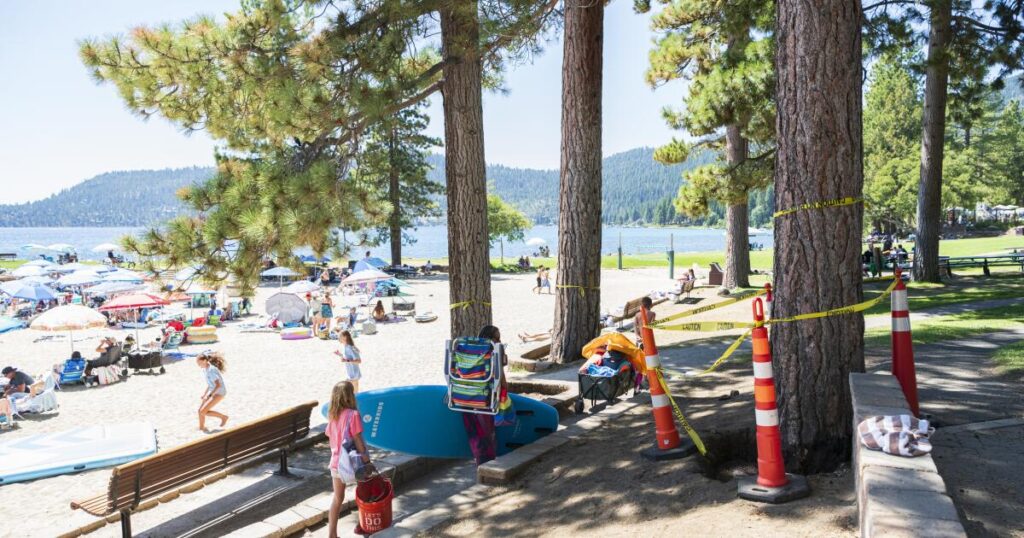
A bizarre crime rampage has roiled an upscale mountain community on the north shore of Lake Tahoe.
The suspects are unknown. The victims? More than a dozen towering pine trees.
Someone has, on multiple occasions, slipped into a residents-only beach in Incline Village, Nev., drilled holes near the roots of the conifers and poured a chemical inside. At least 10 trees have died, some of them over a century old.
The incidents date to 2022 but have escalated in recent months, with 16 trees poisoned on three occasions since May.
Although investigators haven’t determined a motive for the malfeasance, theories abound.
“My gut instinct tells me this is someone that lives nearby that is trying to improve the value of their home,” said Lt. Chad McKinnon of the Washoe County Sheriff’s Office, “whether they want to resell it soon so they think maybe this is a way to help improve the lake view to get more money.”
Resident Annalise Sandhu has canvassed the neighborhood and taken note of several homes that would gain a clearer sight line from the trees’ loss. The co-founder of a startup moved from the Bay Area last year, attracted by the close-knit community and its embrace of the abundant wildlife.
“It’s almost like an atrocity, just because we have such respect for nature,” she said.
Incline Village — nicknamed “Income Village” — has long had a reputation as a haven for the ultrawealthy. Property owners include Oracle founder Larry Ellison, Sergey Brin of Google and venture capitalist Steve Jurvetson, who reportedly purchased a $125-million lakefront estate earlier this year.
Lake views are a hot commodity, made scarce by planning rules that restrict new construction and limit tree removal. Buyers pay steep premiums for properties with unobstructed sight lines.
The poisonings took place at Burnt Cedar Beach, a picturesque wooded cove surrounded by a fence and accessible only through a staffed gatehouse that closes from dusk to dawn.
The most recent incident was discovered there Sunday, when someone noticed an odor and found 10 trees with a substance around their bases, said Paul Raymore, a spokesman for the Incline Village General Improvement District, which owns and manages the beach.
Diesel fuel was poured around the trees in the past, and based on the smell, it’s possible that was used again, McKinnon said.
As crews dug around the trunks to remove the tainted soil, they realized that someone had also drilled holes in most of the trees and injected what is suspected to be copper sulfate, an oxidizing agent, inside, according to Matt Patellos, a parks worker who has been cleaning up the site. Investigators are having soil samples tested to confirm precisely what chemicals were used.
“The copper sulfate will basically slowly kill and rot the tree from the inside out,” Patellos said.
A trail camera captured a flash of light near the area around 2 a.m. Sunday, according to the sheriff’s office. Authorities are trying to learn how the perpetrator gained access, including whether they boated over from the other side of the lake, McKinnon said.
The beach’s mature pines act as a powerful natural filtration system, slowing runoff and absorbing nitrogen and phosphorus that could otherwise cloud the famously clear waters of Lake Tahoe, said Aaron Vanderpool, staff research associate at the UC Davis Tahoe Environmental Research Center.
“Pine trees themselves are pretty resilient in general — they’ve evolved to be resistant to beetles and disease and different attacks on them that are natural,” he said, “but in this case we’re talking chemicals.”
There hasn’t been enough research on these kinds of impacts to estimate a tree’s chances of survival, according to Tahoe Regional Planning Agency Forester Bruce Barr.
“Some of the trees in this case were hit once before and survived,” Barr wrote in an emailed statement. “It’s to be seen if those come back after a second attack. That makes stopping this from happening again all-the-more important.”
In addition to the 10 discovered last weekend, two trees were found poisoned in late July and four more in May, Raymore said. Six trees were also poisoned in 2022, four of which died, he said. The next year, six more trees were poisoned and survived. But then in 2024, someone re-poisoned those six trees, and they all died, he said.
“We are hopeful that mitigation efforts, because this one was caught quickly, will be more successful this time around,” Raymore said. The improvement district is working with arborists and consultants in an attempt to save the damaged trees.
The sheriff’s office will likely work with the local fire department to investigate whether someone could be planning to burn the trees and may have soaked them in an accelerant to make them ignite more easily, McKinnon said. There are other possibilities, including a homeowner seeking to improve defensible space around their property, someone who’s grown tired of raking pine needles or a vandal intent on causing chaos, he said.
The theory that it could be a wealthy property owner in search of an improved lake view is a popular one among residents.
Some community Facebook group commenters are even posting addresses where lake views would benefit from the felled trees. One widely cited property is a Lakeshore Boulevard estate that sold for $10 million two months ago.
The buyer, Nadeem Mohammad, is a retiree who made his wealth at Nvidia. He’s not big on social media and hadn’t heard that his purchase was a topic of discussion until he was contacted by a Times reporter on Thursday.
He said that his property does indeed overlook the beach, and he can understand the speculation.
“But the thing people don’t understand is that the beauty of the view is not just about the lake,” he said. “It’s about nature — the lake and the trees and all that.”
He had nothing to do with the poisonings and is actually quite fond of the trees, he said, and he hopes the improvement district is able to protect those that remain.
Because the homes in Incline Village are staggered up a hillside, more than 100 properties could gain a better lake view from the poisoned trees’ removal, estimated McKinnon, of the sheriff’s office. Some of the trees are more than 100 feet tall, he said.
“Trying to narrow down exactly what house or residence could be responsible for it, if that’s the cause of it, becomes a daunting task,” he said. “And of course no one’s ever going to take responsibility for killing 100-year-old trees on purpose to improve their lake view, so that’s where our job gets interesting.”
The Tahoe Regional Planning Agency has also launched an investigation into the poisonings, public information officer Jeff Cowen said. The agency maintains ordinances regarding tree removal and permitting requirements. Staff will review past permit applications filed by surrounding properties, including those seeking to remove trees, to see if there’s any helpful information they can provide to law enforcement, Cowen said.
The agency has dealt with homeowners illegally culling trees to improve their views in the past, but those are dwarfed by the scale of these poisonings, Cowen said. “When I heard it was 16 trees this time, I was so devastated.”
In the meantime, residents are rallying together to try to find ways to keep the poisonings from continuing.
Sandhu and other community members plan to attend an upcoming improvement district meeting to advocate for more cameras. She’d also like to see motion-activated lights and, potentially, security patrols.
While she thinks the culprit is most likely “one of those petty people who feels entitled to see the beach view,” she also wonders whether it could be someone seeking to provoke a reaction. The poisonings have been “pretty divisive,” stoking existing tensions between wealthy homeowners and longtime residents whose children can no longer afford to live in the area, she said.
“People’s first thought is that it’s one of the folks that want to increase their home value or want to see the lake view, but I wouldn’t say, 100%, it’s that reason,” she said. “It could also be somebody that just enjoys destroying trees.”
Photographer Scott Sady contributed to this report.
The post A Lake Tahoe murder mystery: Who is poisoning towering pine trees? appeared first on Los Angeles Times.