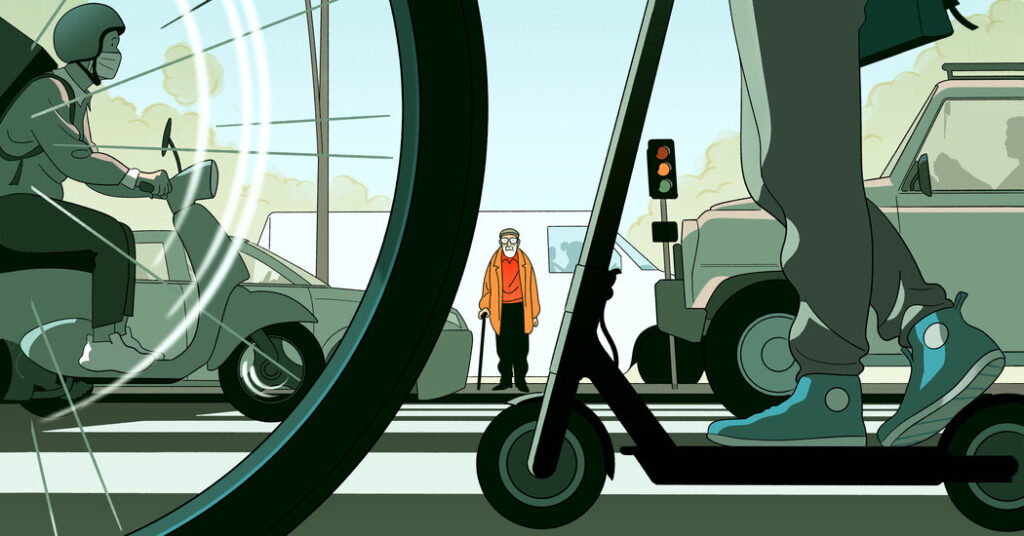
On an August morning two years ago, Meredith Melville was crossing Piedmont Avenue in Oakland, Calif., to meet a friend at a cafe. While in the crosswalk, she noticed a car some distance away.
Perhaps she misjudged its speed, she said, because she’d walked only partway across the street when the car, a Toyota sedan, came bearing down on her.
“She should have seen me,” Ms. Melville said of the driver. “All of a sudden she was there, and I didn’t have any way to get out of her way. I flew I don’t know how many feet.”
Passers-by came to help; the police and an ambulance arrived. Soon Ms. Melville, a retired teacher, was at a hospital being treated for multiple fractures. Surgeons replaced her right hip and repaired her broken right elbow. She would probably need a knee replacement soon, too, doctors advised.
After a week’s hospitalization and a month in rehabilitation, Ms. Melville, then 73, went home in a wheelchair. Physical therapists helped her gradually progress to a walker and then a cane, but “it was a long process,” she said.
She still contends with back and knee pain, and hasn’t been able to resume the hiking and backpacking she loved.
Still, when people say she’s lucky, Ms. Melville agrees. “It could have been a lot worse,” she said.
It often is.
Older pedestrians, like Ms. Melville, aren’t injured by motor vehicles at a greater rate than younger ones, according to 2023 data from the National Highway Traffic Safety Administration. But they’re more likely to die. The death rate for pedestrians over 65 is higher than the average for all ages. Nearly 8,200 pedestrians 65 or older were injured that year — likely an undercount because not all serious crashes and injuries show up in police reports. More than 1,500 died. And the picture is not improving.
Researchers point out that older pedestrians remain more vulnerable to collisions. “They move through intersections at a slower pace,” said Andrew Rundle, an epidemiologist at Columbia University. Impaired hearing or vision can make them less apt to notice approaching vehicles or respond to traffic signals. And because reaction time slows with age, they’re less able to evade a car that’s turning, speeding or ignoring a signal.
Physically, they “have greater frailty, loss of muscle mass and fragile bones,” Dr. Rundle added.
As a result, “the consequences of injuries are stratospherically different the older you get,” said Charles DiMaggio, an injury epidemiologist at the New York University Grossman School of Medicine. “A hip fracture in a 45-year-old is unfortunate. In a 75-year-old, it’s tragic.”
Moreover, after a marked decline in pedestrian deaths among all age groups from 1975 to the mid 2000s, progress for the older population has stalled for nearly 20 years.
Data from the Insurance Institute for Highway Safety shows that from about 2008 through 2024, the fatality rate for pedestrians 70 or older was not only higher than the average for all ages but “has stayed stubbornly flat,” Dr. Rundle said.
One factor could be exposure: Older adults appear increasingly likely to be outdoors on foot. The National Health and Aging Trends Study shows that the proportion who report walking for exercise climbed to 65 percent in 2023 from 60 percent in 2011. “And we encourage them to, because quality of life includes daily physical activity,” said Stephen Mooney, an injury epidemiologist at the University of Washington.
Further, the increasing popularity of large S.U.V.s and trucks means “the vehicles on the road have become more dangerous” compared to traditional sedans, Dr. Rundle said. In June, a New York Times investigation documented the way their taller hoods and larger blind zones contributed to rising fatalities.
The latest threat: explosive growth in the use of e-bikes. That’s a generic term often used to refer not only to motor-assisted bicycles that, with pedaling, can reach 28 miles per hour but also to heavier, faster and therefore more dangerous bikes akin to motorcycles. The industry has dubbed those e-motos.
“E-motos need to be regulated like motor vehicles,” said Noah Miterko of the trade association PeopleforBikes, noting that states and cities are taking steps to police their sale and use. From 2019 to 2022, the rate of e-bike injuries increased by nearly 300 percent, according to an analysis of emergency room data published in the American Journal of Public Health.
The “micromobility” phenomenon, or the uptick in the use of motorized two-wheeled vehicles, is so recent that researchers lack national data on its risks to pedestrians. In New York City, for instance, pedestrians remain far more likely to be hurt or die in encounters with cars, trucks or vans. Last year, the city recorded 112 pedestrian deaths, of which 105 involved motor vehicles.
But “my clinical colleagues are sounding the alarm,” Dr. DiMaggio said. “Emergency departments and trauma teams are saying we need to pay more attention” to e-bike injuries.
One often overlooked factor in pedestrian deaths: alcohol. Among adult pedestrians killed in nighttime crashes, about a third had blood alcohol levels indicating intoxication; so did about 20 percent of those killed during the day. Public health officials have cautioned for years that older adults are drinking more, and more often.
“It’s almost a blind spot,” Dr. Rundle said. “We talk about drunk drivers a lot” but less about inebriated pedestrians.
Nevertheless, crashes that cause injury and death are preventable, said Laura Sandt, co-director of the Highway Safety Research Center at the University of North Carolina. Federal and local government policies have evolved since the era when pedestrian fatalities “seemed just part of the business of driving,” she said.
More than 200 municipalities have adopted the Vision Zero approach, for instance, a public health focus on programs and environments that increase traffic safety for all ages. Changes that can save lives involve improved street design (pedestrian islands, crosswalks, lighting and bumped-out curbs making street-crossers more visible), safer signal timing (giving pedestrians a head start over turning cars) and lowered speed limits.
A recent study of where older pedestrians die in collisions found that the risk was substantially greater in places with a high density of walkable senior destinations, like hospitals and health facilities, pharmacies, and senior and community centers. That suggests the possibility of traffic strategies targeting such neighborhoods, analogous to child safety efforts focused on schools and their surroundings.
Traffic safety “shouldn’t rely on a pedestrian’s noticing a car coming and jumping out of the way,” said Dr. Mooney, one of the authors of the study. “Our job is to make the system safer for all ages and capacities.”
Ms. Melville, who was unable to leap out of danger, is “out and about now,” she said. “I’m not where I was, and I don’t know if I ever will be, but I can function. I’m leading a normal life.”
She still mourns her hikes in Reinhardt Redwood Regional Park and Point Reyes National Seashore, she said, but “I’m going to get there.”
The New Old Age is produced through a partnership with KFF Health News.
The post Why Older Pedestrians Fare Worse in Car Crashes appeared first on New York Times.