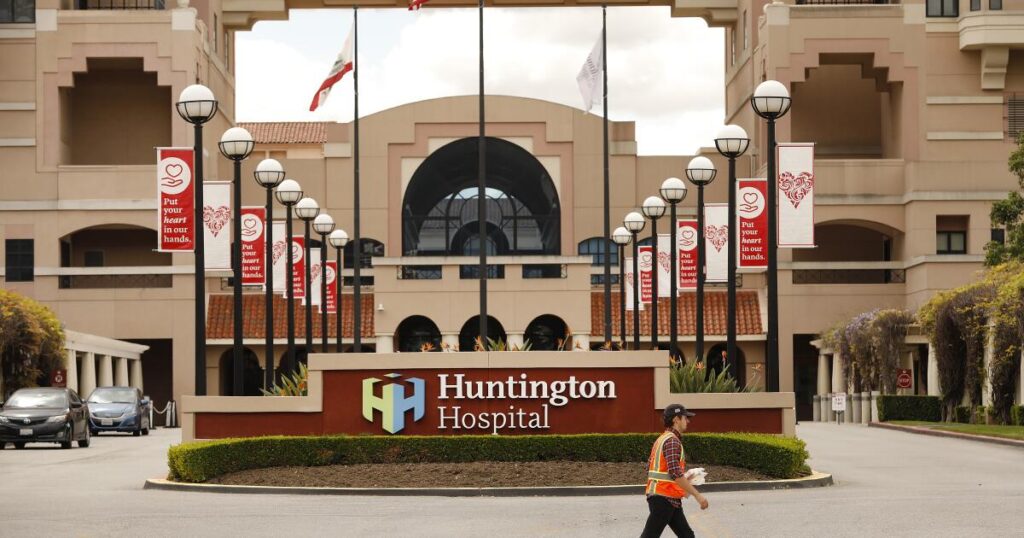
Huntington Hospital was the scene of a massive law enforcement response Friday morning after a person claiming to be part of a global online network of extremists made a 911 call threatening a bomb and other violence, authorities said.
The threat at the Pasadena hospital was received from an IP address at 5:40 a.m., prompting police officers, fire personnel and K-9 units to search the hospital, according to city spokesperson Lisa Derderian.
The threat was deemed to be a swatting call, in which a person reports a fake threat to illicit panic and a large emergency response, she said. An all-clear at the hospital was issued around four hours after the call.
The caller said they were a member of 764, according to a source familiar with the investigation.
The FBI describes 764 as a violent online network that seeks to coerce children into engaging in violent and sexual acts against themselves, animals and other minors.
Group members will often blackmail victims by threatening to make swatting calls at their home address and have also been known to coerce minors into placing swatting calls themselves. A 17-year-old girl associated with 764 was arrested in Vernon, Conn., in 2024 after she was accused of phoning in bomb threats at schools and places of worship.
Swatting calls linked to 764 have also been reported at the University of South Carolina and in Red Wing, Minn.
During Friday’s investigation into the bomb threat at Huntington Hospital, patients and staff were not evacuated. However, incoming emergency room traffic was temporarily diverted to other hospitals, Derderian said.
“The hospital remains open, and normal operations are resuming,” the hospital said in a statement at 9:40 a.m. “We are grateful for the swift response of our local law enforcement partners and appreciate the cooperation of our staff, patients, and visitors throughout this situation.”
The Pasadena Police Department and the FBI are continuing to investigate in hopes of identifying the caller who made the threat.
“It takes numerous resources every time something like this happens,” Derderian said. “If we can try to determine an individual or group, in working in coordination with the FBI and other agencies, we will definitely follow up with criminal charges.”
Derderian noted that a few swatting calls were made to local schools during the past school year, however it’s unclear whether those were connected to the same suspect or group.
Huntington Hospital also was the target of a swatting call in March 2025. In that case, the perpetrator was determined to be a disgruntled patient, Derderian said.
Though swatting is a well-known practice, law enforcement has a responsibility to take every threat seriously and investigate them thoroughly, she said.
“It’s very disruptive and takes a lot of resources and time away from our day-to-day operations,” she said.
Swatting is just one criminal element associated with 764, which federal authorities have characterized as a network of nihilistic violent extremists. The group consists of online predators who specialize in grooming and coercing young girls into performing sexual acts and harming themselves on camera.
While it appears the network formed around 2021, the FBI became increasingly aware of the growing threat around 2022 and has seen a sharp rise in cases since then, according to agency spokesperson Laura Eimiller.
The FBI has opened more than 500 investigations related to the group, she said.
Several alleged associates of 764 have been arrested in the Los Angeles area and face child pornography charges in California’s Central District Court.
They include Bryant Najera Gonzalez, who was arrested in Downey in February and allegedly targeted victims as young as 11. He is accused of ordering one victim to carve his screen name into her skin and threatening to release sexually explicit images to his victims’ families if they didn’t obey his orders.
In August 2025, alleged 764 member Dong Hwan Kim was also arrested in Downey. He is accused of extorting minors to write names on their naked skin, cut themselves and stick objects such as knives into their genitals. Earlier that year, Jose Henry Ayala Casamiro was arrested in the San Fernando Valley and is accused of creating an online server with Kim that acted as a “grooming pool” targeting underage girls, and of coercing at least one victim to carve his name into her arm.
The post Bomb threat at Pasadena hospital linked to violent extremist group appeared first on Los Angeles Times.