How many lives can be packed into one? If we live long enough, most of us reinvent ourselves several times over, by switching careers, changing partners, having children, moving to a new place. What constitutes the essence of us, even when we can no longer identify ourselves as the thing we used to be?
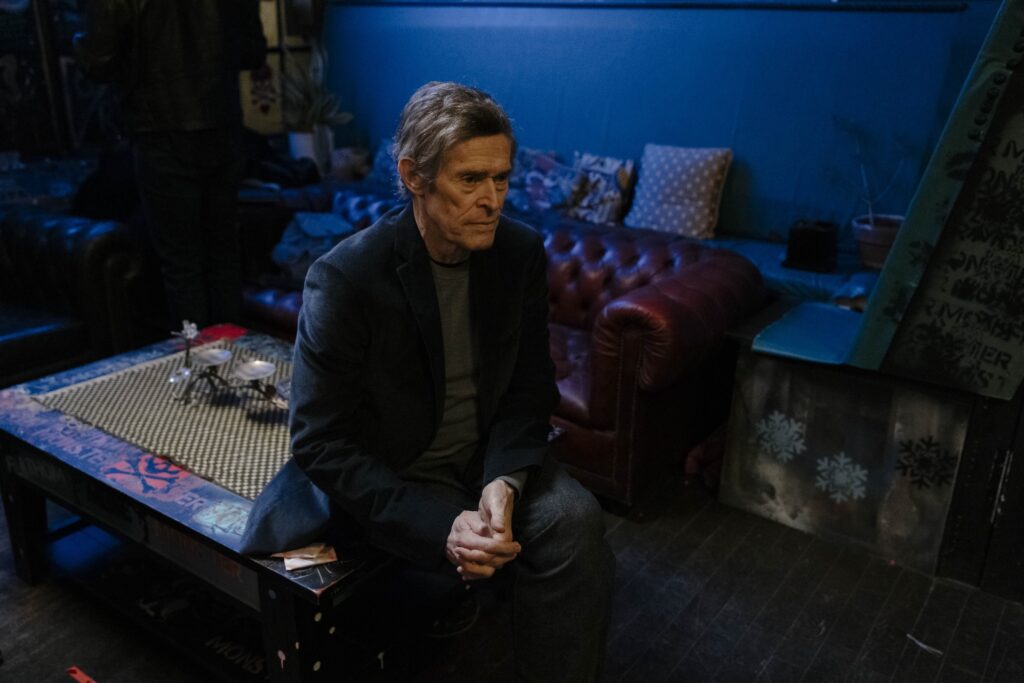
That’s one of the questions Kent Jones’ intimate, wry little picture Late Fame tangles with. Willem Dafoe plays Ed Saxberger, a seventy-ish New York City postal worker who used to be, or may still be, a poet: In 1979 he published a reasonably well-received book of poetry—a pretty admirable feat by itself—but now he’s just a guy. By day he sorts letters; in the evenings he wanders down to his local watering hole to hang out with his geezer pals, MTA workers and the like, guys who do everyday jobs just like he does. As far as they’re concerned, there’s nothing fancy or special about him. He’s not just a regular, he’s regular.
For Saxberger, there’s nothing sad about that; it’s just the texture of his life. But one day, he’s alerted to the presence of a wiry, nervous-looking, well-dressed young man who’s been hanging around his modest but by no means depressive apartment building. Saxberger approaches him amiably. The kid introduces himself as Wilson Meyers—he’s played, with clean-cut bonhomie, by Edmund Donovan—and begins to gush over Saxberger’s single book, which he unearthed, he says breathlessly, at “Foyles on Charing Cross Road,” an unnecessary bit of information that telegraphs nearly all you need to know about this guy. Meyers tells Saxberger that he’s part of “an artistic community” of poets and intellectuals who gather occasionally at a local speakeasy, and they’re all huge fans of his work. Would he join them sometime? Unsure what, exactly, this crew might want from him, Saxberger at first demurs; then he relents.

The members of this group call themselves “The Enthusiasm Society,” refer to one another by last names only, and claim to loathe internet influencers. They’re mostly aimless and obviously well-off guys in their twenties and early thirties, fellows who clearly think it’s bourgeois to work and luckily don’t have to. Saxberger appears amused by their callow pretensions—they’re obviously hoping that hanging out with him will somehow turn them into poets too—but he does wonder, and eventually asks: “Are there any women in your group?” There is one, they assure him, though he’s not prepared for the bewitching creature who eventually swans in. Gloria (Greta Lee), a performer in every sense of the word, seems to have dropped in from another century. Her sentences tumble out in breathy, peacock-feather bouquets; she favors swirling capes and flirtatious, oddball cloches. She invites Saxberger to one of her intimate cabaret performances—she slinks through “Surabaya Johnny” with molten eroticism—and he watches in awe. She’s both unbearable in her excessive theatricality and unavoidably captivating. Saxberger is a goner. But then he also wonders, years after having given up writing, if he may still be a poet after all.
And that’s the central rib of Late Fame, which was adapted from a long lost and only recently published 1895 novella by Arthur Schnitzler. What makes a poet? Is it the act of writing, or a subterranean, unextinguishable quality that lives in the soul? Late Fame is Jones’ second fiction feature—his debut was the gentle-spirited 2018 drama Diane, starring Mary Kay Place—and though it’s deeply observant about what it takes, and what it costs, to be an artist, it also has the light touch of a comedy. Characters who begin as types gradually emerge as people: Donovan’s Meyers is the kind of spoiled rich kid who proves how easy it is to be a dilettante when you’ve got daddy’s dollars behind you—and still, there’s something sad about the way he grabs greedily at others’ gifts, because he knows what’s lacking in himself. Dafoe is terrific as Saxberger, a guy who’s made peace with what his life has become, only to find himself rattled by the idea that maybe he hasn’t. A scene in which he tries to introduce his bar pals to his old poetry cuts deep: they laugh because they can’t see him as anyone but their drinking buddy (though it’s also pointed out that he no longer drinks alcohol, for reasons we can intuit). Dafoe’s face, a map of scarred-over disappointments, shows him reckoning with a brutal truth: he’ll have to learn to live with the fact that these people he truly cares about can never truly understand him.
.jpg)
But Lee’s performance may be the secret key to Late Fame. Gloria is a user, a poseur extraordinaire; her fluttery flamboyance, rooted in insecurity, summons another Gloria, the one from Sunset Blvd. And yet she’s the only member of the Enthusiasm Society who has ever taken a risk—as well as, clearly, the only one with any true artistic gift. As Lee plays her, she shifts seamlessly from hypertheatrical creation to fragile human being. And though other members of the group desire her, only Saxberger—intoxicated with her even though he knows it’s hopeless—sees the truth of her. Late Fame is all about the bitter, beautiful reality that no one is ever who they used to be. How could we be, if we’re doing the work of becoming? Is Saxberger still a poet, even when he finds it impossible to write new verse? What he and only he sees in Gloria is a new kind of poem, written on the wind if not on paper, but real even so.
The post Willem Dafoe Shines as a Postal Worker and Poet in the Luminous Late Fame appeared first on TIME.