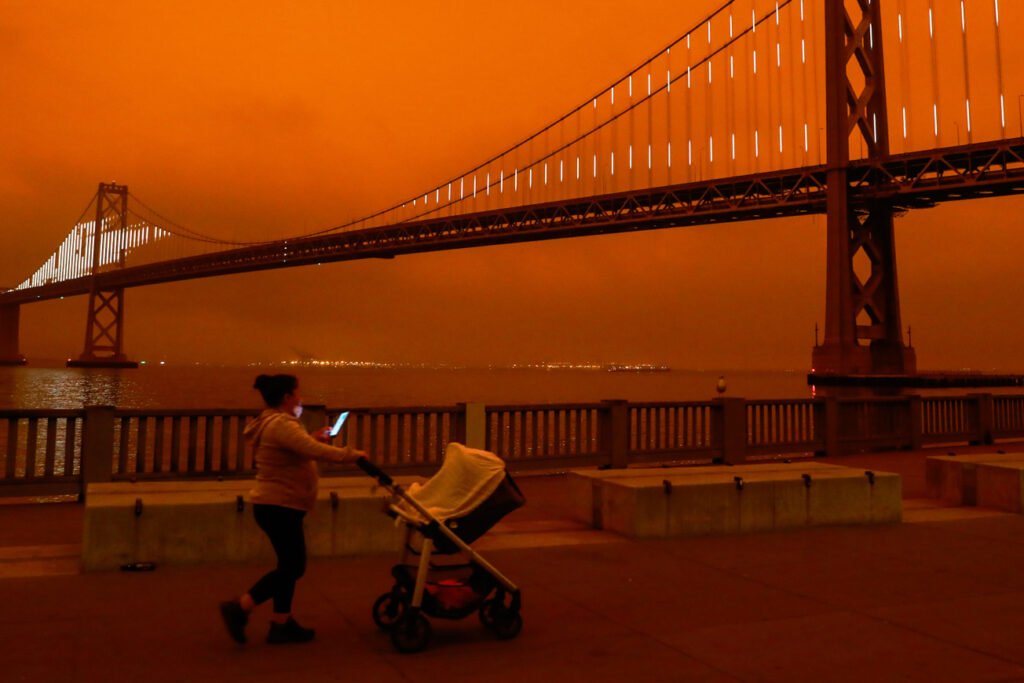
Amid a summer when wildfire smoke has often filled the skies, a new study is adding to the body of research about the growing impact of fire-fueled air pollution, this time raising the alarm about prenatal health.
Wildfire pollution has become an increasing proportion of the pollution that pregnant mothers and their unborn babies are exposed to, according to a study published Friday.
The new study by University of Maryland researchers found that out of the air pollution unborn babies are exposed to, the share of exposure to wildfire-generated microscopic air pollution more than doubled between 2003 and 2019.
The study did not discuss specific health outcomes for the prenatal exposure and births it analyzed, but previous studies have suggested that fine-particulate-matter pollution, known as PM 2.5, caused by wildfires can be more harmful than other forms of air pollution.
Studies have linked wildfire smoke to poor pregnancy outcomes and a variety of early-childhood health issues. The particles are small enough to enter the lungs and bloodstream, and they have also been linked to lung damage, respiratory disease and cancers.
“We know that if we prevent PM 2.5 exposure in the prenatal period, these infants are going to grow to be healthier, more productive adults,” said Michel Boudreaux, an associate professor of health policy and management at the University of Maryland and one of the study’s authors.
The research also refers to the continued way pollution from wildfires cuts into improvements made in the United States’ air quality in the past two decades.
Researchers credit the Clean Air Act for reducing pollution from cars and industrial facilities.
But wildfire smoke has cut into those gains, according to several studies in recent years. A 2023 study found that, since 2016, wildfire smoke has eroded the equivalent of around four years of air quality progress in most of the country.
Wildfire pollution occurs inconsistently, Boudreaux said, flaring up when mega-fires break out in different regions.
It remains a small share of the PM 2.5 Americans are exposed to, but annual levels of wildfire smoke stayed consistent as other sources of pollution declined over the past two decades, the new study found.
Boudreaux’s study modeled air pollution across the country from 2003 to 2019, both including and excluding pollution created by wildfires, and used birth records to estimate the air pollution exposure to prenatal infants over this period. Researchers also analyzed the regions they studied by demographics and access to health care services.
The study found that the proportion of wildfire smoke in annual air pollution has increased by several percentage points from 2003 to 2019.
The greatest increase was in the Northwest, where around 13 percent of prenatal PM 2.5 exposure could be attributed to wildfires by the end of the decade. Regions with poor access to hospital facilities and maternal care, which were largely rural, had lower average PM 2.5 levels but faced the largest proportion of pollution from wildfires.
The new study also found that wildfires accounted for more than 70 percent of “exceedance days” — days where PM 2.5 levels exceeded 35 micrograms per cubic meter, an Environmental Protection Agency standard — by 2017 and 2018. Wildfire-attributable exceedance days stayed constant over the period studied, while exceedance days from other sources declined sharply.
“Because we’ve done such a good job of decreasing these non-wildfire sources, the share of ‘exceedance days’ that are due to wildfire smoke has increased,” Boudreaux said. “If we want to continue making progress on this … we have to start thinking about, how do we protect people from wildfire smoke?”
Academics not involved in the study said the work was limited by its scope and that the 2020s have seen a larger increase in wildfires after the study’s time frame. The five-year period from 2020 to 2025 was the smokiest on record in the United States, a study last year found.
“The last six years have just looked fundamentally different,” said Marshall Burke, a global environmental policy professor at Stanford University.
Michael Brauer, a professor at the School of Population and Public Health at the University of British Columbia, said further research is needed on the health risks of wildfire smoke, such as the effect of spikes in wildfire pollution at different stages of a pregnancy.
Burke said the study’s focus on prenatal exposure highlighted the breadth of air pollution’s impact across the population.
“We typically think of vulnerability to air pollution in terms of people with respiratory or other preexisting conditions,” Burke said. “But here, this is showing that pregnancy … really widens the lens of who we think as vulnerable.”
The post Wildfire smoke is a growing danger to unborn babies, study finds appeared first on Washington Post.